

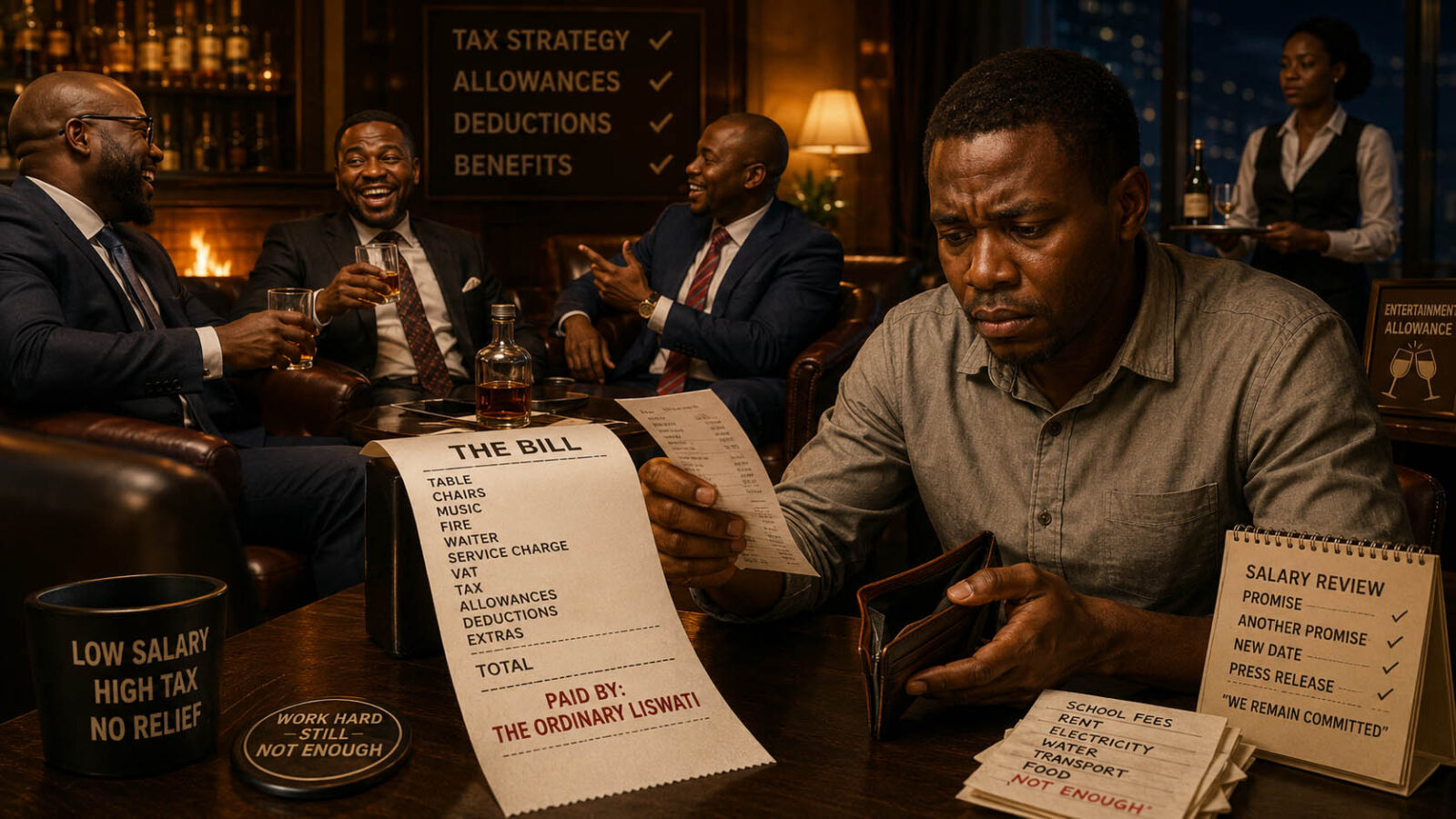
Iwas in a decent bar the other night.
If you know me, I don’t do grey areas. I don’t sit on fences and I don’t negotiate with middle ground. My complexion and my humour are living proof of that.
The only thing I refuse to overdo is alcohol. Seven years sober. No Johnnie Walker. No Windhoek Draught.
So, what was I doing in a bar? Socialising. A sober man in a room full of half-truths is entertained. And in Eswatini, half-truths buy their own rounds.
Early in my newsroom days, I learnt a fundamental truth, give a man three drinks and a woman he wants to impress and suddenly he becomes the auditor general of his own life.
All because the woman asked: “So, what do you do?”
“My company is involved in infrastructure.”
Man, you sell cement. Don’t exaggerate!
The bar was comfortable. Soft music was playing. The fire was crackling. It created that beautiful, dangerous illusion that you were sitting in someone’s wealthy uncle’s lounge.
Except you were paying through the nose for the privilege.
I was sitting near the heavy hitters, the guys who sit on corporate Boards during the day and discuss the financial fate of ordinary families before lunch. One of them was explaining corporate tax planning with the confidence of someone who had personally invented PAYE.
Designer suit. Expensive watch.
“The trick isn’t paying nothing, my brother,” he said. “The trick is making sure you don’t pay a single cent more than the law requires and keeping enough paperwork to prove it when ERS comes knocking.”
He took a slow, victorious sip. This man had turned lawful tax minimisation into a competitive sport. Somewhere in Ezulwini, I imagined a tax auditor developing a headache.
And that’s when the laughter died in my throat, because listening to him, I realised something.
We aren’t just divided by income. We are living in three different Eswatini.
The businessman has a tax strategy.
The civil servant has a payslip and a WhatsApp group called Salary Review Appeals – Official.
The businessman has an accountant.
The civil servant has a calculator, three micro-lenders on speed dial and a cousin who ‘knows someone at the ministry’.
The businessman has a company car depreciating at 20 per cent a year.
The civil servant has a kombi timetable, a prayer and a driver treating the Malagwane downhill like the final lap of the Times Marathon.
My mind drifted from the man’s drink to the civil service salary review. Low-earning public servants were dealt a heavy blow. Then came the partial reprieve, the promise, another promise with a date, then a press release: “We remain committed.”
At this point, the salary review has more plot twists than a telenovela.
Because inflation does not care; it doesn’t care whether you work for government, Pick n Pay, a construction company or sell tomatoes outside the bus rank. Inflation is the only employer that gives everybody exactly the same salary review. And inflation never misses a deadline.
At least inflation is fair. It doesn’t have a cousin in Cabinet. It doesn’t need a committee. It doesn’t need a sitting allowance.
It simply wakes up one morning and says: “Today, your E100 is worth less.” Then it goes back to work.
Meanwhile, political remuneration sits on another financial planet. There is something almost magical about allowances. Sitting allowance. Housing allowance. Entertainment allowance.
Ordinary workers get a salary. Political office holders get a salary with accessories. It’s the deluxe package. And then there is the entertainment allowance. Think about that.
A politician can receive an allowance to entertain guests while a mother somewhere at Bulandzeni is calculating whether one egg can be divided between four children for dinner.
That isn’t satire. That’s Tuesday in Eswatini.
I was pulled back into the bar when my tax wizard signalled the waiter. “Another round.”
Of course. Some people plan their taxes. The rest of us plan whether the salary will survive the month, whether the electricity units will survive the week and whether the kombi fare will survive Friday.
I started looking around the room differently. The fire was still burning. The music was still playing. Everybody looked comfortable.
And I realised that perhaps this is one of our greatest national talents, making the room look comfortable while the house is burning.
We polish the glasses. Adjust the curtains. Take photographs. Hold conferences. And then we wonder why ordinary people still feel like they are standing outside the party.
Because eventually, the waiter comes. He puts the bill on the table. And suddenly, the room goes cold.
That’s when you realise the tab was never just for the drinks. It was for the entire structure. The businessman looks at the tax calculation. The politician looks at his allowance. The connected man reaches for his phone. And the ordinary liSwati?
He reaches into his pocket. Past the unpaid water bill. Past the micro-lender’s final demand. Past the school expenses. Past the grocery list that has already been edited three times. He reaches the bottom. Nothing!
And suddenly, the grand illusion disappears, because the ordinary liSwati isn’t merely sitting at the bar. He isn’t merely paying VAT. He isn’t merely paying tax.
He is paying for the table, the chairs, the music, the fire, the waiter and the man explaining how to reduce his own share of the bill. The rich man pays what he owes. The businessman checks his deductions. The politician submits his claim. The connected man makes a phone call.
And the ordinary liSwati looks at the receipt. Then checks his wallet. Then looks at the receipt again. And finally understands the joke. He isn’t just paying the bill. He is the bill.










Leave a comment