

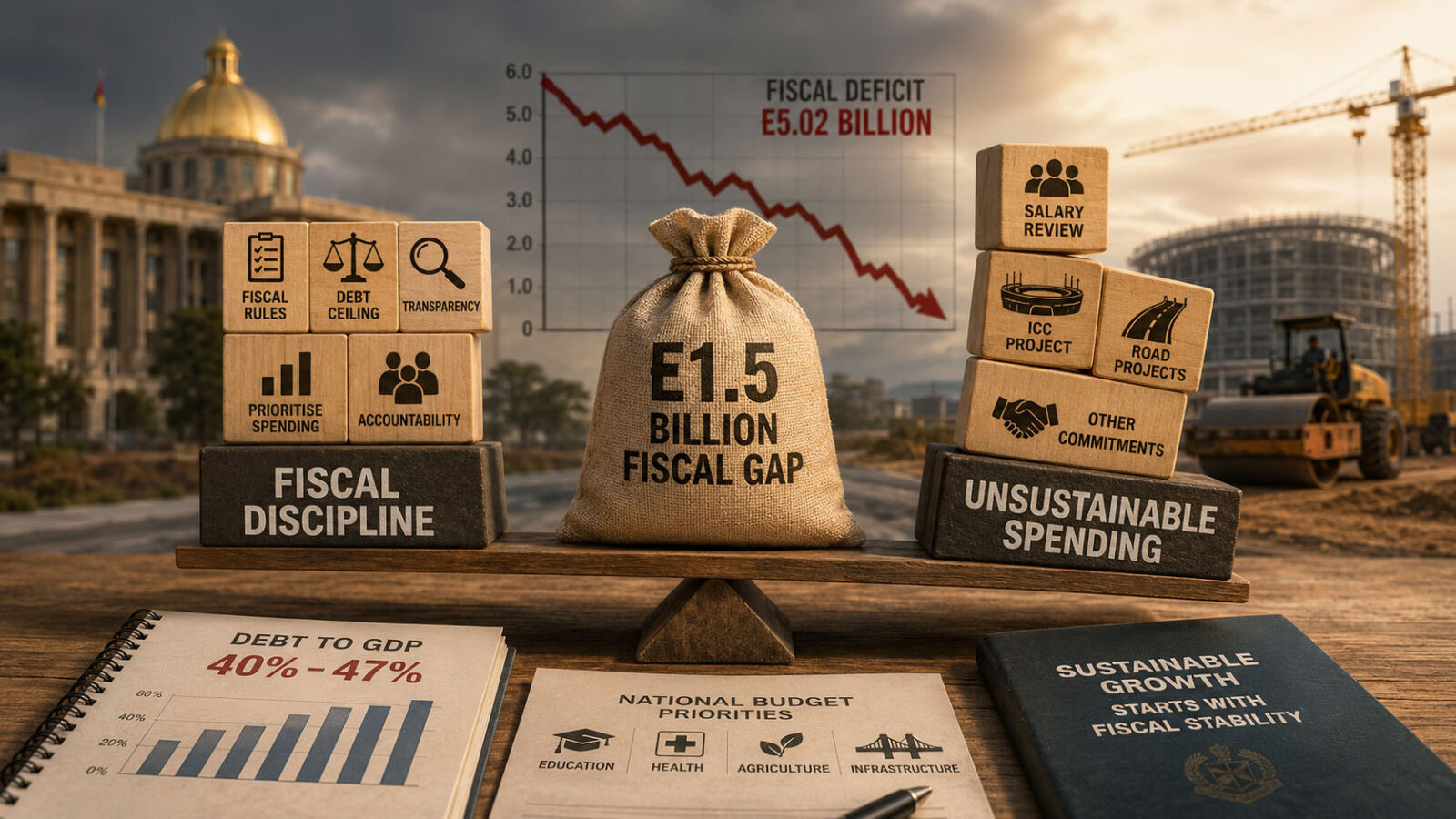
Thecountry’s fiscal position has once again come under the spotlight following Finance Minister Neal Rijkenberg’s announcement that government must raise E1.5 billion this financial year to ease cash flow pressures and fund capital projects. With total expenditure projected at E36.92 billion and capital spending alone at E7.78 billion, the country faces a deficit of E5.02 billion. This gap is not merely a technical imbalance; it is a stark reminder of the tension between ambition and sustainability in public finance.
The strain is driven by multiple commitments: The salary review for civil servants, completion of the ICC and ongoing road construction projects. Each of these is politically attractive, but together they stretch the fiscal envelope beyond what the economy can comfortably sustain. The danger is that Eswatini risks financing prestige projects at the expense of essential services, leaving the country more indebted and less resilient.
Fiscal discipline vs development ambition
Government’s challenge is not unique. Across Africa, States grapple with the dilemma of financing development while maintaining fiscal discipline. Yet Eswatini’s small economy magnifies the risks. Unlike larger economies that can absorb shocks, the country’s fiscal space is narrow. A misstep in debt management could quickly spiral into crisis, eroding investor confidence and constraining government’s ability to deliver basic services.
Fiscal rules and debt ceilings are not abstract concepts; they are safeguards against precisely this scenario. Without clear limits, governments are tempted to borrow excessively in pursuit of short-term gains. Eswatini must, therefore, consider institutionalising fiscal rules that cap deficits and debt ratios, ensuring that ambition does not overwhelm sustainability. A statutory debt ceiling, say, capping public debt at 50 per cent of GDP, would force government to weigh every new loan against long-term sustainability. Complementary rules, such as requiring balanced budgets over the medium term, would provide discipline and predictability.
Cost of ignoring discipline
The consequences of ignoring fiscal discipline are already visible. Interest payments on public debt now exceed spending on education, a reversal of priorities that should alarm policymakers and citizens alike. When debt servicing consumes more resources than classrooms and hospitals, the social contract begins to fray. Citizens expect government to prioritise social investment, not funnel scarce resources into debt repayments. We need to focus on projects that will generate immediate economic returns rather than budget support and projects that will not yield immediate fiscal benefits. The debt must generate an ability to repay the commitment. The opportunity cost is immense: Every Lilangeni spent on interest and debt servicing is a Lilangeni not spent on textbooks, clinics or agricultural support. Fiscal discipline is not about austerity for its own sake; it is about ensuring that borrowing remains a tool for growth rather than a spiral into dependency.
Safeguards for the future
To safeguard the kingdom’s fiscal future, several measures must be adopted with urgency and commitment. First, the country needs binding fiscal rules that set clear limits on deficits and debt ratios, enforced by law and subject to independent oversight. Such rules must be transparent and measurable, ensuring that fiscal discipline is not left to political discretion. Alongside this, a statutory debt ceiling is essential to cap borrowing and prevent runaway debt accumulation. A ceiling forces policymakers to prioritise projects, weigh trade offs carefully and avoid reckless expansion. Equally important is expenditure prioritisation, which requires redirecting resources away from dormant line items and rationalising each Lilangeni in the budget to identify potential savings. This will improve the value of each Lilangeni spent and ensure that we are channelling resources where they are needed. Furthermore, strengthening transparency and accountability is also critical: Government should publish detailed debt reports and subject capital projects to rigorous cost benefit analysis so that citizens can see how their money is spent and whether projects deliver value. As it stands, the debt to GDP figure ranges from 40 per cent to 47 per cent depending on who has the microphone, underscoring the need for clarity and consistency in fiscal reporting.
Stability before growth
The temptation in policymaking is always to chase growth. Yet in Eswatini’s current context, stability must come first. A fragile fiscal position undermines confidence, deters investment and erodes government’s ability to deliver services. Stability, by contrast, creates the foundation upon which sustainable growth can be built. This does not mean abandoning development ambition. It means sequencing it wisely: First secure the fiscal base, then pursue transformative projects. Hydropower, for instance, is a sound investment precisely because it strengthens energy security and supports industrial growth. Ambiguous budget support, by contrast, is a drain on resources without clear returns. Fiscal discipline requires distinguishing between productive and unproductive expenditure.
Maintain the 40 per cent debt-GDP ratio target
I note with concern how the rhetoric has now shifted from Eswatini’s original 40 per cent debt to GDP target towards the regional average of 60 per cent. This recalibration risks normalising higher debt levels without addressing the structural vulnerabilities of our small economy. For Eswatini, adopting the regional benchmark as a comfort zone is dangerous; fiscal discipline must remain anchored in prudence, not convenience. The lesson is clear: Sustainability requires firm limits, not shifting goalposts.
















Leave a comment