

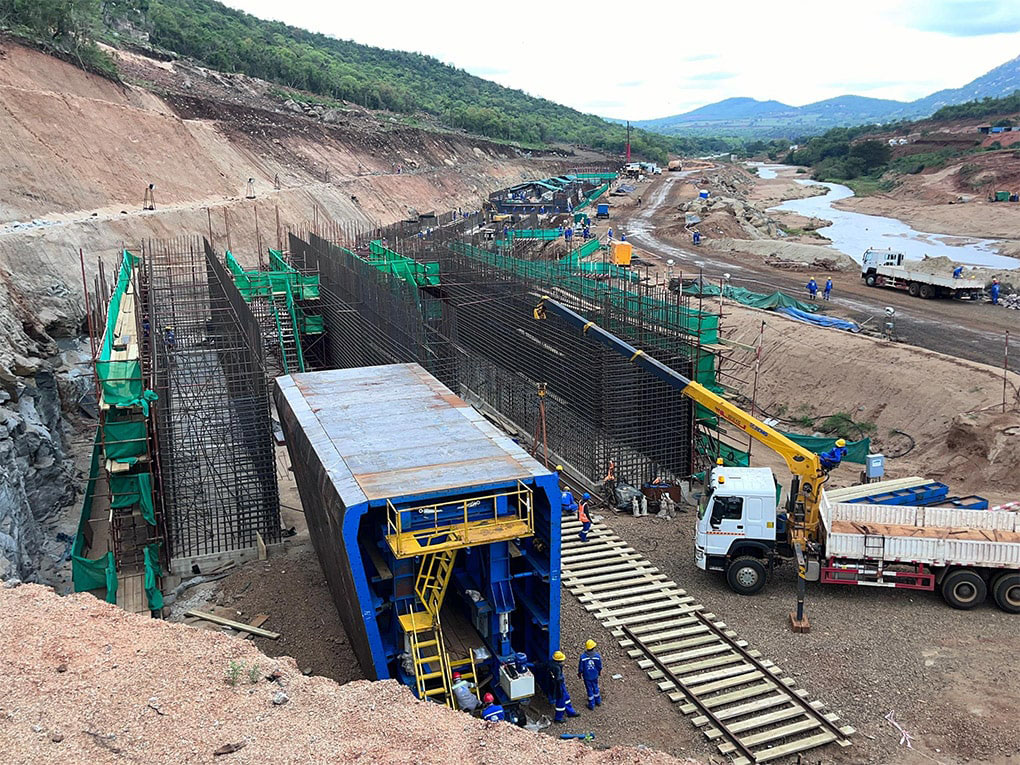
MBABANE – The Chinese consortium contracted to construct the E2.6 billion Mpakeni Dam has categorically stated that it will not abandon the project in Eswatini.
This is despite a travel advisory from the People’s Republic of China warning its nationals to evacuate Eswatini because of safety and security reasons. The Government of the Kingdom of Eswatini issued a statement in response to the travel advisory, dismissing claims that the kingdom presents an exceptional or generalised security risk.
The travel advisory from the People’s Republic of China (PRC) reads: “Do not travel to Eswatini due to high safety risks and rampant telecom fraud. We urge Chinese citizens in Eswatini to leave ASAP. The Chinese Government will do everything necessary to protect Chinese nationals overseas.”
Several Chinese companies are doing businesses in Eswatini, one of which was awarded a contract valued at E2.6 billion.
Sakhalive Joint Venture (JV), a majority Chinese-owned entity comprising Sinohydro and Yellow River, is currently undertaking the massive infrastructure project under the Mkhondvo-Ngwavuma Water Augmentation Project (MNWAP). They are not the only companies from PRC as Zhengtai Group was also awarded a contract in the kingdom.
Huawei Technologies operates in Eswatini by providing core digital and telecommunications infrastructure services to major local mobile operators. The headquarters of Huawei is located in Longgang district, Shenzhen, Guangdong, China.
It must be said that on May 1, 2026, China eliminated import tariffs for 53 African nations, excluding Eswatini because the country maintains formal diplomatic ties with Taiwan.
However, Eswatini continues to welcome businesses from Mainland China, awarding them contracts to undertake major projects.
Meanwhile, the Times SUNDAY was able to get hold of Sakhalive JV.
Responding to the travel advisory, the management of Sakhalive JV ‘respectfully’ noted the warning issued by Beijing, which cited security concerns and advised Chinese nationals and institutions to relocate to relatively safer areas such as South Africa. However, in a detailed response, the consortium moved to allay fears regarding the continuity of the dam’s construction.
When asked directly if the company was prepared to abandon the project before completion, given that their government had labelled the country unsafe, Sakhalive JV offered an unequivocal refusal.
“No. Sakhalive JV remains fully committed to the successful delivery of the Mpakeni Dam Project,” the consortium stated. “Construction activities continue in accordance with the approved programme and there are no plans to suspend, scale down or abandon the project.”
The contractor further emphasised that, based on current information, the advisory will not derail the project’s targeted completion date of April 2028. “Sakhalive JV does not anticipate any material impact on the project’s targeted completion date. The joint venture remains focused on meeting all contractual obligations and project milestones,” the response from Sakhalive read.
Regarding the immediate measures being taken to protect Chinese staff, the JV said the safety and well-being of all employees remained its highest priority. The company noted that it had reviewed its existing security and risk management protocols and would continue to implement appropriate precautions in line with official guidance.
However, the consortium declined to provide specific figures regarding its workforce composition. Out of the approximately 850 workers currently on site, Sakhalive JV refused to disclose how many are Chinese nationals. “As a matter of employee safety, operational security and out of respect for the advisory issued by the Chinese Government, Sakhalive JV will not disclose the number of Chinese nationals deployed on the project,” the company said.
Despite the non-disclosure of numbers, the JV was clear that no personnel have been recalled or relocated to South Africa at this stage, noting that “operations continue as normal.”
On the question of whether the Eswatini Water and Agricultural Development Enterprise (EWADE) or the Eswatini Government had engaged them on continuity plans, the contractor indicated that communication channels remain open.
“Sakhalive JV maintains regular communication with EWADE and relevant government authorities on matters relating to project implementation and continuity,” the management said, adding that it would continue working closely with all stakeholders to ensure the dam’s successful delivery.
The firms behind Sakhalive JV bring decades of engineering experience to the Mpakeni Dam project. Both Sinohydro and Yellow River companies are major Chinese state-owned enterprises and foundational pillars of the Power Construction Corporation of China (POWERCHINA).
Sinohydro, founded in October 1954, served as the main state-owned enterprise for hydropower construction in China. Domestically, it has been responsible for building roughly 65 per cent of China’s medium and large-scale hydroelectric and water conservation projects, including critical sections of the iconic Three Gorges Dam and the Xiaolangdi Dam.
The company secured foreign trade rights in 1993, subsequently expanding into over 100 countries across Africa, Asia and the Americas to handle massive infrastructure turnkey projects, such as Ecuador’s Coca Codo Sinclair. It was integrated into POWERCHINA upon its establishment in 2011.
The Yellow River companies trace their origins back to the Yellow River Sanmenxia Engineering Bureau, established in 1955, and the Yellow River Engineering Consulting Co., Ltd. (YREC), founded in 1956 under the Ministry of Water Resources. These entities specialised in harnessing, planning and protecting the Yellow River basin, historically known as ‘China’s Sorrow’, and designing critical control systems like the Xiaolangdi Multipurpose Dam. Today, restructured into modern technological and enterprise groups under POWERCHINA, they provide global consulting, ecological restoration and engineering supervision across more than 30 countries.
It remains to be seen how the evolving diplomatic posture between Beijing and Mbabane will impact the daily realities of the Mpakeni Dam site, but for now, Sakhalive JV’s stance is clear: The builders are staying put.
















Leave a comment