

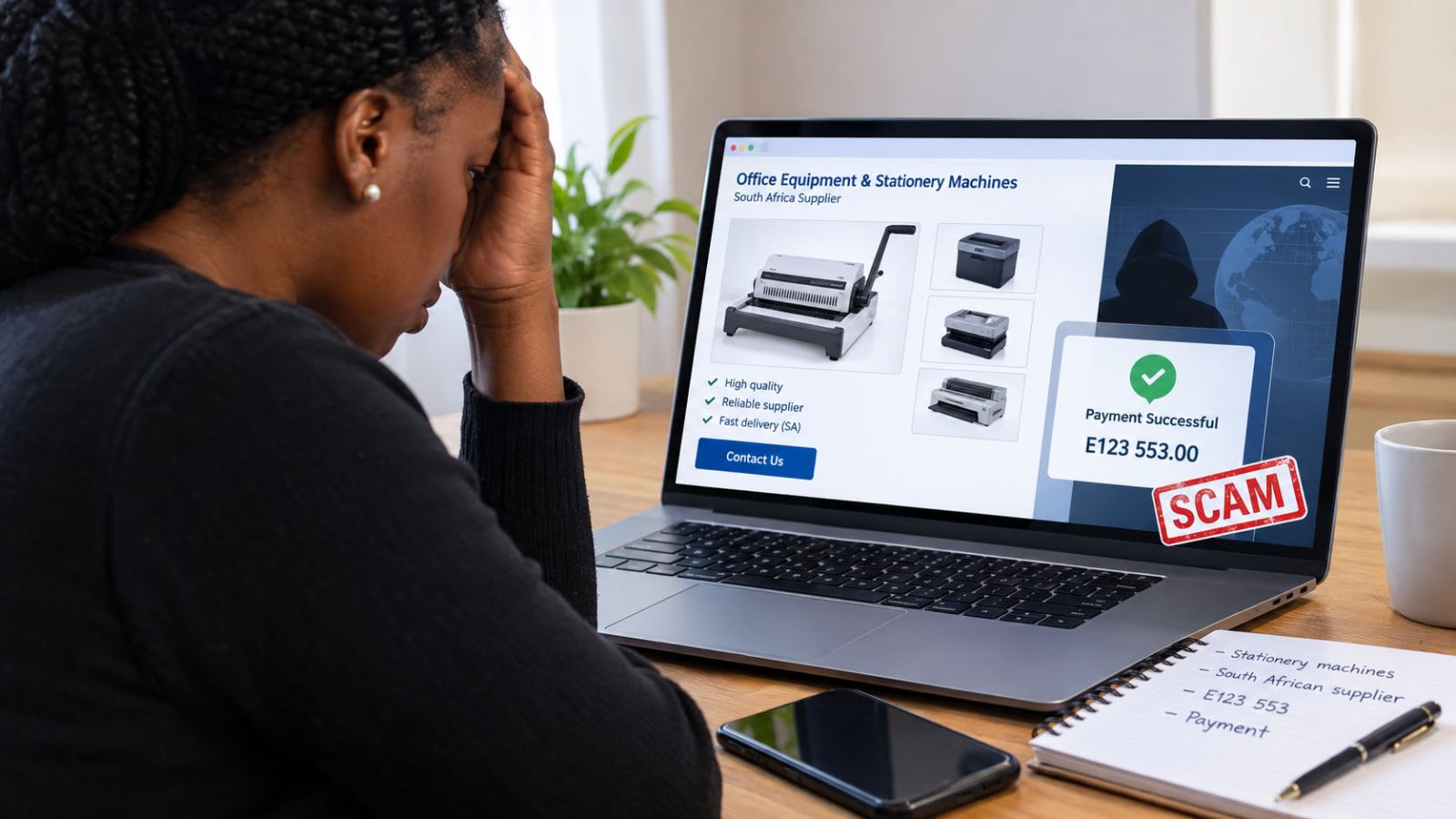
MANZINI – A Sandleni woman has allegedly lost E123 553 after she was duped into believing that she was purchasing stationery machines from a South African business advertised online.
The woman, a 44-year-old , reported the matter to the police after allegedly discovering that the business from which she intended to purchase the machines was fake.
She was allegedly scammed on Tuesday, August 11, 2026, at about 10am while she was in Manzini. According to sources, the complainant was allegedly dealing with an unknown person who presented the supposed South African business as a legitimate supplier of stationery machines. She reportedly believed that she was dealing with a genuine business and proceeded with the transaction. She subsequently lost E123 553. The circumstances of the case point to the growing risks faced by people who use online platforms to purchase goods and services, particularly where transactions are conducted with persons or businesses whose identities have not been independently verified.
Online transactions can allow a person to present a business as being based in another country without the customer physically meeting the seller or visiting the business premises.
The reported loss comes at a time when online scams have increasingly become a concern in Eswatini, with members of the public being targeted through various forms of digital deception.
Recent cases reported by this publication have shown how criminals can use online platforms, social media accounts and other digital tools to create convincing schemes aimed at obtaining money from unsuspecting victims.
In one recent warning, the public was advised to exercise caution when dealing with online offers and to verify information before sending money. The warning followed growing concerns about scammers using digital platforms to deceive members of the public. The Times of Eswatini has also reported cases in which fake documents, fictitious businesses and manipulated information were allegedly used to facilitate fraudulent transactions. In April this year, for example, the Eswatini Electricity Company uncovered an alleged fraud scheme involving E166 244.45, where an employee was suspected of manipulating customer refund processes. In another case reported in August, the Ministry of Natural Resources and Energy warned members of the public about a fraudulent tender document that was being circulated through email and other online platforms. The ministry said the purported tender had not been issued or authorised by it and urged members of the public to verify procurement notices through authorised government channels.
There have also been warnings about scammers using fake social media accounts and impersonating public figures.
In June, the Deputy Prime Minister’s Office warned the public after fraudsters allegedly created a fake Facebook post and used a cloned voice purporting to belong to Deputy Prime Minister Thulisile Dladla. Members of the public were reportedly invited to deposit money into an organisation supposedly linked to a government housing initiative. The cases demonstrate the different methods allegedly being used to obtain money from members of the public through digital platforms. Malinga’s case, however, is different in that the alleged scam was linked to the purchase of physical business equipment.
The police report indicates that the transaction was based on the belief that she was purchasing stationery machines from a South African business. The identity of the person behind the alleged scam was not provided in the police report, and it was not stated whether the person had been arrested at the time the matter was reported.
The report also did not provide details on the online platform allegedly used to advertise the stationery machines or how the payment was made.
These details remain important as investigations into the matter continue.
The reported incident serves as another reminder of the risks associated with sending large amounts of money to people or businesses encountered online without first confirming their legitimacy. Members of the public who intend to purchase expensive goods online are generally encouraged to establish the physical existence of the business, verify its registration and contact details, and independently confirm the identity of the person receiving payment.
Where a business claims to operate from another country, potential customers may also face additional challenges in verifying its physical location and legitimacy. For Malinga, the alleged transaction resulted in a reported loss of E123 553.
The matter has been reported to the police, with the person allegedly responsible still unknown according to the information available in the report.
The case adds to a growing list of incidents in which members of the public have allegedly lost money after being persuaded to trust people, businesses or offers presented through digital platforms. The latest incident also demonstrates that online fraud is not limited to investment opportunities, fake prizes or impersonation schemes, but can also involve ordinary commercial transactions in which victims believe they are purchasing legitimate goods.
















Leave a comment