

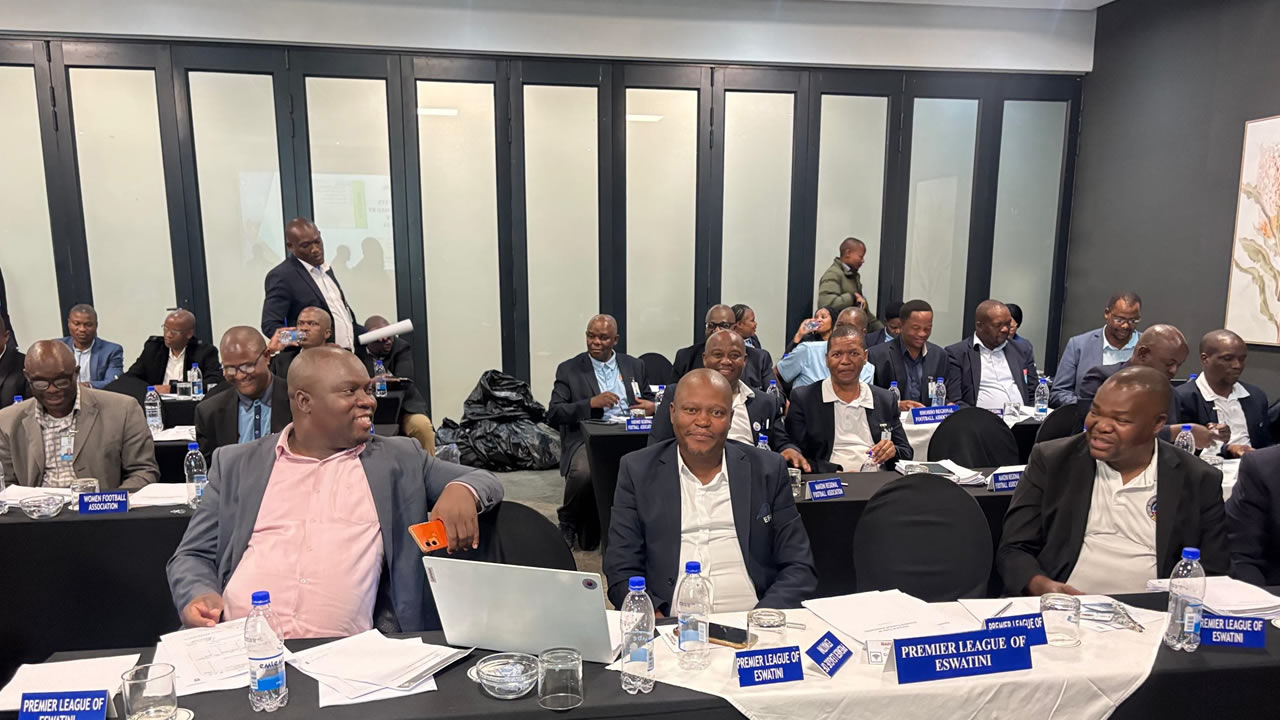
MBABANE – The Eswatini Football Association (EFA) has officially established an arbitration tribunal to address football-related disputes.
This was revealed during the EFA Statutes Meeting held at the Happy Valley Hotel in Ezulwini yesterday.
Delegates at the meeting adopted the newly-amended EFA Statutes and Electoral Code, paving the way for this significant development. The creation of the arbitration tribunal was prompted by the increasing number of football disputes taken to civil courts by EFA affiliates, highlighting the need for an internal resolution mechanism.
Set to be fully operational before the 2025/26 season, the arbitration tribunal will provide an alternative avenue for clubs, players or other stakeholders dissatisfied with decisions from the EFA Disciplinary Committee or Appeals Board, allowing them to escalate their cases to the tribunal. The EFA will unpack regulations governing the tribunal’s processes, including how clubs or member associations should proceed, during the annual general meeting (AGM) on July 17.
The tribunal’s importance came to prominence during discussions on Article 67 of the EFA Statutes, with delegates expressing strong support for its establishment. Eswatini Referees Association (ERA) Chairman Simanga Nhleko and Bongani ‘Bhanyaza’ Mdluli provided valuable insights into how the tribunal will benefit Eswatini football as a whole. The need for such a body was underscored by a high-profile case in the 2024/25 season, when Manzini Wanderers successfully challenged their relegation in court, securing their place among the 16 teams in the 2025/26 Premier League of Eswatini (PLE) season after a legal battle that dragged on for nearly the entire season.
Article 67 of the EFA Statutes outlines the structure and function of the Arbitration Tribunal. The tribunal consists of a chairperson, a deputy chairperson and a number of members as outlined in the Disciplinary and Ethics Code. Its functions are governed by the EFA Disciplinary and Ethics Code, and it is responsible for hearing appeals against decisions from the Appeals Board. The tribunal definitively resolves all football-related disputes, excluding matters requiring interpretation of national law, which may be referred to ordinary courts. Decisions of the Arbitration Tribunal may only be appealed to the Court of Arbitration for Sport (CAS) in accordance with the EFA Statutes.
appellate
The Court of Arbitration for Sport (CAS), based in Lausanne, Switzerland, serves as the final appellate body for football disputes under the global soccer governing body’s framework, as outlined in Article 57 of the FIFA Statutes. CAS has jurisdiction to hear appeals against final decisions of International Federation of Association Football (FIFA) bodies. These include bodies like the Confederation of African Football (CAF), or member associations such as the EFA, provided the matter is not an internal disciplinary issue of minor consequence or explicitly excluded from appeal. Appeals to CAS must be filed within 21 days of the decision being appealed, and cases are typically heard by a panel of three arbitrators, with each party nominating one arbitrator and the third appointed by CAS to ensure impartiality. Arbitrators are selected from a pool of experts in sports law and arbitration, and CAS decisions are final and binding, with limited grounds for appeal to the Swiss Federal Tribunal in cases of procedural irregularities. FIFA guidelines mandate that member associations like the EFA include provisions in their statutes recognising CAS’s jurisdiction for football disputes, ensuring unresolved national-level disputes, such as those from the EFA Arbitration Tribunal, can be escalated to CAS if they meet FIFA’s criteria.
dispute
In contrast, South Africa’s arbitration tribunal, established under the South African Football Association (SAFA), operates similarly as an internal dispute resolution mechanism, but is tailored to the specific governance and legal framework of South African football. Like the EFA’s tribunal, SAFA’s arbitration body handles disputes arising from decisions of its disciplinary or appeals committees, aiming to resolve matters internally before they reach civil courts.
Meanwhile, at the end of the meeting, the Electoral Committee was announced, and its members were adopted by the delegates. This included Siphosini Dlamini as Chairperson, Phumzile Thomo as Vice, Luke Shongwe, Bongani Phakathi and Mandla Dlamini. Additionally, the delegates renewed the Appeals Board, which included Ndumiso Shongwe, Polycarp Ngubane, Leonard Ndlovu, Derrick Jele and Mthokozisi Dlamini.












Leave a comment