

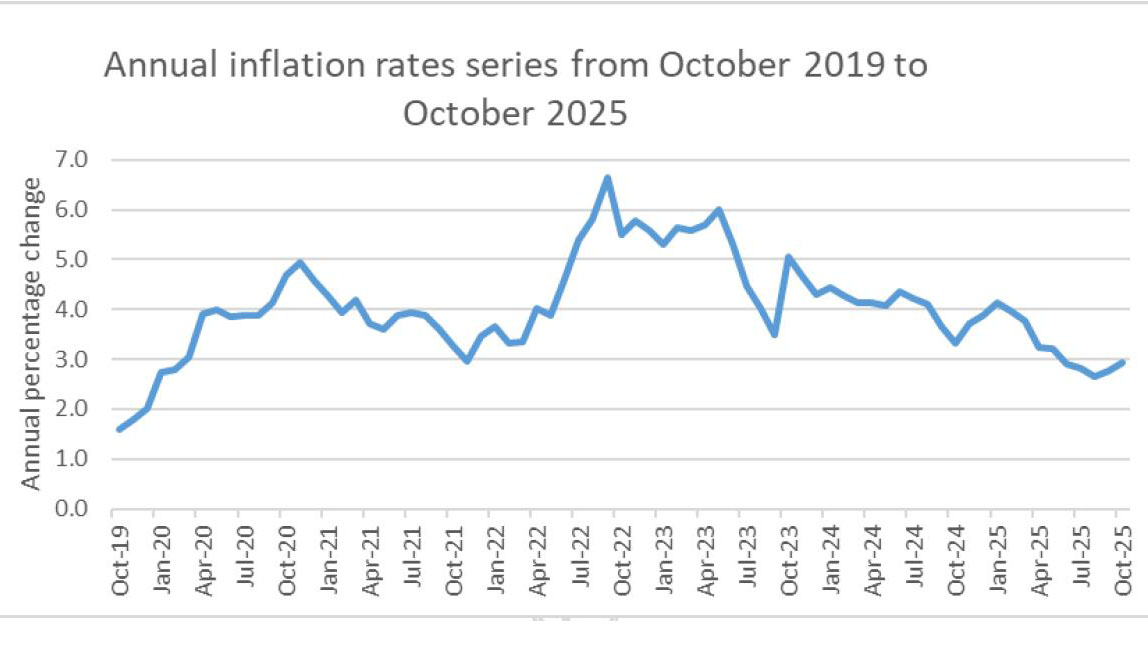
MBABANE – Eswatini’s inflation rose slightly to 2.9 per cent in October 2025, driven mainly by housing, utilities and alcohol price increases amid continued drops in restaurant and hotel costs.
Inflation ticked upward in October 2025, signalling a mild but notable shift in consumer price dynamics as the country continues to navigate a period of broad cost stabilisation.
According to the Central Statistical Office’s (CSO) Consumer Price Index (CPI) report released on Friday, annual inflation climbed to 2.9 per cent, up from 2.8 per cent recorded in September.
Although the increase is marginal, the figure reflects changing pressures across different consumption categories, with some sectors experiencing strong price growth while others continue to decline.
The October reading, however, remains significantly lower than the 3.3 per cent inflation rate recorded in October 2024, affirming that Eswatini is still within a low-inflation environment.
The latest data also shows a divergence between goods and services, with prices of goods rising by 3.3 per cent and services increasing by 2.3 per cent year-on-year.
Three categories were chiefly responsible for the upward push in headline inflation:
- Housing, water, electricity, gas and other fuels, contributing 1.2 percentage points.
- Alcoholic beverages, tobacco and narcotics, adding 0.7 percentage points.
- Clothing and footwear, contributing 0.3 percentage points.
These combined contributions largely outweighed the declines recorded in other sectors, particularly restaurants and hotels, which continued to report steep price reductions.
The report highlights that the month-on-month inflation rate for October stood at 0.4 per cent, a notable rise from 0.0 per cent in September. This month-to-month increase was propelled mainly by higher prices in alcohol, clothing and recreational goods.
*…
… food prices increase modestly by 0.4 %
MBABANE – Food prices increased modestly by 0.4 per cent year-on-year, reflecting ongoing stability in essential food items.
Prices for meat and dairy saw moderate growth of 2.2 per cent and 4.4 per cent, respectively.
Fruit prices rose strongly by 6.1 per cent, driven partly by seasonal patterns and supply fluctuations. However, this did not significantly impact the overall food category due to its relatively smaller weighting.
Non-alcoholic beverages recorded a robust 5.1 per cent annual increase, attributed to higher costs for soft drinks, bottled water and related products.
Transport inflation remains subdued at 0.9 per cent, supported by stable fuel costs during the month. Fuel and lubricants for personal transport rose by 4.0 per cent year-on-year, but with the overall category weighted by road and air transport charges – many of which remained unchanged – the impact on the headline rate was limited.
Passenger road transport, which forms the biggest component, recorded no monthly change, helping to maintain stability.
Air transport costs increased by 4.0 per cent year-on-year but declined sharply by 9.5 per cent month-on-month, reflecting volatile pricing patterns in the aviation sector.
*Full article available in our publication



















Leave a comment