

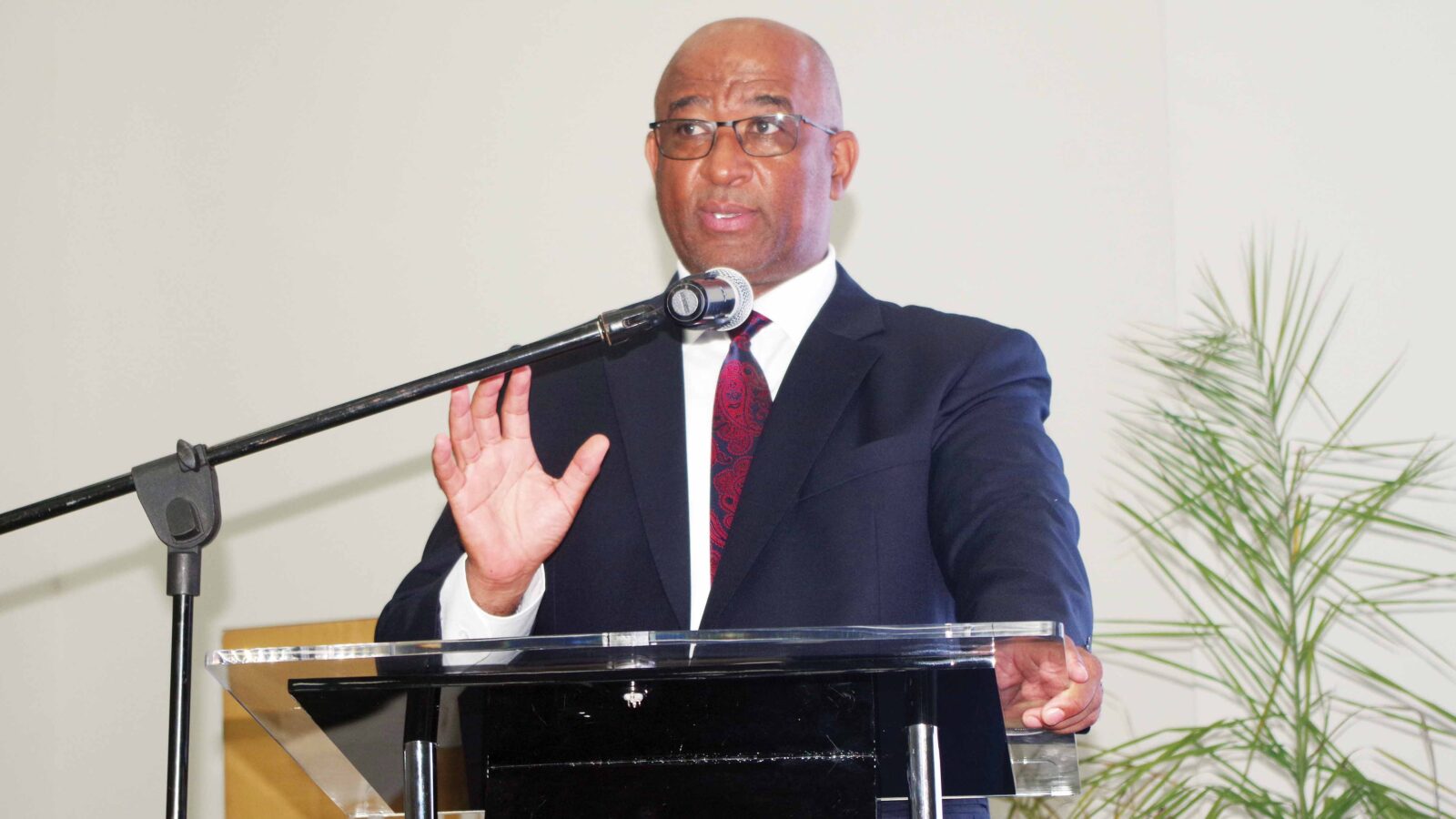
EZULWINI – The Governor of the Central Bank of Eswatini (CBE), Dr Phil Mnisi, has issued a strong and timely warning about the country’s rising financial stability risks.
The governor cautioned that fiscal pressures, external vulnerabilities, and household strain are converging in ways that demand urgent policy attention.
Presenting the 2025 Financial Stability Review (FSR) at the CBE Headquarters in Ezulwini yesterday, the governor said although the financial system remains broadly resilient, ‘systemic risks are increasing and buffers are thinning’.
At the centre of his message was a detailed assessment of how widening fiscal deficits, mounting public debt and uncertain trade prospects pose real threats to economic stability—threats that, if left unmanaged, could spill over directly into the banking sector.
The governor revealed that Eswatini’s fiscal deficit is projected to widen further to E2.88 billion in the 2025/26 financial year, equivalent to 3 per cent of GDP, up from E2.46 billion in 2024/25.
This deterioration, he said, is driven by rising expenditures, including wage adjustments for security services, the recently concluded salary review and capital commitments on infrastructure.
The deficit expansion is happening at a time when fiscal buffers are already depleted. “Persistent deficits continue to erode contingency reserves, increase borrowing needs, and elevate sovereign-liquidity risks,” Dr Mnisi said.
*…
… potential spillovers to banks require vigilance
EZULWINI – While the banking sector remains well capitalised and liquid, the CBE Governor, Dr Phil Mnisi, highlighted the danger of spillover risks from fiscal fragility to banks.
These include delayed government payments, volatility in the sovereign bond market, and pressures on public-sector entities that form part of the banks’ credit portfolios.
Persistently high non-performing loans (NPLs) and concentration risks also require careful supervision. “The bank’s monetary policy stance remains carefully calibrated to support growth while preserving financial stability,” he said, emphasising ongoing enhancements to stress-testing frameworks, early-warning systems and prudential oversight.
*…
Banking assets rise to E30.3bn
MBABANE – Total banking sector assets expanded by 4.9 per cent to reach E30.3 billion.
This was driven primarily by a 9 per cent increase in loans and advances and a 13.6 per cent rise in holdings of government securities, stated the governor.
Central Bank of Eswatini (CBE) Governor Dr Phil Mnisi said the growth reflects improved financial intermediation and continued portfolio diversification within the sector. However, he cautioned that the higher loan book and deeper exposure to government instruments may also point to rising credit risks and a persistent build-up of sovereign concentration. “While the sector remains broadly resilient, these emerging vulnerabilities require ongoing supervisory vigilance,” he said.
Over the year, to June 2025, the banking industry sustained strong capital and liquidity buffers despite the challenging operating environment. Deposits grew by 3.8 per cent to E21.8 billion, although the faster expansion of lending relative to deposits suggests increasing funding and liquidity pressures. Shareholders’ funds were up 3.4 per cent, signalling moderate capital strengthening despite softer profitability trends.
*…
Public debt climbs, raising rollover risks
EZULWINI – Public debt climbed to 40.3 per cent of GDP by June 2025—up from 38.6 per cent a year earlier—driven mainly by higher domestic borrowing.
Domestic debt increased to 21.6 per cent of GDP, while external debt eased marginally to 18.7 per cent.
As of October 2025, debt levels eased slightly to 39 per cent of GDP, but the CBE Governor Dr Phil Mnisi cautioned that the overall debt path remains upward.
More borrowing will be required to finance deficits and major public investments, including the Phuzumoya Oil Reserve Project.
“This trajectory raises rollover and interest-rate risks,” he emphasised. “High public debt could crowd out private-sector credit and leave less space for development-oriented lending.”
*Full article available in our publication




















Leave a comment