

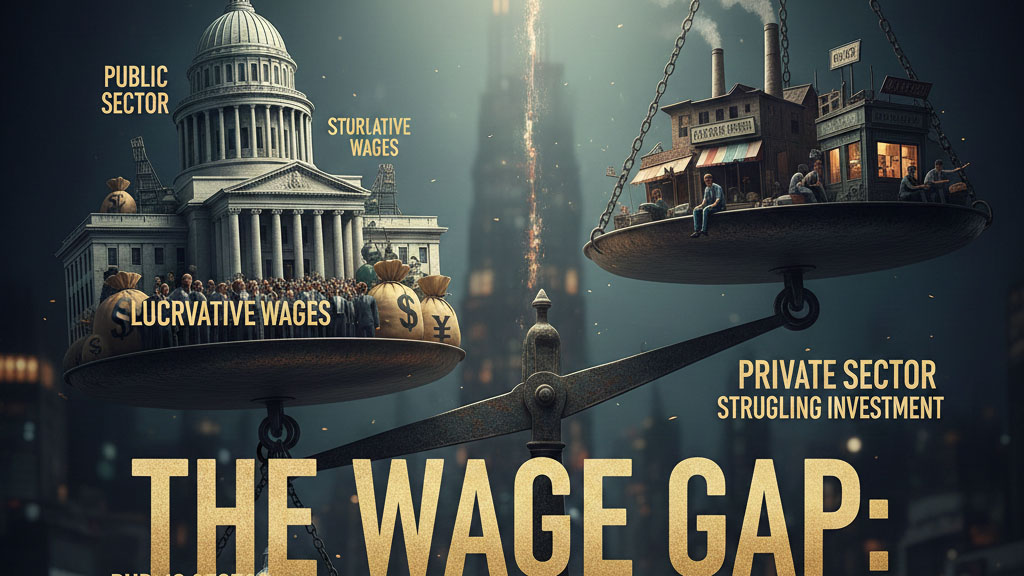
Earlier in the year, the World Bank presented that the public service wage premium is lucrative compared to the private sector. We are fresh from a salary review exercise, which in my view, has extended the pay gap between the public service and the private sector.
This public sector wage premium has marked impacts on the overall growth trajectory of the private sector and long-term impacts on the growth prospects of the kingdom. It is imperative that we have a conversation on how we can implement private sector-led growth, in the midst of this potential crowding out of private sector investments.
Public sector
The sector has long been the dominant employer, offering stable jobs, predictable benefits and relatively attractive wages in the kingdom. Furthermore, on the exist of the 2008 financial crisis, the burgeoning public sector wages became an apparent problem that the country had to solve. This culminated in the Fiscal Adjustment Roadmap and the Economic Recovery Strategy. Key to the attainment of these strategies was the containment of the wage bill. While this has historically provided a safety net for many families, the growing disparity between public and private sector compensation is now a structural impediment to economic vitality. Furthermore, empirical evidence across the globe shows that high public sector wages are often misaligned with productivity, distort labour markets, undermines the very development that the country urgently needs.
Double-edged sword
Public sector wages in the kingdom account for over 33 per cent of government’s budget, with the recently implemented salary review exercise, the wage bill is set to outstrip SACU revenues in the 2026/27 financial year. While at times a wage premium may be justified as an impetus to attract rare skills and talent in the public service, especially in certain areas, the broader effect is a wage premium that the private sector cannot match.
This wage gap creates a powerful incentive for skilled workers to seek public employment, not because it is more productive or innovative, but because it is more secure and better paid. As a result, the private sector especially SMEs struggles to attract and retain talent. This is particularly damaging in sectors like agribusiness, manufacturing and ICT, which are critical for job creation and export diversification.
Labour market distortions and talent drain
High public sector wages are distorting the labour market, drawing even highly skilled graduates away from private enterprise and into government roles, not for productivity, but for better pay. This ‘queueing’ behaviour delays economic engagement and fosters dependency.
Wage-setting in the public sector is often politically driven and detached from productivity, creating an effect that locks in high costs. This sets an artificial wage floor the private sector cannot match, undermining its ability to attract talent. The question remains: can Eswatini achieve private sector–led growth while sustaining such a wage premium in the public sector?
Crowding out and investment constraints
High public sector wages also have macroeconomic implications. In Eswatini, the public wage bill consumes over 33 per cent of total government expenditure. This leaves little fiscal space for capital investment in infrastructure, education quality or business development services that could support private sector growth.
Furthermore, when government revenues fall short, as they have in recent years due to declining SACU receipts, the State often resorts to borrowing or arrears accumulation to meet its wage obligations. This crowds out private credit, raises interest rates and undermines investor confidence. In effect, the State becomes a competitor to the private sector for scarce financial resources.
Inflationary pressures and wage expectations
Another underappreciated consequence of high public sector wages is their impact on inflation and wage expectations. When government employees receive above-inflation salary increases, it fuels aggregate demand without a corresponding increase in output.
This can lead to demand pull inflation, eroding the purchasing power of low-income households and forcing private employers to raise wages just to keep up. This may trigger a wage-price spiral, where inflation expectations become entrenched and undermine macroeconomic stability.
Coherent wage policy
Public servants deserve fair compensation for their essential work, often under challenging conditions. However, fairness must be balanced with fiscal sustainability and economic coherence. A smarter wage policy would reward performance, align with productivity, and support national development goals.
The country urgently needs comprehensive public sector wage reform grounded in three principles: affordability, ensuring wage growth reflects fiscal realities and avoids politically driven increases; equity, aligning public-private wage differentials with actual skills and responsibilities, while rationalising pay in overstaffed areas; and support for private sector growth, redirecting savings from wage moderation into infrastructure, skills development and SME support to foster a more dynamic economy.
Conclusion
The current trajectory of high public sector wages is fiscally unsustainable and economically counterproductive. If the country is to achieve inclusive growth, reduce unemployment, and build long-term resilience, it must rebalance its wage policies to empower the private sector.
This is not a call for austerity, but for strategic alignment, between pay and productivity, ambition and affordability and the public and private sectors. The future depends not on wage generosity, but on how wisely it invests in national productivity.



















Leave a comment