

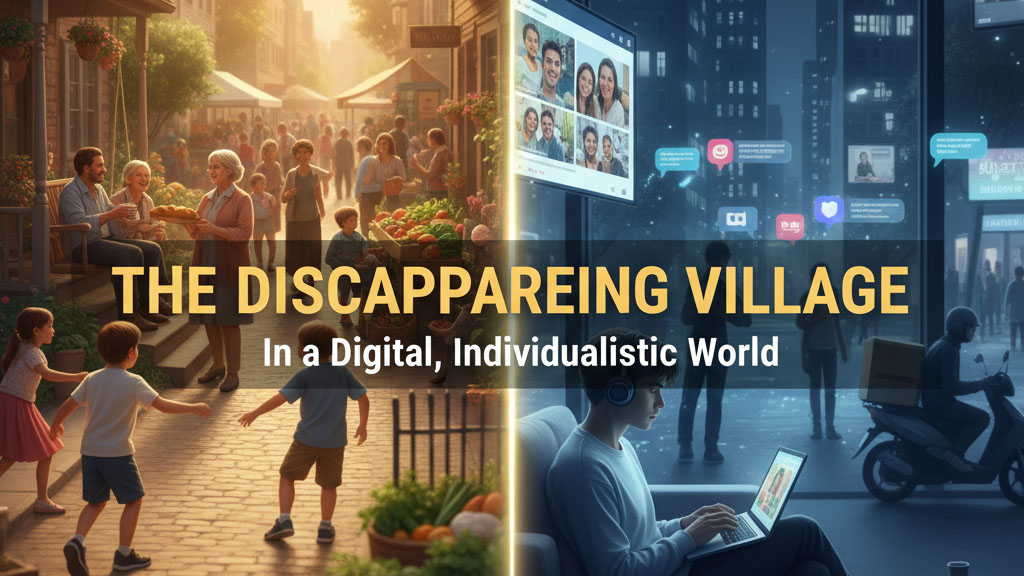
There was a time when community was not something we had to search for; it was simply woven into everyday life. Neighbours knew one another by name, children played outside without supervision and people borrowed sugar or bread without hesitation. Friendship was not scheduled weeks in advance because it happened on porches, in shared gardens, at church gatherings, school halls or community markets. This is the childhood many grew up in, in community without being worried about privacy or overstepping. It is the life our grandparents lived, parts of it that we envy when we look at today. Today, many of us live surrounded by people, yet feel strangely alone. Modern life has given us access to millions of social connections, but fewer meaningful ones and this shift raises an important question: Why does life feel so individualistic now?
Disappearing village in digital world
Technology has connected us globally, while separating us locally. We can follow someone’s life on another continent, yet struggle to meet the people living across the street. Online, we are surrounded by constant interaction, endless opinions and curated friendships, but these interactions rarely demand commitment, sacrifice, or responsibility. Social media gives us the illusion of community, without the work of building it. We can scroll through milestones, comment on achievements and watch others grieve or celebrate, without having to truly show up. Connection becomes performative: birthday wishes posted publicly instead of phone calls, condolences typed instead of visits, congratulations written in emojis instead of shared moments. As our social lives migrate online, real community may seem messy, inconvenient, but deeply human becomes harder to find.
Busyness has become barrier
Modern life is busy in a way that leaves little room for others. Work follows us home through emails and notifications. Hustle culture glorifies productivity over presence. We celebrate those who grind, strive and succeed, often at the expense of relationships. Time that was once spent socialising or participating in communal activities has been swallowed by deadlines, commutes, side hustles and personal goals. Even rest has become individualistic. Instead of resting in community sharing meals, conversations, laughs people isolate to recover from exhaustion. Individual burnout replaces collective restoration. Busyness has become a badge of honour, but it comes with a cost: It distances us from one another. We are too tired to nurture relationships, too overwhelmed to show up and too distracted to care deeply.
Self-sufficiency has replaced interdependence
Modern culture praises independence. We are encouraged to be self-made, self-reliant and self-sufficient. On the surface, this sounds empowering. It teaches resilience and confidence, but it also breeds isolation. Older generations relied on community to raise children, share resources, teach skills and navigate life. Today, many feel pressured to do everything alone: Parent alone, earn alone, build wealth alone, heal alone. Asking for help feels like weakness, not connection. We have replaced interdependence, the skill of relying on one another with hyper-independence, believing we should carry everything ourselves. Yet, humans were never meant to live emotionally or socially solo. The more we chase individual freedom, the more we realise freedom without connection feels empty.
Consumerism has redefined identity
Community used to be a place where identity was shaped through relationships, culture and shared values. Today, identity is increasingly tied to consumption. We express ourselves through what we buy, not who we belong to. Brands, lifestyle aesthetics and online personas become extensions of our self-image. We build ‘communities’ around products, celebrities and trends, but very little around shared responsibility, empathy or care. Consumer culture encourages us to curate a life rather than live it with others. Instead of growing roots, we grow personal brands. Instead of asking: ‘Who am I to my community?’, we ask: ‘Who am I to the world?’ The shift prioritises individual attention over collective belonging.
Urban living and loss of the village
Modern environments also play a role. Cities are crowded, yet neighbours remain strangers. People rent more and move more frequently, preventing long-term bonds from forming. Safety concerns, high walls, security systems and gated communities physically separate us from one another. Even community spaces have transformed. Parks are emptier, children rarely play outside and informal gathering spaces are replaced with commercial areas, where interaction requires spending money. Community has become something to purchase via gym memberships, social clubs, coworking spaces, rather than something created organically.
Isolation today feels, particularly heavy because we are constantly reminded of what we are missing. We see friendships online that seem effortless, families that look close, lovers who look supportive. Yet, many of us are longing for connection without knowing how to rebuild it. It is not that humans have changed. Our needs have not. We still crave belonging, love, trust and shared life, but the systems around us no longer prioritise these values.

















Leave a comment