


EZULWINI – The private sector must be placed at the centre of Eswatini’s economic transformation if the country is to thrive in what global experts are increasingly calling the ‘post-aid era.’
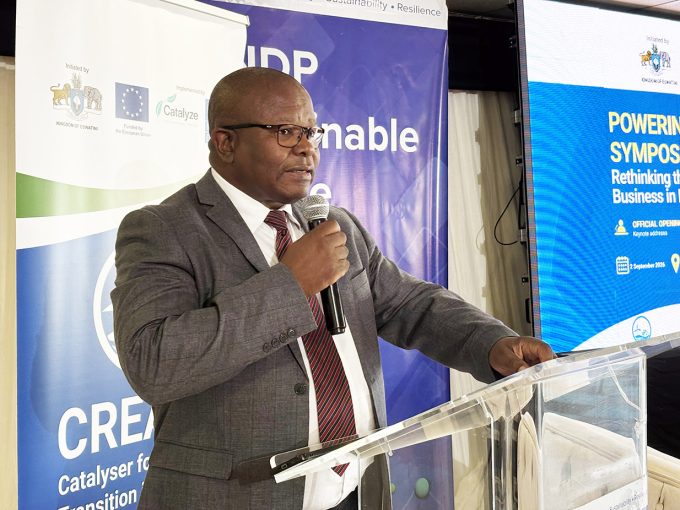
This was said by United Nations Resident Coordinator George Wachira. Speaking during the launch of the second Eswatini Investment Conference at Royal Villas in Ezulwini yesterday, Wachira emphasised that sustainable development will increasingly depend on strong partnerships anchored on private investment, domestic resource mobilisation and stronger institutions.
Delivering remarks under the theme ‘Re-Calibrating Development Partnerships at a Time of Change,’ Wachira said the global development landscape was undergoing a fundamental shift, forcing countries to rethink how they finance growth and development.
“The private sector must be positioned as a key development partner at the centre of economic activity, generating jobs, fostering innovation and boosting productivity,” Wachira said.
He added that a thriving private sector is critical for driving industrialisation, expanding trade, facilitating infrastructure development through investments and public-private partnerships and ultimately expanding the tax base needed to finance public services.
Wachira explained that the concept of ‘development partners’ first emerged in the 1980s when international development discourse sought to move away from the traditional donor-recipient relationship towards more collaborative partnerships.
However, despite the change in terminology, official development assistance (ODA) remained a dominant feature of global development cooperation for decades.
Today, he said, the world has entered what many analysts describe as a post-ODA era, where the traditional model of aid is increasingly giving way to development financing driven by investments and market-based partnerships.
“As we meet today, we have entered what many have described as the post-ODA era, a period in which the traditional model of development funding and development aid has given way to development financing and investments as the drivers of nationally-led sustainable development,” Wachira said.
In this evolving environment, countries are increasingly expected to mobilise their own resources and attract investment to sustain economic growth.
*…
… development partners providing catalytic funding
EZULWINI – United Nations Resident Coordinator George Wachira also highlighted the importance of development partners providing catalytic funding that helps attract private investment.
He said development support is most impactful when it mobilises additional financing rather than replacing private capital.
“Development partner support is most powerful when it attracts private finance and multiplies the investment,” he said.
He explained that development partners can play a key role by providing guarantees, blended finance facilities, risk-sharing instruments and technical assistance that unlock capital at scale.
Countries that have strengthened fiscal transparency and regulatory frameworks, such as Mauritius and Rwanda, have been able to secure cheaper financing and greater investor confidence.
Another crucial area for development partnerships is strengthening institutions and systems that enable markets to function efficiently.
Wachira said improving regulatory frameworks, governance systems and data reliability can significantly enhance a country’s attractiveness to investors.
“Our collective focus should shift towards fixing and oiling the systems and strengthening institutions that make markets work and attract investments,” he said.
He added that stronger institutions also help reduce corruption, curb illicit financial flows and lower the cost of capital for businesses.
Predictable policy frameworks and efficient service delivery, he said, are equally essential for building investor confidence.
Wachira further stressed the need for policy coherence across government institutions.He said economic transformation requires a whole-of-government approach, where policies, strategies and legislation work together to create an enabling business environment.
*Full article available on Pressreader*


















Leave a comment