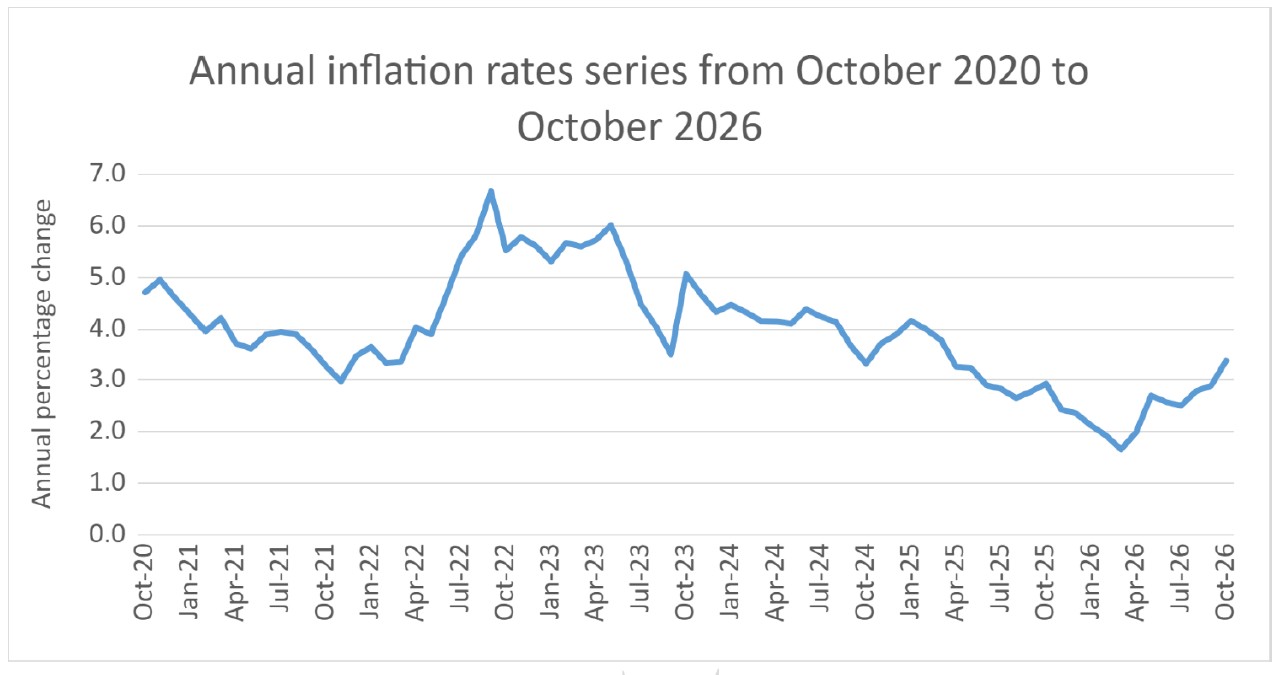
MBABANE – Eswatini’s headline inflation rate accelerated sharply in October 2026, climbing by 0.5 percentage points to 3.4 per cent from the 2.9 per cent recorded in September.
This was primarily driven by surging fuel prices and elevated utility costs.
According to the October 2026 Consumer Price Index (CPI) Report released today by the Central Statistical Office (CSO) within the Ministry of Economic Planning and Development, the latest print marks the highest annual inflation rate recorded in the Kingdom since February 2025.
Compared to the same period last year, annual inflation is also 0.5 percentage points higher than the 2.9 per cent registered in October 2025.
On a monthly basis, consumer prices rose by 0.9 per cent between September and October 2026, representing a significant 0.7 percentage point jump from the 0.2 per cent month-on-month increase observed in September.
Data from the CSO reveals that the upward trajectory in the headline figure was heavily anchored by two major expenditure categories: housing and utilities, and transport.
Together, these two baskets accounted for 3.0 percentage points of the overall 3.4 per cent annual inflation rate:
- Housing, water, electricity, gas and other fuels: Carrying the heaviest weight in the national CPI basket at 27.69 per cent, this category recorded an annual inflation rate of 6.8 per cent and contributed 1.9 percentage points to the headline figure. Within this group, liquid fuels surged by 54.2 per cent year-on-year (and 13.7 per cent month-on-month), while electricity tariffs remained 15.1 per cent higher than in October 2025. Actual rentals for housing also rose by 4.1 per cent annually.
- Transport: Accounting for 17.53 per cent of the CPI basket, transport inflation jumped dramatically from 0.9 per cent in October 2025 to 6.9 per cent in October 2026, contributing 1.1 percentage points to headline inflation. This surge was propelled by fuels and lubricants for personal transport equipment, which spiked by 41.6 per cent year-on-year and 13.2 per cent month-on-month, alongside a 27.9 per cent annual increase in passenger air transport.
- Education: Contributing 0.2 percentage points to the headline figure, education recorded an annual inflation rate of 3.4 per cent, led by pre-primary and primary education (6.2 per cent) and tertiary education (4.4 per cent).
Food prices offer reprieve
While energy and transport costs strained household budgets, the Food and Non-Alcoholic Beverages category—which holds the second-largest weight in the CPI basket at 20.15 per cent—remained largely subdued, recording a marginal annual deflation of -0.1 per cent (down from 135.89 index points in October 2025 to 135.80 in October 2026).
Modest annual price declines in staples such as bread and cereals (-1.6 per cent), sugar and confectionery (-1.3 per cent), and fruit (-0.6 per cent) helped offset increases in fish and seafood (4.3 per cent), oils and fats (2.2 per cent), and non-alcoholic beverages (5.1 per cent). Without the moderating effect of food prices, underlying inflation stood notably higher; the CSO’s analytical series shows that CPI excluding food and non-alcoholic beverages reached 4.3 per cent year-on-year.
A closer look at the CSO’s analytical breakdown underscores the impact of regulated tariffs and energy adjustments on the broader economy:
- Administered vs. non-administered Prices: Inflation for administered prices—which carry a 20.08 per cent weight—surged to 11.0 per cent year-on-year (up 2.2 per cent month-on-month), starkly outpacing non-administered prices, which rose by just 1.4 per cent annually.
- Goods vs. services: Goods inflation stood at 4.0 per cent in October 2026 (up 1.0 per cent month-on-month), while services inflation remained comparatively contained at 2.4 per cent (up 0.6 per cent month-on-month).
Elsewhere in the economy, price movements showed mixed dynamics. Alcohol beverages, tobacco and narcotics moderated significantly on an annual basis, slowing from 13.8 per cent in October 2025 to 1.0 per cent in October 2026 due to slower beer price growth (1.6 per cent) and an annual contraction in wine prices (-1.1 per cent), although the category rose 1.5 per cent month-on-month.
Conversely, Restaurants and Hotels swung from -4.2 per cent annual deflation in October 2025 to 2.6 per cent annual inflation in October 2026, driven by accommodation services (3.7 per cent year-on-year), despite recording a 2.5 per cent monthly dip between September and October. Communication remained completely flat at 0.0 per cent both monthly and annually.
The October inflation jump breaches the 3.0 per cent threshold after headline inflation had remained below 3.0 per cent throughout the earlier months of 2026. The print arrives ahead of the Central Bank of Eswatini’s (CBE) upcoming Monetary Policy Committee (MPC) deliberations. In late September, the CBE raised its benchmark repo rate by 25 basis points to 7.0 per cent (lifting the prime lending rate to 10.25 per cent) amid warning signs over global oil prices and supply-side pressures—signalling that persistent energy pass-through could keep monetary policymakers vigilant heading into the final quarter of the year.