

MBABANE – Eswatini’s financial sector experienced mixed developments at the start of 2026.
Private sector credit declined slightly on a monthly basis while foreign reserves and banking sector liquidity also weakened, according to the latest monthly statistical release issued by the Central Bank of Eswatini (CBE).
The report, which captures monetary developments for January and February 2026, shows that although lending activity slowed in the short term, credit growth remains positive on an annual basis, reflecting underlying resilience in the domestic economy. At the same time, a notable decline in the country’s gross official reserves has placed renewed attention on external sector stability and the adequacy of foreign currency buffers.
Overall, the data paints a picture of an economy navigating shifting liquidity conditions, moderate credit growth and external pressures.
Credit extended to the private sector stood at E22.1 billion at the end of January 2026, reflecting a 1.4 per cent decline month-on-month, but a 5.3 per cent increase year-on-year.
The Central Bank attributed the monthly contraction to broad-based declines across several credit categories, including loans to businesses, households and other sectors of the economy.
Despite the short-term dip, the annual growth indicates that financial institutions are still expanding, lending activity compared to the same period last year.
Within the broader credit landscape, the business sector continued to dominate borrowing activity.
Credit to businesses amounted to E11.7 billion in January 2026, representing a 1.4 per cent decline from the previous month, but a 5 per cent increase compared to January 2025.
The contraction in business lending during the month was largely driven by declines in several key industries.
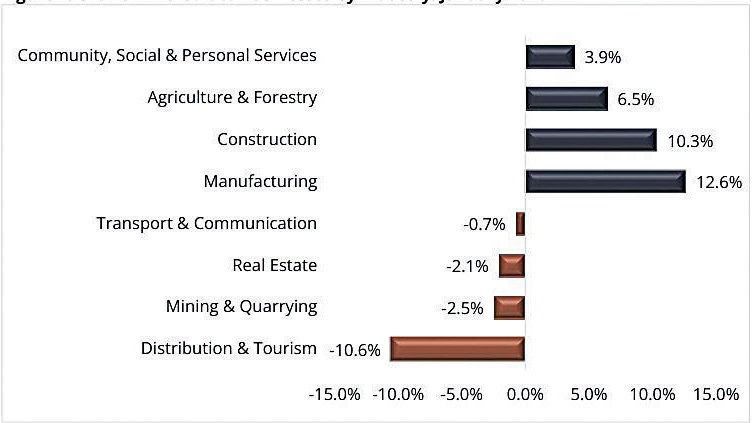
Among the sectors that experienced reduced access to credit were:
- Distribution and tourism, which fell by 10.6 per cent
- Mining and quarrying, which declined 2.5 per cent
- Real estate, which dropped 2.1 per cent
- Transport and communications, which declined 0.7 per cent
However, the data also revealed strong growth in other productive sectors of the economy.
Manufacturing recorded a 12.6 per cent increase in credit, while construction grew by 10.3 per cent and agriculture and forestry expanded by 6.5 per cent. Community, social and personal services also recorded a growth of 3.9 per cent.
*…
… banking sector liquidity declines
MBABANE – The liquidity position of the banking sector also weakened during the period under review.
Domestic liquid assets declined 7.9 per cent month-on-month, although they remained 17.4 per cent higher on an annual basis, reaching E10.6 billion. The decline was mainly attributed to a significant reduction in commercial banks’ balances held at the Central Bank. As a result, the liquidity ratio dropped to 37.6 per cent, compared to 40.9 per cent in December 2025.
Despite the decline, the ratio remains well above the regulatory minimum, indicating that the banking system continues to maintain sufficient liquidity to meet its obligations.
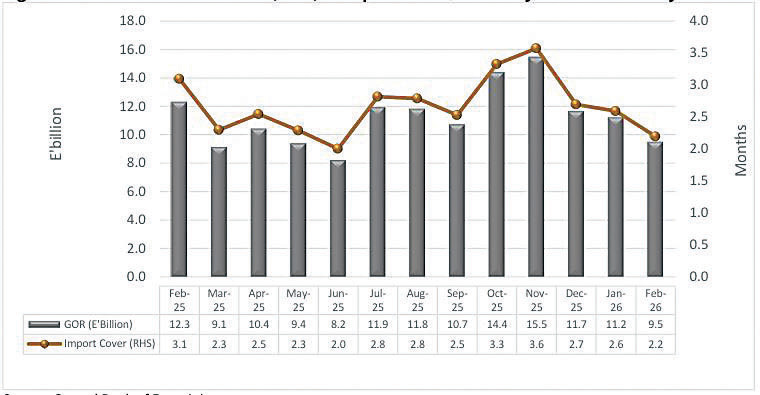
One of the most notable developments in the report was the significant decline in the country’s foreign reserves. Provisional gross official reserves stood at E9.5 billion in February 2026, representing a 15.3 per cent decline from January and a 22.8 per cent drop year-on-year.
The Central Bank said the drawdown in reserves was mainly driven by foreign currency outflows linked to transactions with commercial banks, as well as the settlement of government fiscal obligations.
*Full article available on Pressreader*


















Leave a comment