


MBABANE – The Eswatini Standards Authority (ESWASA) has taken a significant step towards strengthening the country’s industrial competitiveness.
This follows the signing a memorandum of understanding (MoU) with the South African Bureau of Standards (SABS).
This is a move expected to enhance product quality, certification processes and market access for local businesses. The agreement, signed last week, formalises a two-way partnership between the two national standards bodies, focusing on the sharing of knowledge, technical expertise and best practices.
It also opens the door for collaboration in conformity assessment services such as product testing and certification, capacity building and participation in standards development initiatives.
At its core, the partnership is designed to position Eswatini’s products to compete more effectively in both regional and global markets by aligning them with internationally recognised standards.
Speaking during the signing ceremony, ESWASA Executive Director Ncamiso Mhlanga described the MoU as a strategic milestone that would deepen cooperation between the two institutions and accelerate the development of Eswatini’s standards ecosystem.
“This is a very important MoU that will shape our future collaboration as institutions,” said Mhlanga. “It will allow us to leverage their extensive experience and ensure that we can work together effectively.”
The partnership brings together two institutions at different stages of development. SABS, with over 80 years of experience, is among the most established standards organisations on the African continent, while ESWASA, established in 2007, is still building its institutional capacity.
Through the agreement, ESWASA is expected to benefit from SABS’s longstanding expertise in standards development, quality assurance systems and certification processes—areas that are critical for boosting industrial productivity and export readiness.
*…
… partnership boosts Eswatini export potential
MBABANE – Mosley-Lefatola revealed that dedicated technical committees have already been established to oversee the execution of the agreement, with a six-month review timeline set to assess progress and ensure accountability.
He further highlighted that the partnership is structured to deliver direct benefits to the business community, particularly small and medium enterprises (SMEs), which often face barriers in accessing standards, certification services and technical knowledge. “The intention is to make sure that enterprises in Eswatini truly gain from this MoU,” he said. “We want to see real impact on industry and society.” For local businesses, improved access to standards and certification processes is expected to reduce compliance costs, enhance product quality and unlock new export opportunities, particularly within regional trade frameworks such as the Southern African Development Community (SADC) and the African Continental Free Trade Area (AfCFTA).
The MoU will run for an initial period of three years, after which both institutions will evaluate its effectiveness and determine whether to renew the agreement based on achieved outcomes. Importantly, both ESWASA and SABS stressed that the collaboration is not a one-sided transfer of knowledge, but a mutually beneficial partnership. While ESWASA stands to gain from SABS’s extensive experience, SABS also expects to benefit from shared insights and regional collaboration. “Even though we have over 80 years of experience, it does not mean we know everything,” Mosley-Lefatola said. “We believe this collaboration will also enrich us through shared learning.”
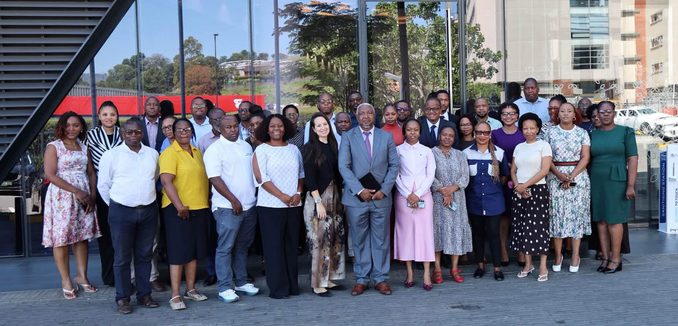
The agreement comes at a time when Eswatini is increasingly prioritising industrialisation, export diversification and value addition as part of its broader economic development agenda. Strengthening standards and quality infrastructure is widely regarded as a critical enabler in achieving these objectives. Prior to signing the MoU, ESWASA hosted the Eswatini Standards Seminar at Royal Villas under the theme: “Unlocking Export Markets for Local Businesses through Standards and Quality Compliance.” The seminar brought together key stakeholders from government, industry and regional standards bodies to drive a shared vision of positioning Eswatini as a competitive export-led economy.
*Full article available on Pressreader*

















Leave a comment