MBABANE – Eswatini attracted approximately E810 million (US$45 million) in foreign direct investment (FDI) during 2025, marking a sharp decline from the E2.41 billion (US$134 million) recorded a year earlier.
This is according to the latest World Investment Report 2026 released by the United Nations Conference on Trade and Development (UNCTAD).
Despite the decline in fresh investment inflows, the country’s overall stock of foreign investment continued to grow, signalling sustained investor confidence in existing operations.
The report shows that while new investment entering Eswatini fell by about 66.4 per cent year-on-year, the country’s cumulative inward FDI stock increased from US$1.044 billion (about E18.8 billion) in 2024 to US$1.175 billion (approximately E21.2 billion) in 2025. This means that although fewer new projects and investments were recorded during the year, foreign-owned businesses already operating in Eswatini continued to retain and expand their investments, adding to the country’s long-term investment base. Foreign direct investment is widely regarded as one of the most important drivers of economic development, bringing capital, employment opportunities, technology transfer, export growth and managerial expertise into host economies. For a small, open economy such as Eswatini, attracting sustained foreign investment remains central to government’s ambitions of accelerating industrialisation, diversifying exports and creating jobs.
The latest figures, therefore, present a mixed picture. On one hand, the significant reduction in annual inflows suggests that fewer new investment projects reached financial close during the reporting period.
On the other, the continued growth in the country’s FDI stock demonstrates that multinational companies already established in Eswatini maintained confidence in their operations and continued committing capital to the local economy.
Neighbours present mixed fortunes
MBABANE – Eswatini’s decline mirrors broader developments across Southern Africa, although neighbouring countries recorded markedly different performances.
South Africa, the region’s largest economy, remained the biggest recipient of foreign direct investment, attracting US$3.903 billion (approximately E70.3 billion) during 2025. However, this represented a significant decline from US$9.280 billion (around E167 billion) received in 2024, illustrating the challenging investment environment facing even Africa’s most diversified economy.
Mozambique maintained its strong position among the continent’s leading investment destinations after attracting US$2.509 billion (about E45.2 billion), marginally improving on the US$2.458 billion recorded the previous year.
The country’s continued success has largely been underpinned by substantial investments in liquefied natural gas projects, energy infrastructure and extractive industries, which continue to draw multinational corporations despite periodic project delays.
Namibia emerged as one of Southern Africa’s strongest performers after more than doubling its foreign investment inflows to US$2.303 billion (approximately E41.5 billion), compared to US$1.072 billion (about E19.3 billion) in 2024. The remarkable increase reflects growing international interest in the country’s emerging oil and gas discoveries, renewable energy developments and critical minerals sector.
Zambia also staged a notable turnaround. After recording a net investment outflow of negative US$65 million in 2024, the country attracted US$641 million (around E11.5 billion) in fresh FDI during 2025, signalling renewed investor confidence following policy reforms and continued expansion in copper mining investments.
Zimbabwe similarly strengthened its investment performance, increasing inflows from US$395 million to US$635 million (approximately E11.4 billion), while Malawi also recorded modest growth, attracting US$214 million compared to US$199 million the previous year.
The comparison highlights the increasingly competitive race among African countries to attract scarce international investment capital.
While some economies benefitted from large-scale investments in natural resources and energy projects, others, including Eswatini and South Africa, experienced weaker inflows amid heightened global uncertainty and more cautious investment decisions.
Global FDI up by 6% to reach US$1.6 trillion
MBABANE – In 2025, global foreign direct investment rose by 6 per cent to reach US$1.6 trillion.
However, this growth masks underlying fragility and disparities across countries, regions and sectors.
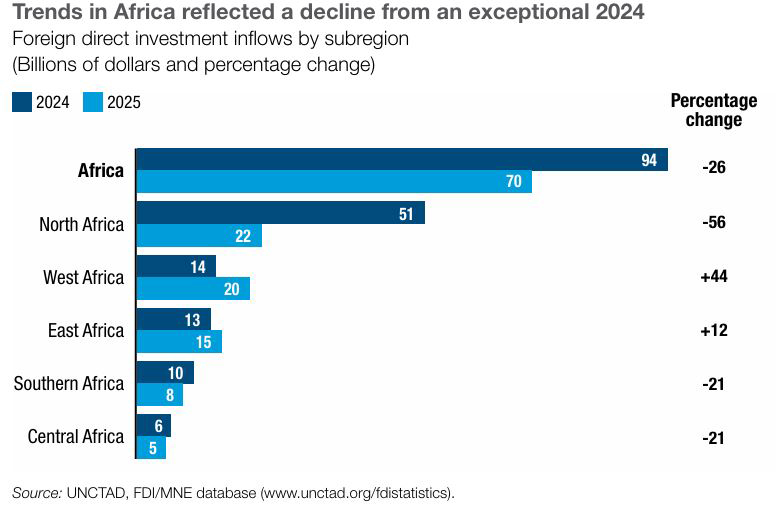
According to the report, investment expansion was driven largely by a small number of megaprojects, particularly infrastructure related to artificial intelligence. Across most sectors, new project activity is subdued, reflecting heightened investor uncertainty amid geopolitical tensions, trade policy volatility, the rising cost of capital and intensifying technological competition. At the same time, global investment is being reshaped by fault lines in international cooperation and rising economic security concerns. In response, governments are focusing on a narrow set of strategic sectors, while firms are redesigning supply chains along regional and geopolitical lines. The opportunities and risks are many. Developing economies may break into new high growth industries, including clean energy and advanced manufacturing, but investment could become concentrated, leaving many behind. Monitoring by UNCTAD shows that governments are becoming increasingly active in shaping investment flows, with new investment policy measures reaching a record high in 2025. Among those measures are strong support for strategic sectors, industrial upgrading, digital transformation and the green transition.
Now is the time to reinvigorate international cooperation around investment as a driver of sustainable development, as developing countries build and strengthen the systems their people require. UNCTAD says governments must also rally behind the Sevilla Commitment’s global call to address the limited access to finance faced by developing countries, and scale up investment at speed and scale. The analysis and recommendations of UNCTAD offer important guidance for policymakers and development advocates to navigate an increasingly complex economic environment and harness international investment for sustainable and inclusive growth.