

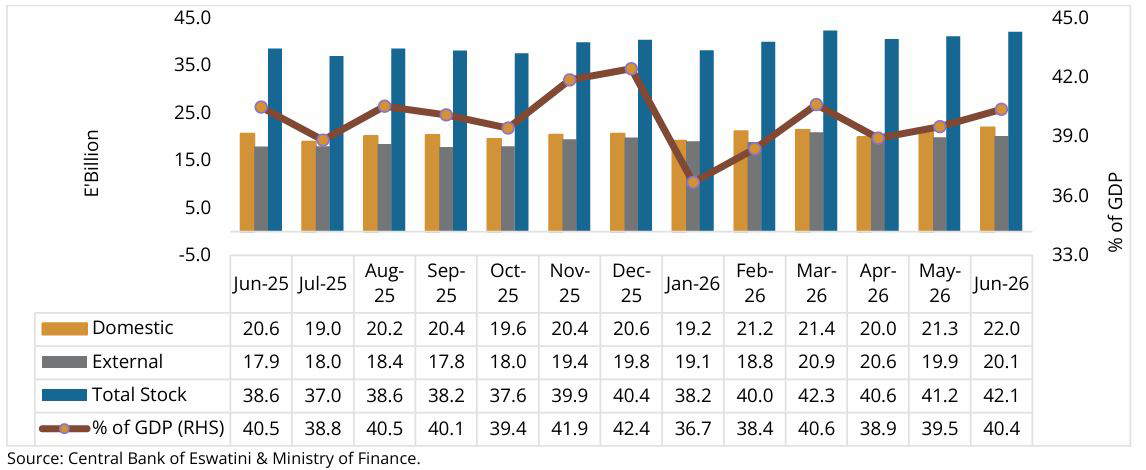
MBABANE – The country’s public debt rose by 2.2 per cent to E42.1 billion at the end of June 2026.
It was driven by increased domestic borrowing and a slight rise in external debt, according to the Central Bank of Eswatini.
The latest Recent Economic Developments (RED) report shows that total public debt increased from E41.2 billion recorded at the end of May to E42.1 billion in June, representing 40.4 per cent of gross domestic product (GDP).
The Central Bank attributed the increase to growth in both domestic and external debt during the month under review.
The latest figure represents an increase of E900 million within a month. Domestic debt remained the larger component of government’s debt portfolio, rising to E22.0 billion, equivalent to 21.1 per cent of GDP, from E21.3 billion in May.
This represented a 3.4 per cent month-on-month increase.
According to the report, the increase was mainly driven by an additional E500 million advance extended to government, together with higher issuances of Treasury Bills and privately on placed government bonds during June.
The report further noted that non-bank financial institutions (NBFIs) continued to dominate holdings of long-term government securities, while commercial banks remained the primary investors in short-term instruments.
“This reflects the distinct investment preferences of their respective portfolios,” the Central Bank observed.
Public external debt also increased, although at a slower pace.
At the end of June, external debt stood at E20.1 billion, equivalent to 19.3 per cent of GDP, compared with E19.9 billion recorded in May.
The 1.0 per cent increase was largely attributed to the slight depreciation of the Lilangeni against major foreign currencies in which government debt is denominated, particularly the United States Dollar.
The report indicates that exchange rate movements continue to influence the value of the country’s external debt obligations even in the absence of significant new foreign borrowing.

















Leave a comment