

MBABANE – Everyday consumers are facing a fresh wave of financial pressure as basic necessities become significantly more expensive over the next 12 months.
This is according to the latest Chief Economists’ Outlook released by the World Economic Forum (WEF) yesterday.
The report builds on extensive consultations and surveys with chief economists from the public and private sectors, organised by the World Economic Forum’s Centre for the New Economy and Society. The report supports the WEF’s Future of Growth Initiative, a space for exchange and collaboration to enable greater competitiveness and economic transformation. The survey featured in this edition was conducted from August 4 to 20, 2026.
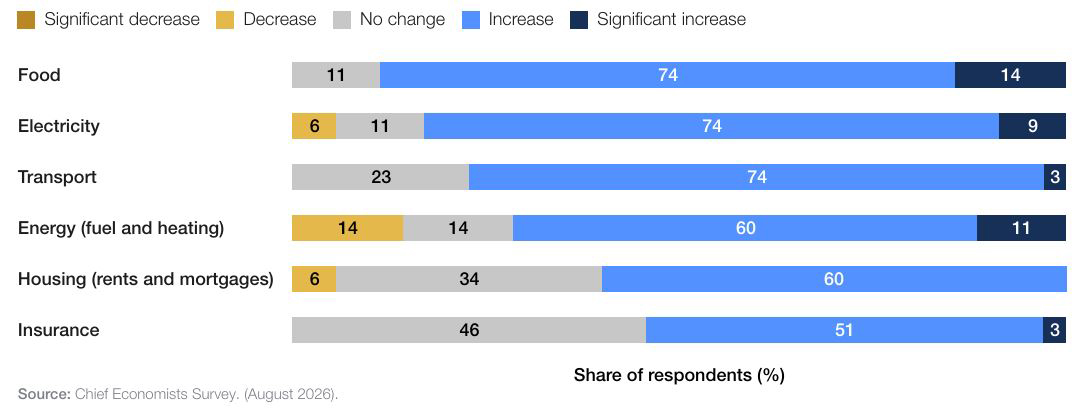
The report warns that household budgets worldwide will feel the pinch as essential items drive a renewed cost-of-living squeeze. An overwhelming 88 per cent of chief economists surveyed expect food prices to rise, while 83 per cent predict higher electricity bills and 77 per cent foresee increases in transport costs.
As a result, real incomes, the actual buying power of a paycheck after taking inflation into account, are expected to either stagnate or shrink across most regions. Sub-Saharan Africa faces a particularly difficult outlook: 31 per cent of chief economists expect inflation-adjusted household earnings to drop over the coming year, while 42 per cent expect earnings to remain flat.
Only a few emerging Asian economies, such as India and South-East Asia, are projected to see meaningful real income growth.
What makes this upcoming squeeze particularly difficult for families is that governments have far less room to help.
Since 2020, State intervention, such as stimulus checks, energy subsidies and emergency relief programmes served as the single biggest buffer protecting households and businesses from global shocks. Sixty-nine per cent of economists point to government spending as the main pillar of economic resilience over the past four years.
However, only 28 per cent of economists expect governments to play that protective role over the next year.
High public debt burdens and depleted national coffers mean States no longer have the financial capacity to cushion families from price hikes.
“Government support played a critical role in navigating successive crises, but fiscal capacity is likely to be more constrained going forward,” noted Attilio Di Battista, Head of Economic Growth and Transformation at the WEF. “The priority now is to strengthen the foundations of resilience before the next shock arrives.”
With limited funds, governments are expected to rely on quick, broad-brush relief measures rather than direct cash payouts. Sixty per cent of economists expect States to reduce taxes on basic goods, 54 per cent expect consumption subsidies and 50 per cent anticipate price caps.
Only 26 per cent expect targeted cash transfers to low-income households.

















Leave a comment