


MALKERNS- South African singer-songwriter Wandile Mbambeni says Africa’s future depends on people embracing their identity and preserving authentic stories through music and art.
Fresh from a stirring performance of his acclaimed song ‘I Don’t Regret It’ on the Honeycomb Stage at the Standard Bank Luju Food and Lifestyle Festival, South African singer-songwriter Wandile Mbambeni said the future of Africa rests on one simple principle: telling authentic stories without apology.
His message could not have been more fitting for this year’s festival theme, ‘A Return to the African Future’, which encouraged festivalgoers and artists to celebrate African identity while reimagining the continent’s future through culture, food, music and creativity.
Mbambeni, whose music blends soul, folk and Afro-inspired sounds with deeply personal storytelling, said returning to the African future was not about going backwards but reconnecting with values and wisdom that had always existed. “I think time is such a weird thing because we come from somewhere, but that somewhere is here and now, and we’re also going towards that somewhere,” he said during an interview after his performance.
He said the journey was about aligning himself with those who came before him. “I feel like I pray every day to God to guide me on that same path. It’s aligning myself with what our forefathers walked before us.”
The Johannesburg-based artist, originally from South Africa’s Eastern Cape, has built a reputation as one of the country’s most thoughtful singer-songwriters. Rather than relying on elaborate productions, he has become known for emotionally honest lyrics that explore identity, healing, vulnerability and human connection.
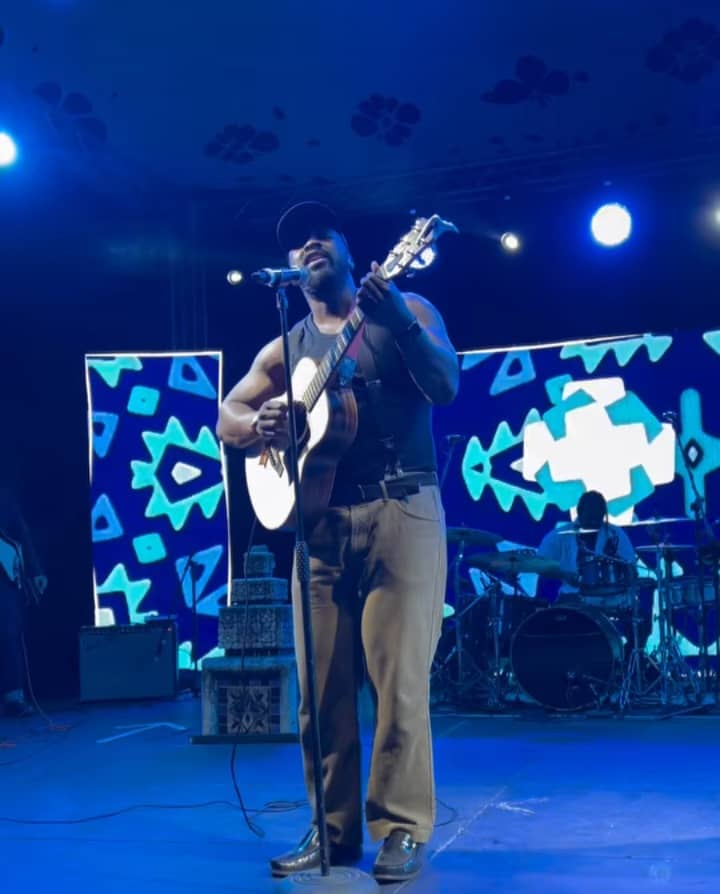

That honesty was evident as he performed ‘I Don’t Regret It’, a song that has become one of his signature works. The emotionally charged performance had festivalgoers gathered around the Honeycomb Stage, with many singing along as Mbambeni delivered the heartfelt lyrics with quiet conviction.
For the musician, however, the real power of music lies beyond entertainment.
He said every song becomes a historical document that captures the emotions, struggles and realities of a particular moment in time. “I document my story as it is. I’m not trying to be anybody but me,” he said. “I know that in a hundred years people may ask, ‘Why did he write like this? Why was he feeling that way?’ That’s why documenting my story is important.”
Mbambeni said he deliberately performs and records music under his family name because he wanted future generations to know where he came from. “I am a footprint of history,” he said.
“That’s why I keep my name. People will ask who the Mbambenis were, who those people were. That’s important to me.”
He said African identity today could no longer be confined to traditional clothing or cultural symbols alone. Instead, he believes modern Africans express their identity through confidence, creativity and authenticity. “We are boldly and proudly African just by the way we take up stages, by the way we create our art and by the way we dress,” he said.
“I don’t even think I make the decision to be proud to be African anymore. It’s just who I am.”
Looking around the festival grounds, Mbambeni said Luju itself reflected that confidence.
Artists, designers, chefs, entrepreneurs and festivalgoers were celebrating African excellence naturally rather than trying to imitate anyone else.
He said this was evidence that African identity had become self-defined. “We’re proudly African because that’s simply who we are.”
As a songwriter, Mbambeni believes simplicity often carries the greatest emotional weight.
While he appreciates the sophistication of jazz and technically complex music, he said he eventually realised that audiences connect most with honesty. “For me, it’s three chords and the truth,” he said.
“What is the story? That’s always what matters.”
The singer also spoke candidly about the healing power of music, revealing that one of the most defining moments of his career came after releasing a song he had almost abandoned.
He said he had kept the track unreleased for two years because he feared exposing his vulnerability to the world. “I thought people would think I was weak,” he admitted.
When he finally released the song, it unexpectedly became the piece of music listeners connected with most.
People began approaching him to explain how the song had helped them through difficult moments in their own lives.
“That song has healed so many people,” he said.
“And sometimes I get confused because I realise that’s how God works.” The experience fundamentally changed how he viewed art.
He now believes musicians should not create for applause, awards or commercial success.
Instead, they should focus on honestly documenting their lives, trusting that the work will eventually reach those who need it.
“It’s not about you,” he said. “It’s bigger than you. My role is simply to create it and put it out there.”
That philosophy resonated with the spirit of Luju, a festival that has grown into one of Southern Africa’s premier cultural events by placing African stories, heritage and innovation at its centre.
Long after the performances have ended and the festival’s audiences have gone home, he believes it is those truthful stories that will continue speaking to generations yet to come.
















Leave a comment