

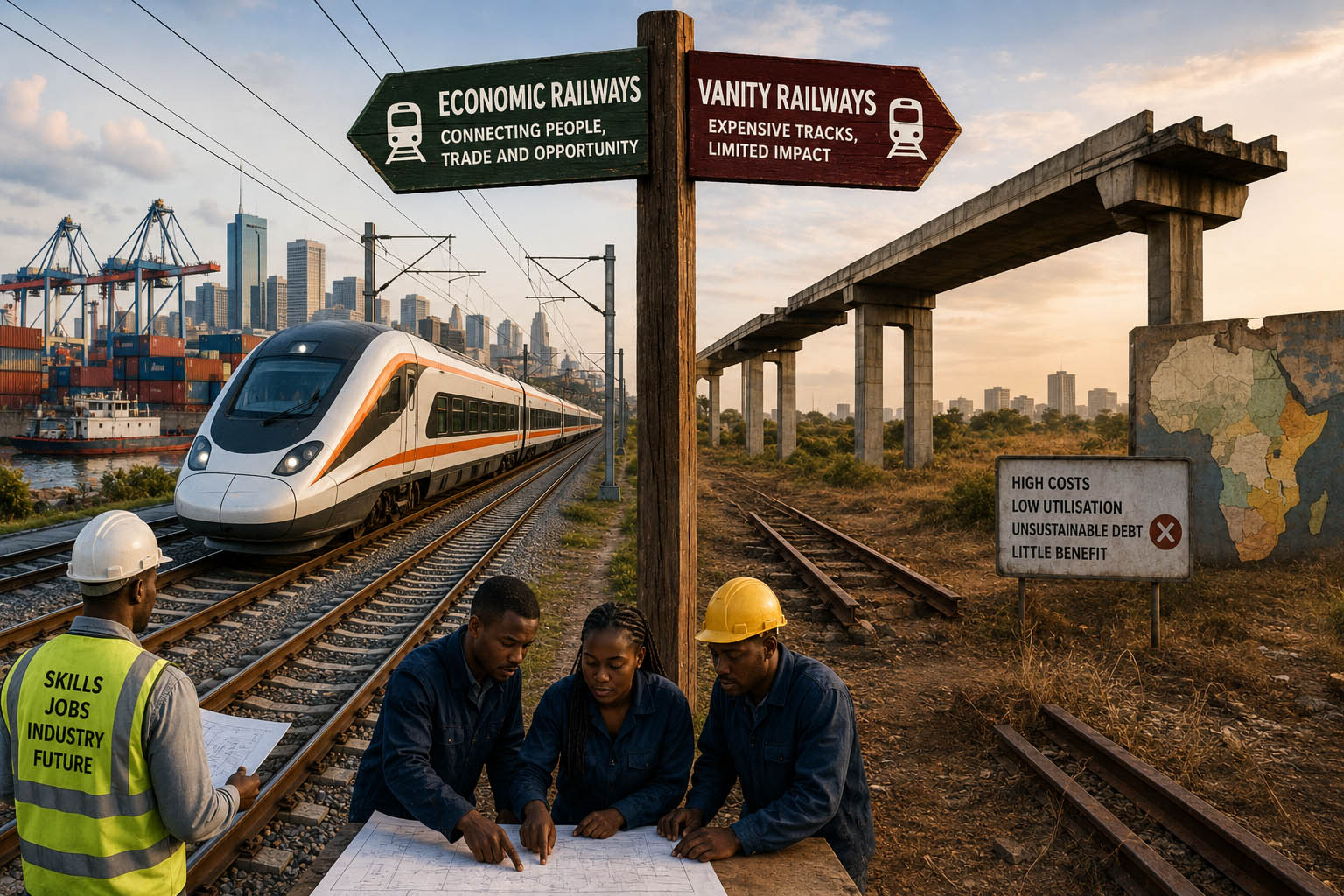
Africa has never lacked grand railway dreams. What it has lacked is the money, planning, technical capacity and in some cases, patience to turn those dreams into economically sustainable networks.
The latest debate brings into focus a question beyond the celebration of steel tracks and faster journeys: Is Africa ready to build railways at the scale proposed and can these investments pay for themselves?
The answer is neither an enthusiastic yes nor an outright no. Rail can work in Africa. The evidence is already there. Morocco has built Africa’s first high-speed railway, while Tanzania has been developing a standard-gauge network connecting Dar es Salaam with the country’s interior and neighbouring States. Ethiopia has connected Addis Ababa to Djibouti by an electrified railway, giving the landlocked country a direct route towards the sea. South Africa has maintained one of the continent’s most extensive and economically important freight railway systems.
These examples show that railway development is not inherently an African white elephant. The issue is whether governments build the right railway for the right economic purpose. Morocco offers a useful lesson. Its high-speed network forms part of a wider transport system. In July 2026, the African Development Bank approved €205 million to support its expansion. Tanzania is pursuing a different model, developing standard-gauge rail around freight, passengers and regional trade. Its 2 560-kilometre network is intended to connect Dar es Salaam with inland trade corridors and eventually neighbouring countries. The first 722-kilometre section has been operational since 2024, with freight services added in 2025. Rail becomes economically useful when it connects production to markets. A railway carrying minerals, agricultural products, manufactured goods and imports between ports and inland economies has a stronger commercial case than one built primarily because a government wants a modern-looking train.
The East African has reported that Tanzania’s SGR is already moving thousands of passengers daily between Dar es Salaam and Dodoma, while officials say it is generating wider economic activity for the country’s port and revenue authorities.
Kenya provides a cautionary lesson. Its Standard Gauge Railway has improved passenger and freight connectivity between Mombasa and Nairobi, but its wider expansion has faced financing difficulties. The Kenyan experience shows that building a railway does not automatically make it financially self-sustaining.
This brings another question into focus: Can African governments afford railways before they can afford the institutions required to run them?
Building the track is only the beginning. Railways require signalling engineers, locomotive engineers, civil engineers, electrical engineers, mechanical technicians, safety specialists, planners, economists, train drivers, maintenance crews and managers capable of operating complex systems over decades.
Does Africa have these skills? Increasingly, yes, but not in sufficient numbers everywhere. Kenya and Ethiopia show what can happen when railway projects include technology and skills transfer. Engineers and workers have gained exposure to construction, signalling, operations and maintenance.
That is perhaps the most important lesson. Africa should not merely buy railways. It must acquire the knowledge to build, maintain and eventually design them.
The African Development Bank appears to recognise the gap. In May 2026, it announced a partnership with Germany’s DB Engineering & Consulting to explore an African Rail Competence Centre focused on railway knowledge, innovation and skills development. Former African Development Bank president Akinwumi Adesina described Tanzania’s railway project as a ‘cornerstone of East Africa’s regional integration vision’, linking the port of Dar es Salaam with landlocked countries through a modern transport system. Tanzania’s President Samia Suluhu Hassan has also described railway expansion as a pathway to the country’s future. Her government has argued that connecting Tanzania to Uganda, Rwanda, Burundi and the Democratic Republic of Congo can turn the country into a regional logistics hub. Nonetheless, optimism must be matched by mathematics. Africa’s infrastructure needs are enormous. Governments must choose between rail, electricity, roads, water, healthcare, education and digital infrastructure. Borrowing billions for a railway that cannot generate enough freight or passengers can leave future generations paying for infrastructure that never reaches its potential.
There is another danger: Copying China’s railway experience without copying the economic conditions that made its expansion possible. A railway cannot create demand indefinitely. It needs cargo, passengers, reliable electricity, efficient ports, functioning customs systems and industries producing goods worth transporting. This is why Africa needs fewer vanity railways and more economic railways. The most viable projects will link mines to ports, farms to markets, factories to consumers and landlocked countries to the sea. They should be designed across countries rather than stopping at national boundaries.
Tanzania’s experience provides a useful example. The Central Corridor already links Dar es Salaam to Burundi, Rwanda, Uganda and parts of the Democratic Republic of Congo, with rail forming part of a wider road, port and inland-waterway system.
The continent has engineers and young people capable of building this future. It needs a system for producing more of them. Projects should include apprenticeships, technical college partnerships, university programmes and requirements for foreign contractors to transfer knowledge.
Governments must also think beyond construction. Who will maintain locomotives after 15 years? Who will repair signalling equipment? Who will manufacture components locally? Who will manage safety? Who will train the next generation when today’s engineers retire?
These questions can determine whether a railway becomes an economic asset or an expensive monument. The railway question is ultimately not whether Africa can afford to build rail. It is whether Africa can afford to build rail without building the skills, industries and economic systems that make the railway pay.

















Leave a comment