

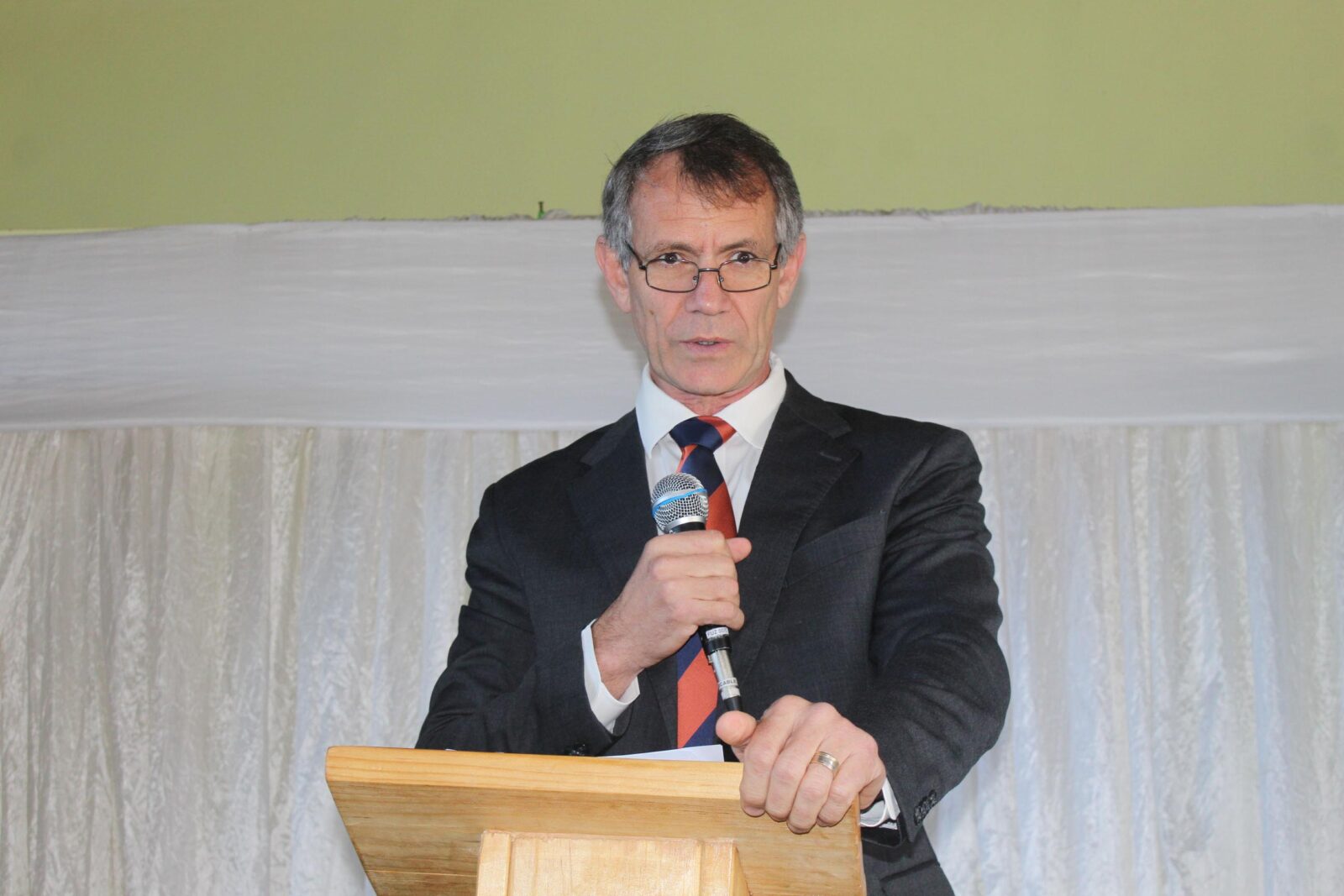
MBABANE – Government plans to raise another E1.5 billion as concerns grow that economic growth is benefiting wealthy emaSwati more than ordinary households.
Finance Minister Neal Rijkenberg said government still needed to raise about E1.5 billion during the current financial year to meet pressure on its finances and fund capital projects.
The announcement comes as government continues to borrow money while the country’s economy grows.
However, Minister for Economic Planning and Development Dr Thambo Gina has admitted that economic growth does not necessarily mean ordinary citizens will see an improvement in their living standards.
Gina said this was partly because of Eswatini’s high income and wealth inequality.
His comments came after Senator Dr Stukie Motsa asked whether ordinary citizens actually feel the benefits when the country’s gross domestic product (GDP) grows.
GDP is the total value of goods and services produced in the country.
Gina said income and wealth remained concentrated among a small section of society.
“This means a growth in GDP is likely to be felt by the wealthiest in society,” he said.
Government expects the economy to grow by 5.6 per cent in 2025, while the International Monetary Fund (IMF) has projected growth of 4.9 per cent.
Gina said the expected growth was mainly being driven by major public and private investments.
These include renewable energy projects, the Mkhondvo-Ngwavuma Water Augmentation Project, new Central Bank facilities and new textile and agribusiness investments.
However, he warned that growth alone would not automatically improve the lives of all emaSwati.
The country’s high levels of inequality mean that the benefits of growth can remain concentrated among those who already have more income and wealth.
A significant number of emaSwati also continue to live below the poverty line.
Gina said government, therefore, needed to make economic growth more inclusive so that its benefits reached more households.
His admission raises questions about whether the billions being borrowed and spent on development projects are translating into better jobs, incomes and services for ordinary people.
Meanwhile, as government is preparing to raise another E1.5 billion, its total public debt fell by E652.48 million between March and June this year.
According to the Ministry of Finance’s First Quarter Report for the 2026/27 financial year, public debt stood at E41.84 billion at the end of June.
This was equal to 40.47 per cent of GDP.
The debt consisted of E21.48 billion owed to lenders within Eswatini and E20.36 billion owed to foreign lenders. At the end of March, total public debt stood at E42.49 billion.
The reduction means government’s total debt dropped by about E652.48 million over the three months. However, domestic borrowing increased slightly from E21.36 billion in March to E21.48 billion in June.
Government said the increase was mainly caused by more borrowing through Treasury Bills and government bonds.
Foreign debt, meanwhile, fell from E21.14 billion to E20.36 billion.
Government attributed part of this decline to slower implementation of capital projects, which meant less foreign funding was drawn during the quarter.
Foreign funding received during the three months amounted to E134.21 million, down sharply from E968.76 million in the previous quarter.
This was a reduction of about E834.55 million.
Despite the fall in the total debt stock, government spent E2.42 billion on debt service during the three months. Debt service includes repayments on borrowed money as well as interest charged on the loans.
The amount was slightly lower than the E2.49 billion spent during the previous quarter. Domestic debt service fell from E1.92 billion to E1.89 billion, while payments on foreign debt declined from E565.40 million to E532.18 million.
The figures show that even when government’s total debt falls, large amounts of money still have to be set aside to service existing loans.
This is where University of Eswatini Economics Lecturer Sanele Sibiya said government should be careful before taking on more debt.
Sibiya said the planned E1.5 billion borrowing should not simply be viewed as a way of filling a gap in government finances.
He said government needed to show what the borrowed money would do for the economy and how it would eventually help repay the debt.
“The debt must generate an ability to repay the commitment.”
Sibiya said borrowing could be useful if the money was invested in projects that created jobs, increased production, supported businesses and generated more revenue for government.
The problem, he said, arose when government borrowed money without a clear economic return. His warning comes as government expects to spend E36.92 billion during the current financial year.
Of this amount, E7.78 billion has been set aside for capital projects. However, the budget has a deficit of E5.02 billion, meaning government plans to spend more than it currently has available.
Rijkenberg said government therefore needed additional funding.
He said the money was needed partly because of major commitments, including the civil service salary review, completion of the International Convention Centre and road construction.
Some of these commitments, he said, had not been included in the original budget.
“Most of them were the right thing to do. I’m not saying any of these things were the wrong thing to do, but unfortunately the money wasn’t in the budget, meaning now we have to go and raise money and call it budget support,” Rijkenberg said.
The minister said budget support did not necessarily mean borrowing money to pay salaries or other daily government expenses.
It could also be used to fund capital projects that government had decided to proceed with before all the money had been raised.
Rijkenberg said government’s budget was fully financed on paper, but the actual money had not yet all been raised.
This has left the E1.5 billion funding gap.











Leave a comment