

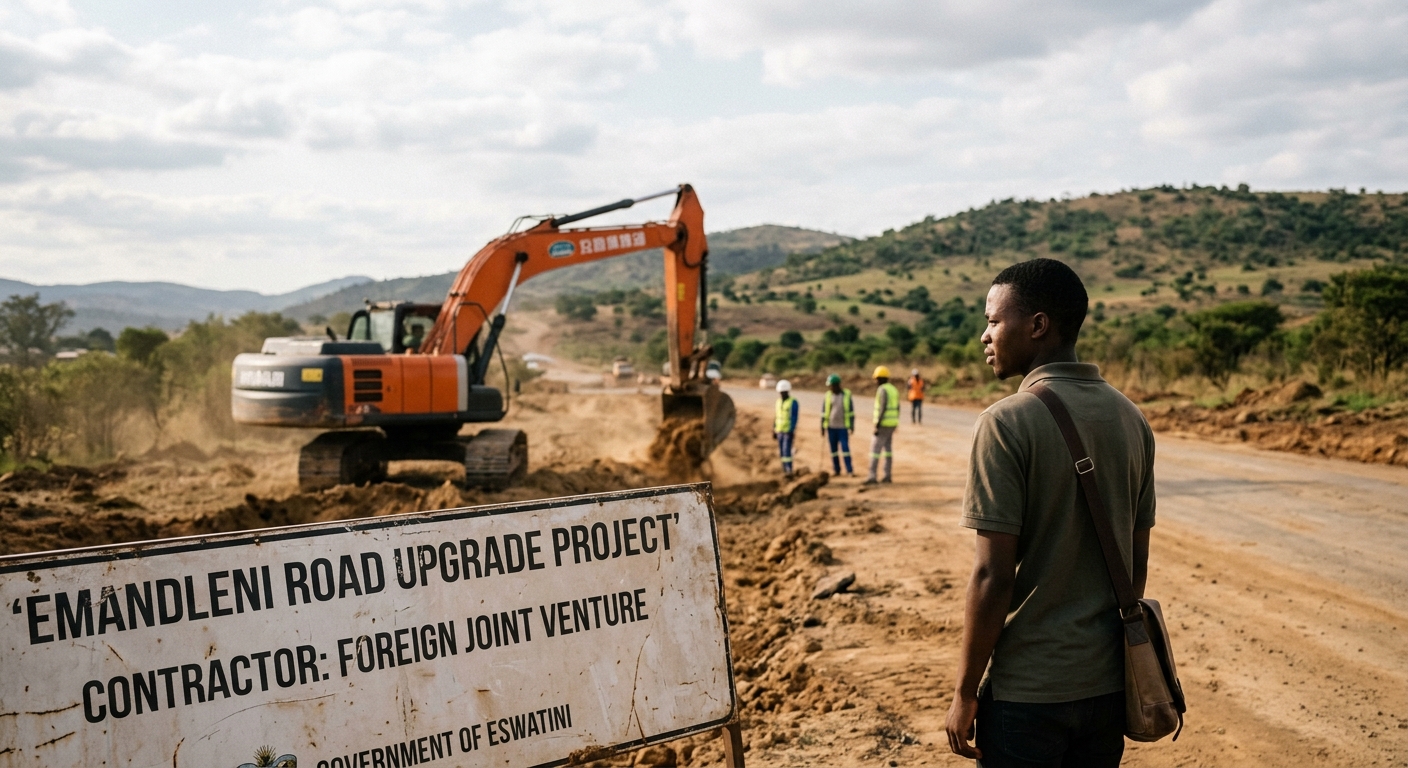
There is a particular kind of hope that comes with seeing a road being built. You hear the trucks before you see them. Then the earthmovers arrive, chewing up the ground. Dust gets everywhere. The traffic slows down. Somebody has put up a project sign with the names of important people on it.
You stand there watching all this and think: ‘Maybe things are finally moving.’
The Construction Industry Council has now put a number to that feeling. Foreign contractors accounted for 55 per cent of Eswatini’s registered construction project value in 2025/26, with foreign works worth about E6.13 billion.
E6.13 billion. That’s not money. That’s a national argument.
And here is the part that makes you scratch your head: About 80 per cent of the total registered construction value came from government and parastatal projects. And then E6.13 billion worth of construction value is sitting under foreign contractors. You start wondering whether we have built the road or simply built a very expensive place to stand and watch somebody else work.
Now, before somebody accuses me of saying foreigners must leave, no. If Eswatini does not have the technical capacity to build something, bring somebody who can. Please.
Bring the expertise. But then leave something behind. Train the engineer. Grow the contractor. Develop the supplier. Transfer the technology. Build the local company until one day the foreign company arrives and discovers that there is nothing left for it to teach us. The CIC says foreign firms are concentrated in fewer, larger and more technically complex projects, while local firms account for most registered projects.
The small contractor is doing smaller jobs while the really big money is somewhere behind the fence. Then comes the graduate.
He has the degree. He has the CV. He has applied everywhere. He has sent the email. He has followed up. He has even sent the WhatsApp message beginning with:
‘Good morning, Sir. I hope you are well…’
That sentence has employed nobody, but every unemployed graduate knows it by heart.
Then he sees a vacancy.
Experience required: Three years.
He graduated last year.
He calls.
‘Where do I get the three years’ experience?’
‘From working.’
‘And how do I work?’
‘You need experience.’
Everybody has a need. Nobody has a solution. Bread goes up. Fuel has just jumped by E3.43 a litre. You put E200 into the tank and watch the fuel gauge move like it is embarrassed to be associated with you.
Then you remember electricity. There is a proposal to increase electricity tariffs, with the full effect expected from April 1, 2027.
April Fools’ Day. You almost expect the electricity bill to say: ‘Surprise, bhuti.’
But somewhere between the filling station and the electricity meter is the question nobody wants to sit with for too long: “What happens to all the economic activity we are creating?”
This is because a construction boom should not only leave behind a road. It should leave behind companies that can build the next road. Workers who can build the next bridge. Suppliers who can supply the next project. Engineers who no longer need to ask for permission to enter their own industry. That is why the debate about foreign contractors is bigger than foreigners. It is about whether Eswatini is developing capacity or dependency. We have meetings about empowerment. We have workshops about empowerment. We have photographs of people discussing empowerment.
At this rate, empowerment itself is the most employed person in the country. The problem is not always the absence of a policy. Sometimes it is what happens after everybody has gone home.
Somebody has to implement it. Somebody has to enforce it. Somebody has to say: ‘This part stays here.’
They understand something simple: “If public money is being spent, the public should get more than the finished building.” Eswatini cannot keep celebrating the size of the project while ignoring the size of the opportunity leaving with it. They become people.
The contractor who cannot make payroll. The supplier waiting for another purchase order. The graduate refreshing his email. The family deciding whether to buy bread or put fuel in the car.
When somebody at home says; “We don’t have money.”
And somebody else says: “But there are billions being spent.”
Exactly.
There are billions being spent. The question is whether enough of that money is building us. And perhaps that is where our great heist begins.
Who took it? Where did it go? Was it tikoloshi’s? Did they come at night? Did they climb the bed on top set on top of the bricks, look around and say: ‘This place is lovely. Let’s take E6 billion.’
No. That would be too easy. The tikoloshis did not need a ladder. They needed a contract. They did not break into the country. They were invited.
And they did not steal the money. We signed it over.
So when the electricity bill arrives on April 1, 2027 and somebody asks why the country feels broke despite all this development, don’t look at the sky.
Don’t blame God. Don’t blame the tikoloshis.
Look at the road. Look at the project sign. Look at the tender.
Then look at the people holding the pens, because the great heist was never about ancestors forsaking Eswatini.
It was about us becoming spectators while our own money went to work for somebody else.















Leave a comment