

MBABANE – The Ministry of Economic Planning and Development has reported that Eswatini’s economy recorded marginal growth in the first quarter of 2025.
The economy expanded by 0.5 per cent compared to the previous quarter. However, on a year-on-year basis, the domestic economy contracted by 0.3 per cent in 2025 Q1, following a strong 5.6 per cent growth in the same quarter of 2024.
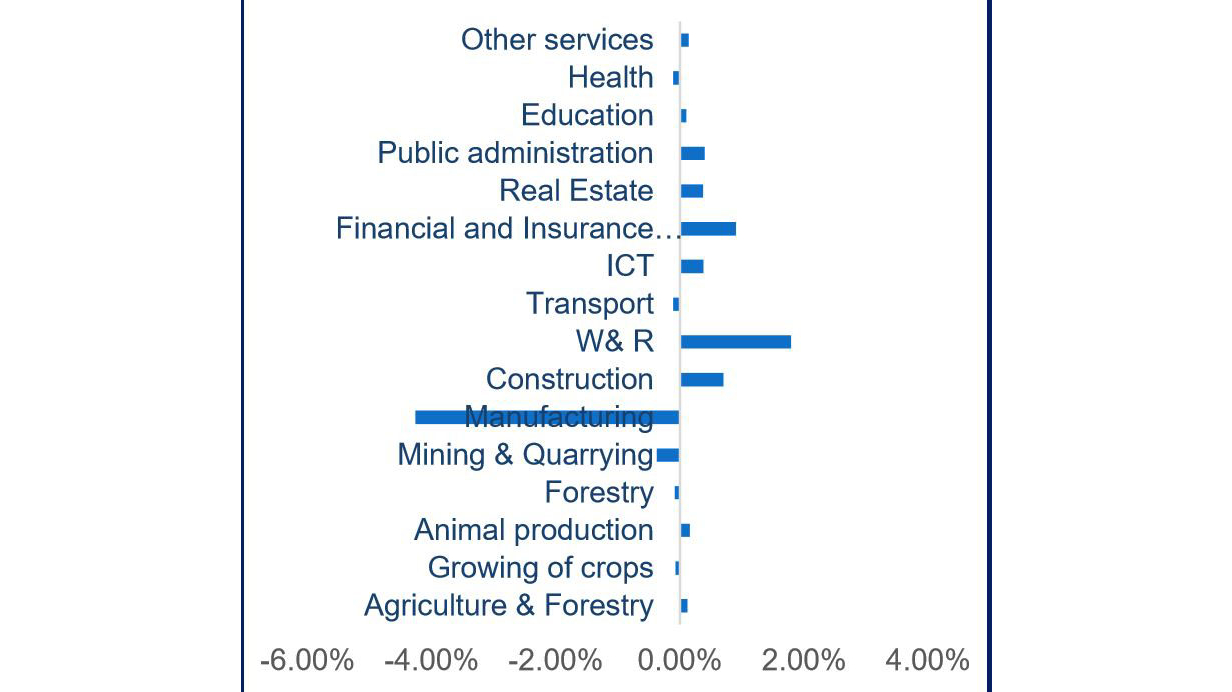
According to the Economic Bulletin for the First Quarter of 2025, the decline was mainly due to weak performances in the primary and secondary sectors, partly offset by strong activity in the tertiary sector.
The primary sector contracted by 7.3 per cent year-on-year, driven largely by declines in mining and quarrying (28.9 per cent), ‘forestry’ (2.0 per cent), and crop production” (9.5 per cent).
Despite these setbacks, the sector was supported by an 11.4 per cent increase in animal production, reflecting resilience in livestock farming.
The secondary sector posted a sharp decline of 10.2 per cent, mainly due to downturns in manufacturing (13.2 per cent), electricity (1.8 per cent), and water supply (7.2 per cent). Manufacturing was particularly hit in subsectors such as chemicals, wood products, beverages and fruit processing.
On a positive note, the construction subsector expanded by 25.9 per cent, buoyed by both private and public sector investments. Major projects such as the Mpakeni Dam, the International Convention Centre and Five-Star Hotel (ICC-FISH) and energy infrastructure developments significantly boosted the sector’s performance.
*…
Trade reflects shift to deficit
MBABANE – Trade data reflected a shift to deficit, with Eswatini recording a merchandise trade deficit of E325 million in 2025 Q2, following a surplus of E1.027 billion in the previous quarter.
Exports fell by 9.3 per cent to E10.093 billion, mainly due to reduced shipments of sugar (down 23.5 per cent), miscellaneous edibles (18.0 per cent) and textiles (2.7 per cent).
These three commodities account for more than half of Eswatini’s export value.
In contrast, forestry products (8.1 per cent) and food processing (16.0 per cent) posted gains.
Year-on-year, exports grew by 10.6 per cent. Regionally, exports to the Southern African Customs Union (SACU) – which accounts for 72.8 per cent of total exports – declined by 5.0 per cent, while exports to the rest of Sub-Saharan Africa rose 1.6 per cent. Exports to the European Union plummeted by 73.2 per cent, reflecting steep declines in sugar and beef exports.
*Full article available in our publication.



















Leave a comment