

MBABANE – The financial year 2024/25 proved to be a challenging one for the Royal Eswatini Sugar Corporation (RESCorp).
Yet, the company emerged resilient, reinforcing its ability to navigate increasing adversities, while laying the groundwork for future growth.
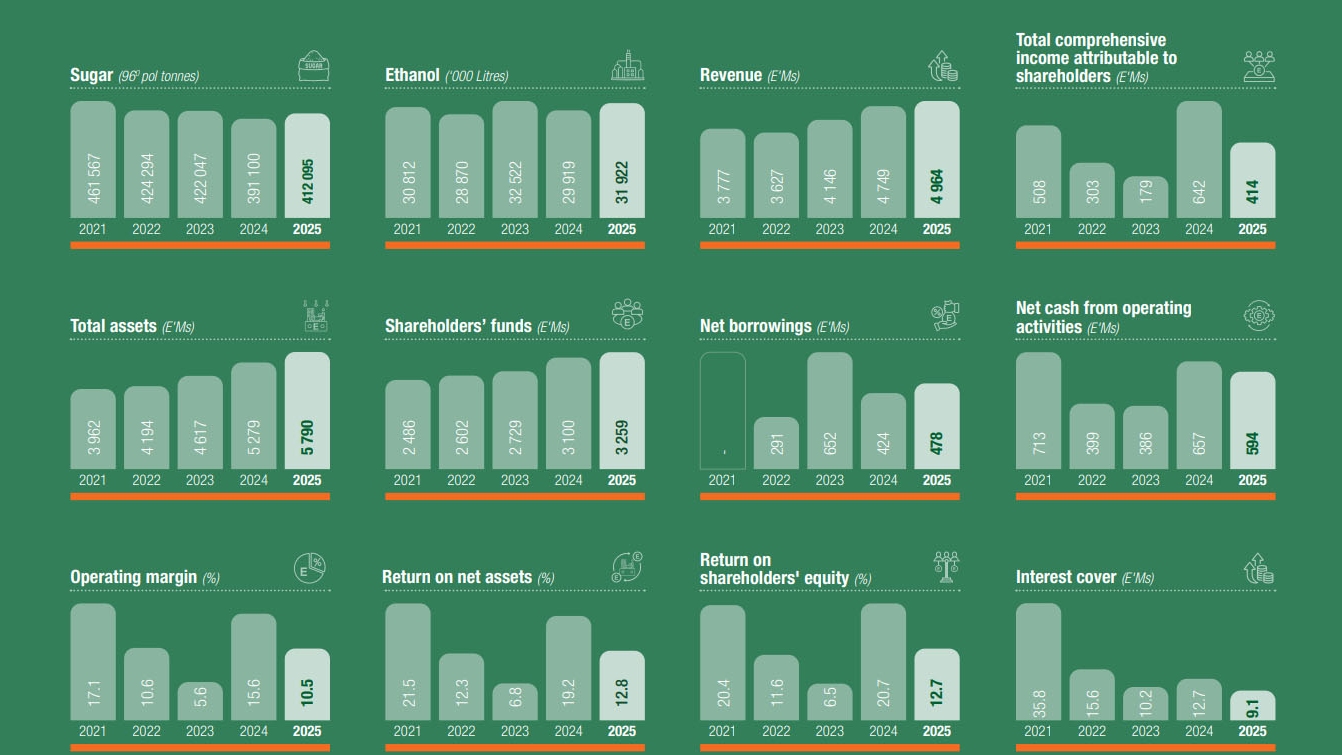
According to the company’s 14th Integrated Report, covering the period from April 1, 2024, to March 31, 2025, total comprehensive income attributable to owners of the company stood at E414.3 million.
This was 35 per cent lower than the record achievement of E641.8 million in the prior reporting year, reflecting the volatility of global sugar markets and the impact of wider economic shocks.
Despite the weaker bottom line, operational performance showed mixed outcomes. Sugar volumes were 5 per cent higher than the prior year, underpinned by improved mill recovery rates, while ethanol sales volumes dropped by 11 per cent due to difficult trading conditions.
World market sugar prices retreated by 19 per cent, squeezing margins, while the local currency remained firm throughout the year, limiting export competitiveness. These pressures were compounded by geopolitical events, including trade tariff disputes, the ongoing Russia-Ukraine war and Middle East tensions, which disrupted supply chains and raised input costs.
RESCorp Managing Director, Nick Jackson, confirmed that the ethanol sector was particularly hard hit, with key customers in the Southern Africa Customs Union (SACU) market shutting down operations.
He further highlighted that adverse weather conditions again affected the 2025 crop, with estates achieving an average yield of 89.0 tonnes per hectare, below both the target of 97.9 and last year’s 89.7 tonnes. “While yields were under pressure, we were encouraged that our sugar mills improved their recovery rates from 85.8 to 87.0 per cent, ranking among the top five out of 25 factories in southern Africa for the fifth consecutive year,” Jackson said.
*…
Maintains robust balance sheet
MBABANE – Despite the earnings decline, RESCorp maintained a robust balance sheet.
Cash generated from operations remained positive, and the board declared dividends of E78 million, underscoring management’s confidence in the long-term prospects of the business.
The report also noted that capital expenditure during the year amounted to E362 million, primarily directed towards estate expansion, mill upgrades and digital systems. Climate change remained a major risk factor for RESCorp, with increased variability in rainfall and higher temperatures threatening cane yields. To counter these risks, the company is investing in climate-smart agriculture, irrigation efficiency and crop diversification. The integrated report also highlighted exposure to market volatility, exchange rate fluctuations and policy uncertainties, particularly in key export markets. Robust risk frameworks, scenario planning and hedging strategies were deployed to mitigate these uncertainties.
*…
RESCorp enters retails space with new Spotted Horse Gold Rum
MBABANE – The Royal Eswatini Sugar Corporation (RESCorp) has entered the alcohol retail space with the unveiling of its flagship product, Spotted Horse Gold Rum.
This is a premium spirit positioned to champion Eswatini on the global stage. The official launch, hosted at Dwaleni Farm Lodge mid-August, marked a bold new chapter of brand innovation for the corporation.
RES Board member Mike Shongwe described the launch as a defining moment for Eswatini’s manufacturing sector. He said the introduction of Spotted Horse was more than a commercial move—it was ‘a statement of export intent.’
“RES has the capacity, the technical foundation and the ambition to take this product beyond our borders,” Shongwe said. “By building premium, branded products, we can ensure that Eswatini is represented on global shelves—not only as a supplier of bulk commodities, but also as a creator of consumer brands.”
He highlighted RES’s industrial record as the foundation for this venture, noting its expertise in bagasse-based electricity generation and its role in government’s E10 petrol-blending pilot project.
“That industrial know-how translates directly into capabilities that can travel well into new categories like this,” he added. Shongwe further underscored the importance of linkages between corporates and small enterprises. “When companies of RES’s scale partner with SMEs, they broaden economic activity through jobs and local procurement,” he said.
*Full article available in our publication.





















Leave a comment