

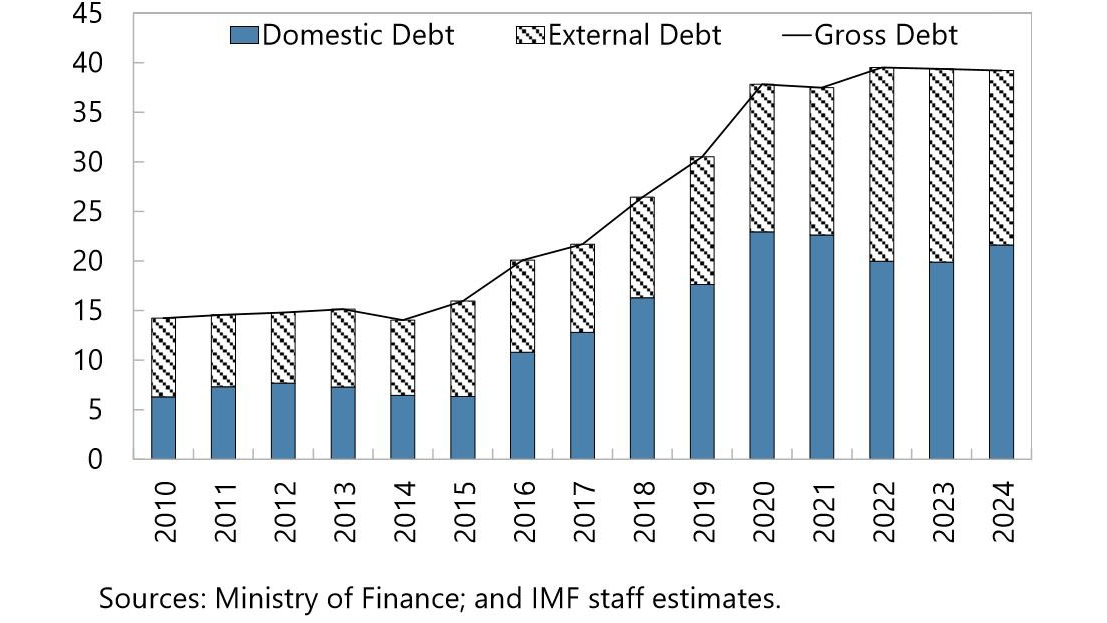
MBABANE – The International Monetary Fund (IMF) has raised concern that Eswatini’s government is paying higher borrowing costs than its regional peers, despite maintaining a moderate level of public debt.
In its latest Country Report on Eswatini, the IMF noted that the country’s borrowing rates remain elevated, reflecting market perceptions of higher risk and structural weaknesses in debt-carrying capacity.
Eswatini entered the regional capital market last year with its first-ever issuance on the Johannesburg Stock Exchange (JSE) – a significant milestone in its effort to diversify funding sources. On May 21, 2024, government placed a E400 million three-year bond at a yield of 11.875 per cent.
While this was comparable to the average domestic market yield of 11.25 per cent for similar maturities, it stood considerably above the 9.313 per cent yield on equivalent South African government bonds on the same day.
A second issuance followed in July 2025, when Eswatini sold E600 million in five-year bonds at a 12.175 per cent yield – a rate about 385 basis points higher than South Africa’s benchmark for the same tenor.
According to the IMF, these higher yields likely indicate a risk premium applied by investors due to institutional weaknesses and perceived fiscal vulnerabilities.
The IMF further highlights mounting pressures within the domestic financial market, where government securities auctions have frequently been under-subscribed.
In many cases, bids submitted at higher interest rates were rejected by authorities, who argued that the yields demanded were unjustifiably high and distorted by the dominance of a few market participants.
“These players perceive limited opportunity costs of being cut off, as government would often revert to private placements at prevailing market rates,” the report noted.
However, authorities have since discontinued private placements, with the expectation that rates will ‘regularise’ over time.
The IMF cautioned that by rejecting high-rate bids, authorities may be masking the true cost of borrowing, as underlying market interest rates could be higher than the realised ones. This, it said, has contributed to liquidity shortages and the accumulation of arrears in recent years, although inflows from international financial institutions (IFIs) have temporarily eased these pressures.
Full article available in our publication.




















Leave a comment