

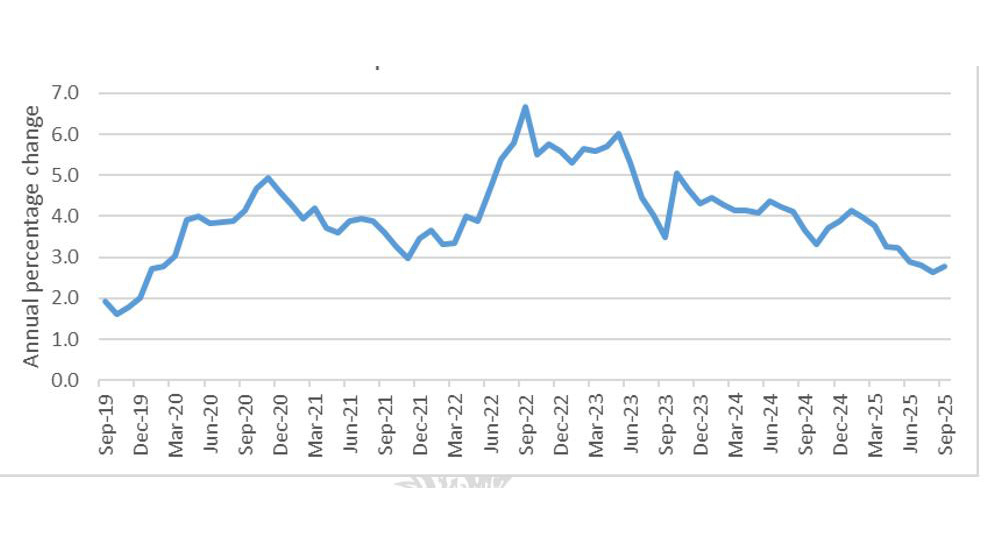
MBABANE – Eswatini’s inflation rate edged slightly higher in September 2025, marking the end of an over five-month downward streak that had provided a measure of relief to consumers and businesses alike.
According to the latest Consumer Price Index (CPI) released on Wednesday by the Central Statistical Office (CSO) under the Ministry of Economic Planning and Development, the country’s annual inflation rate rose to 2.8 per cent in September from 2.6 per cent recorded in August 2025.
This represents a 0.12 percentage point increase month-on-month, though the figure remains 0.9 percentage points lower than the 3.6 per cent inflation recorded in the same month of 2024.
The modest rise was largely driven by higher prices in the alcoholic beverages, tobacco and narcotics, clothing and footwear and housing and utilities categories.
The CSO noted that while the overall price stability persists, September’s uptick hints at gradual price pressures resurfacing in select sectors of the economy.
“Inflation for goods stood at 2.9 per cent and for services at 2.5 per cent,” the report stated, pointing to a balanced rise across categories.
The month-on-month inflation rate was flat at 0.0 per cent, a marginal improvement from -0.1 per cent in August, suggesting that while prices were broadly stable, specific commodity groups experienced upward movement.
A closer look at the CPI breakdown reveals that alcoholic beverages, tobacco and narcotics recorded the steepest price increases, rising 10.2 per cent year-on-year compared to 4.3 per cent a year ago. This surge was mainly attributed to higher beer and wine prices.
The clothing and footwear category rose 4.6 per cent, buoyed by increased footwear costs, while the housing, water, electricity, gas and other fuels category climbed 4.3 per cent, underscoring the continued impact of utility and rental costs on household budgets.
On the other hand, food prices – typically the most influential component of the CPI – grew modestly by 1.3 per cent, signalling a temporary easing in food-related inflationary pressures.
Within the food basket, meat prices rose 4.0 per cent, milk, cheese and eggs increased 3.3 per cent, while sugar and confectionery rose 3.8 per cent.
However, declines were registered in bread and cereals (-0.2 per cent) and vegetables (-0.6 per cent), helping to offset overall food inflation.
Among key consumption categories, housing and utilities remained the single largest contributor to the overall inflation rate, adding 1.2 percentage points to the headline figure.
This was followed by alcoholic beverages and tobacco (0.5 percentage points) and food and non-alcoholic beverages (0.3 percentage points).
The report further showed that transport inflation remained subdued at 0.5 per cent, reflecting relatively stable fuel prices despite fluctuations in global oil markets. Communication costs were unchanged, while education costs maintained a steady 4.6 per cent increase, driven by higher school fees at secondary and pre-primary levels.
The CSO’s analysis shows that non-durable goods experienced a 3.1 per cent price rise, while semi-durable goods went up 4.1 per cent.
Prices of durable goods remained largely stable at 0.7 per cent, indicating that essential and consumable products continue to bear the brunt of inflationary pressure.
Full article available in our publication.




















Leave a comment