

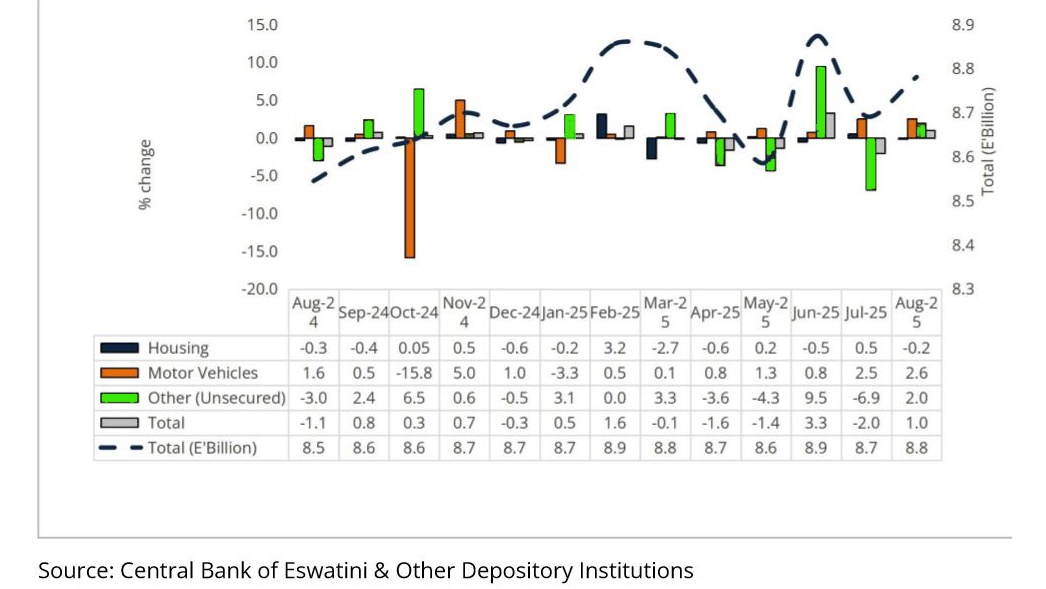
MBABANE – The quality of Eswatini’s banking sector loan portfolio weakened slightly in August 2025, as nonperforming loans (NPLs) increased both on a monthly and annual basis.
This is according to the Recent Economic Developments (RED) report released by the Central Bank of Eswatini (CBE) for August and September 2025.
The report shows that NPLs rose marginally by 0.1 per cent month-on-month to E1.3 billion, reflecting a modest deterioration in loan quality. On a year-on-year basis, however, NPLs surged by 11.4 per cent – a signal of mounting repayment challenges within certain segments of the economy.
As a result, the NPL ratio rose to 7.2 per cent, up by 0.03 percentage points from July 2025 and 0.2 percentage points compared to August 2024.
The uptick in nonperforming loans suggests that while the financial system remains stable, certain borrowers – particularly in sensitive sectors – are beginning to show strain amid tighter financial conditions and slower business activity.
Private sector credit contracted by 1.4 per cent in August compared to the previous month, although it remained 5.4 per cent higher year-on-year.
The month-on-month decline was mainly attributed to reduced lending to other sectors of the domestic economy and to the business sector.
These declines were partially offset by growth in credit extended to households and non-profit institutions serving households (NPISH).
Credit to other sectors of the domestic economy fell sharply by 19.4 per cent month-on-month to E904.8 million.
This drop was largely driven by a steep 27.7 per cent fall in lending to other financial corporations, which settled at E423.3 million.
Credit to parastatals also decreased by 14.1 per cent to E392.8 million, while credit to local government was the only bright spot, increasing by 10.6 per cent to E88.8 million.
Credit to the business sector stood at E11.5 billion in August 2025, reflecting a 1.5 per cent decline from July. However, the figure remained 10.2 per cent higher compared to the same period last year, highlighting sustained demand for financing despite short-term pressures.
Full article available in our publication.



















Leave a comment