

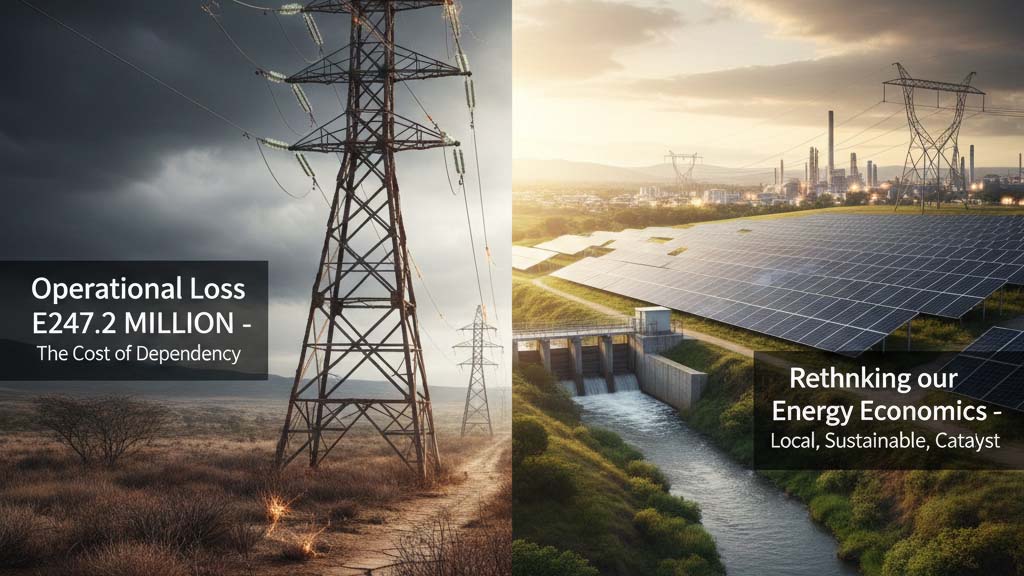
The Eswatini Electricity Company (EEC) reported a staggering operational loss of E247.2 million for the 2025 financial year, a more than threefold increase from the E69.5 million loss recorded in 2024. Overall, the power utility reported a net loss of E80.4 million. While the headline figure is alarming, the underlying causes and consequences are even more sobering. I, therefore, find it fit that as a nation, we rethink our energy economics, because the performance of the power utility company has far-reaching consequences on the kingdom’s development trajectory.
EEC attributes its losses to a combination of factors: A severe drought that crippled domestic hydropower generation, rising costs of imported electricity from South Africa and Mozambique and operational inefficiencies. However, beneath these surface-level explanations lies a deeper structural vulnerability: The country’s overdependence on imported energy and underinvestment in local, sustainable alternatives.
The cost of dependency
The kingdom imports over 70 per cent of its electricity, primarily from Eskom in South Africa and EDM in Mozambique. This dependency exposes the country to external shocks, such as currency fluctuations, regional supply constraints and geopolitical tensions.
When Eskom experiences load-shedding or raises tariffs, the country feels the ripple effects immediately. In a year marked by regional drought, rising energy prices and below cost recovery tariff increases in 2025, EEC’s financial haemorrhage was almost inevitable.
The economic consequences extend far beyond the utility’s balance sheet. Energy insecurity undermines business confidence, disrupts production and inflates operational costs. Small businesses, already grappling with inflation and sluggish demand, will have to contend with the looming threat of tariff hikes. For households, especially low-income ones, rising electricity costs mean difficult trade-offs between lighting, cooking and other basic needs.
Developmental constraints
Reliable and affordable energy is the lifeblood of economic development. It powers factories, fuels innovation and enables service delivery in health, education and public administration. When electricity becomes unreliable or unaffordable, the entire development agenda stalls.
Consider the manufacturing sector, which government has rightly identified as a pillar for job creation and export diversification. Frequent power outages or high energy costs make local manufacturers less competitive, both regionally and globally. Investors, too, are wary of economies, where infrastructure is fragile and unpredictable. Moreover, energy insecurity exacerbates inequality, undermining inclusive and sustainable growth. Middle-class households may afford a higher tariff hike, but for low income and poor households, it means staying in the dark.
Renewable energy
A year of drought typically brings with it excess sunshine, an opportunity to harvest the rays, turning the drought to energy resilient. Furthermore, the kingdom is blessed with abundant flowing rivers and biomass potential. Yet, less than 30 per cent of our electricity is generated locally and only a fraction of that comes from renewable sources.
This is a missed opportunity
Investing in renewable energy, particularly solar, mini-hydro and biomass offers multiple dividends. Firstly, it reduces dependency on imports and shields the economy from external shocks. Secondly, it creates local jobs in installation, maintenance and manufacturing. Thirdly, it aligns with global climate commitments and opens doors to green financing. We need to move beyond rhetoric and get boots on the ground to improve our green energy space.
National energy resilience strategy
The current energy situation ought to serve as a wake-up call. We need a comprehensive, forward-looking National Energy Resilience Strategy that addresses both supply and demand.
On the supply side, government must prioritise investment in local generation capacity. This includes fast-tracking public-private partnerships in solar farms, incentivising rooftop solar for households and businesses and upgrading the grid to accommodate decentralised energy sources.
On the demand side, we need aggressive energy efficiency campaigns. Public institutions, especially schools and hospitals, should lead by example in adopting energy-saving technologies. Tariff structures should be redesigned to reward conservation and penalise waste.Crucially, the strategy must be inclusive. Rural electrification should not be an afterthought. Community-based mini-grids, supported by local cooperatives and development partners, can bring power to underserved areas, while creating local ownership and accountability.
Financing the transition
Sceptics will ask: Where will the money come from? The answer lies in blended financing, a mix of public investment, concessional loans and private capital. Development finance institutions are increasingly eager to fund green infrastructure, especially in countries with clear policy frameworks and credible implementation plans.
Moreover, the cost of renewable energy technologies has plummeted in recent years. Solar panels, for instance, are now more affordable than ever. With the right incentives, even small businesses and households can become energy producers, feeding excess power into the grid and earning income.
Misfortune to catalyst
The EEC’s financial loss is not just a number, it is a symptom of a deeper economic fragility. However, within this crisis lies an opportunity: To reimagine the kingdom’s energy future. A future where power is not just imported and consumed, but generated locally, sustainably and equitably. A future where energy is not a constraint, but a catalyst for inclusive development.
As we approach the new year, let us not simply brace for tariff hikes or rationing, but demand bold leadership, smart investments. Act now, before the lights go out on our economic ambitions.
















Leave a comment