

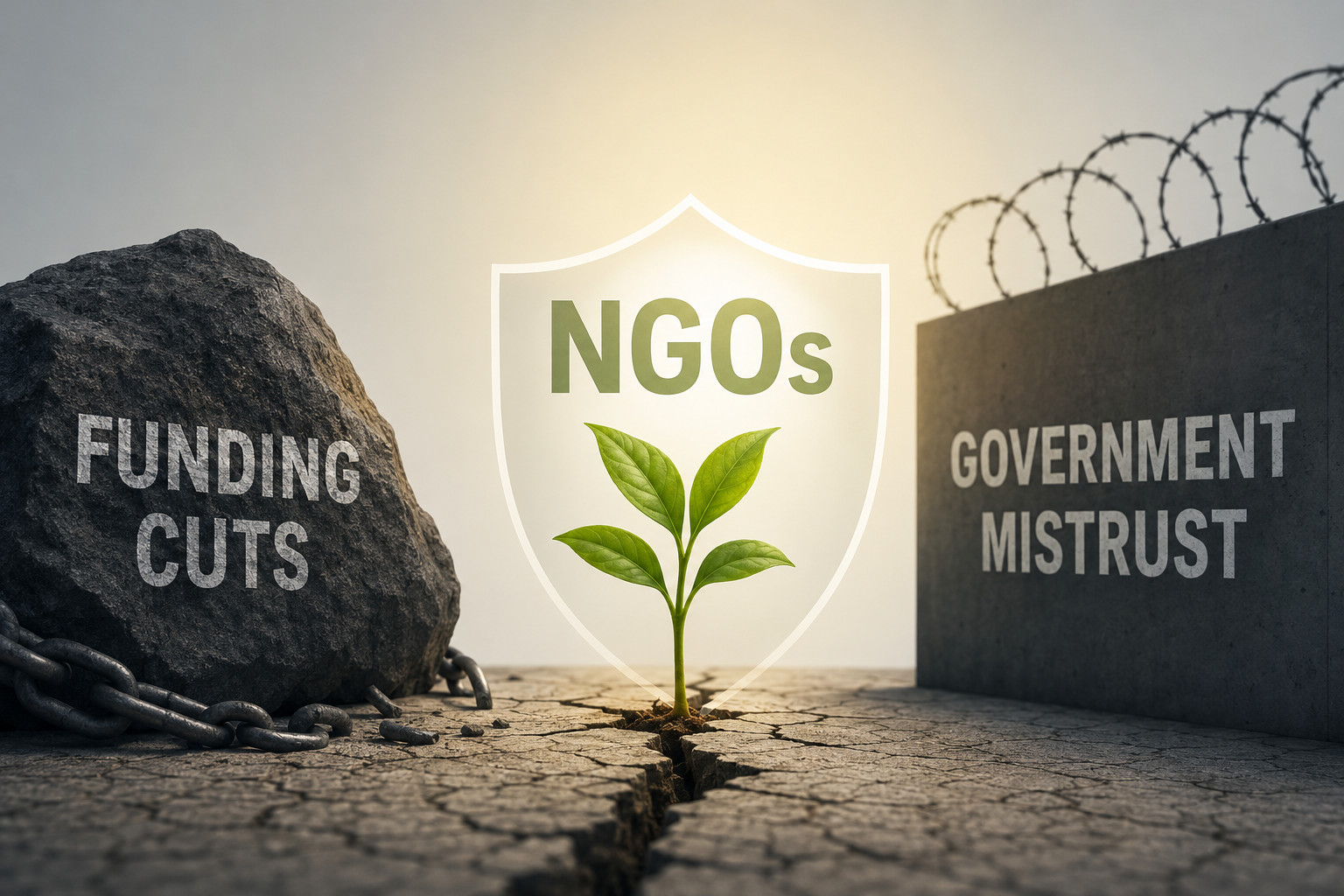
The non-governmental and civil society sector in Eswatini is navigating an unprecedented squeeze. In the aftermath of the landmark June 2021 protests, non-governmental organisations (NGOs) and civil society organisations (CSOs) find themselves caught between an increasingly hostile domestic regulatory climate and a steep global decline in foreign donor Will NGOs survive the challenges of funding cuts, govt mistrust?
funding.
It is well-known that NGOs serve as a vital force for development and safety nets, including public health, social protection for vulnerable groups, victims of gender-based violence (GBV), voice against human rights violations, social enterprises targeting young people affected by HIV/AIDS, disaster relief for those impacted by climate change, access to education for vulnerable children and promoting climate-smart agriculture, among other interventions. Unfortunately, Eswatini’s civil society landscape is currently undergoing a forced structural transformation.
A shrinking civic space
The post-2021 climate brought heightened State surveillance and a shrinking civic space, marking a sharp turning point in state–NGO/CSO relations. As political tensions escalated, government adopted a defensive posture, frequently viewing independent civil society through a lens of national security.
This has led to the conflation of human rights advocacy with terrorism. Consequently, human rights, legal aid and democracy-focused NGOs have faced increased surveillance, intelligence monitoring and public accusations of funding instability, accusations from influential figures that remain unproven to date. Furthermore, regulatory frameworks such as the Non-Profit Organisations (NPO) Bill introduce strict compliance requirements, financial reporting and administrative oversight under the banner of anti-money laundering and national security. While regulatory frameworks are standard, local CSOs fear these tools could be used selectively to silence critical or non-compliant voices.
Global donor retreat
As if domestic uncertainty were not enough, the global donor retreat has dealt a devastating blow to local NGOs. For decades, Eswatini’s NGOs relied heavily on traditional Western bilateral donors (such as USAID and the European Union) and private international foundations. However, shifting geopolitical dynamics have drastically reshaped global aid flows.
Policy shifts by the United States Government under President Trump led to abrupt aid cuts without warning. As a result, NGOs lost millions of Dollars in committed funds, forcing the closure of key projects and the retrenchment of critical staff and volunteers. Simultaneously, other Western donors scaled down official development assistance (ODA) to redirect resources towards conflicts in Ukraine, Gaza and Sudan, while also increasing spending on their own domestic security.Human rights funding has almost dried up, as the human rights agenda seems to be abandoned by the United States Government, which used to lead in funding human rights work globally.
Impact of the double squeeze
The dual burden of reduced funding and heightened political friction directly impacts essential services across the country. The harsh reality is that when civil society capacity collapses, rural communities bear the brunt, losing essential grassroots support networks that public health and social welfare departments cannot fully replace. This comes at a time when the Eswatini Government faces severe financial constraints that have already disrupted the delivery of essential services, including medicine supplies in public health facilities. National umbrella networks, such as the Coordinating Assembly of Non-Governmental Organisations (CANGO), have historically coordinated grassroots interventions including HIV prevention, sexual and reproductive health and rights (SRHR) and youth mentorship, to mention a few. Severe budget cutbacks have affected community interventions. Reduced operational budgets have forced NGOs to freeze salaries or lay off personnel, driving experienced development professionals out of the non-profit sector. Thousands of community workers who provided frontline services in the fight against HIV/AIDS have also been affected, which has inadvertently harmed government revenue, as these workers were taxpayers.Additionally, at a time when GBV has reached unprecedented levels, NGOs are struggling to maintain the comprehensive support services that help survivors access justice and receive protection from perpetrators.
Alternative strategies for Eswatini’s NGOs
To survive this double squeeze, Eswatini’s civil society must shift from reactive to proactive structural reform:
Form strategic consortia: Rather than applying for grants individually, organisations should form joint consortia under umbrella bodies like CANGO to share administrative overhead and pool technical expertise for competitive global tenders.
Diversify revenue streams: Non-profits should explore social enterprise ventures, fee-for-service consultancies and research services to generate sustainable internal revenue rather than relying 100 per cent on external grants.
Leverage regional & continental platforms: Local human rights and governance groups should deepen partnerships with Southern African Development Community (SADC) and African Union (AU) civil society platforms to amplify their voices and foster regional solidarity.
Institutional strengthening: NGOs invest in transparency and accountability.
Re-engage the State: Civil society must continue constructively engaging the government to demonstrate that NGOs are an extended arm of public service and a force for social good—not entities that sponsor instability. This includes advocating for the recognition of human rights organisations as essential contributors to national development.
















Leave a comment