

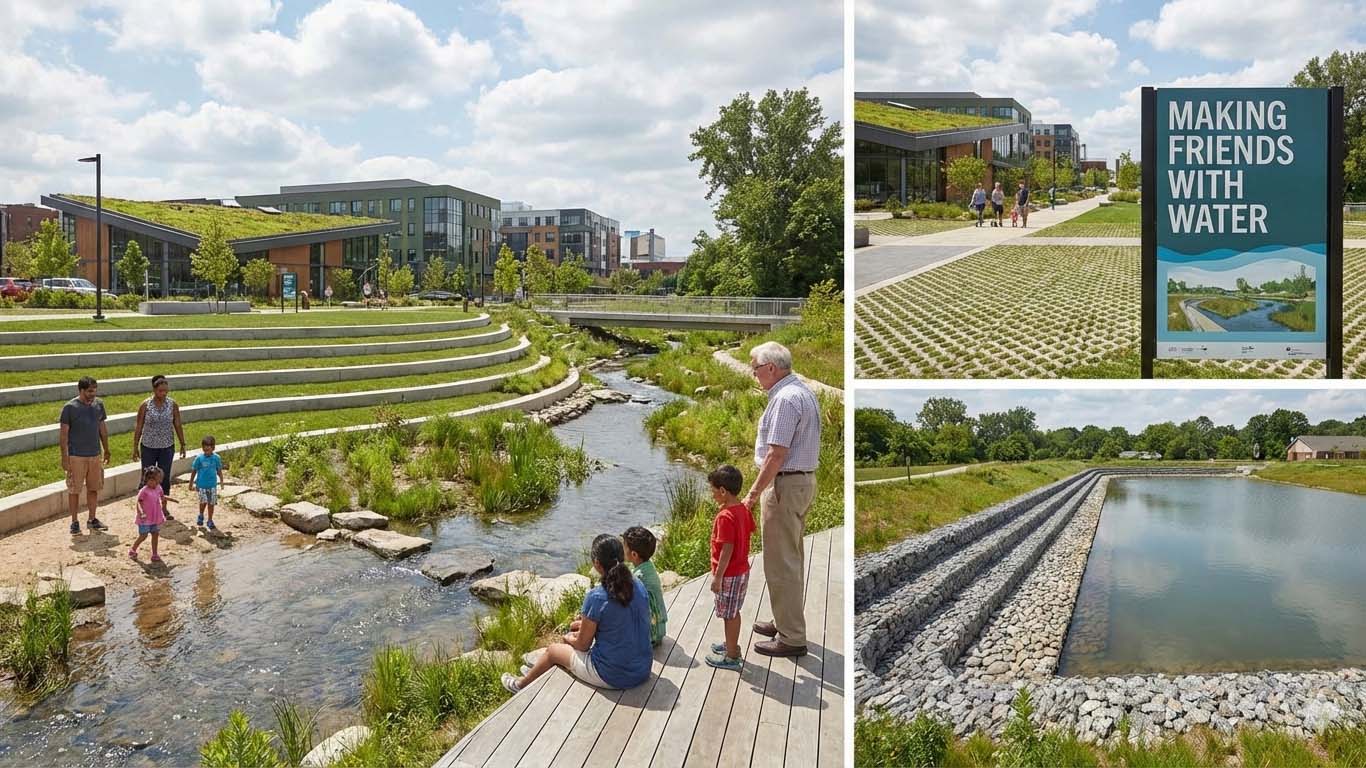
The title allows a significant degree of contradiction within its meaning. On the one hand, water is the essence of life. It is the only liquid or food which we absolutely must have within a very few days of the most recent ingestion. Almost everything we eat is dependent on water for development. With water, we are potentially rich, without it, we are very soon dead. The other side of the coin says that water can be one of human society’s most formidable adversaries. Substantial volumes of water can move buildings. In the wrong volume and at the wrong time, the flooding of water can kill many.
The guy who promoted the idea of ‘making friends with water was more entitled than this writer to make public statements on the subject of water. He was a Chinese architect by the name of Kongiian Yu who was engaged by the Chinese Government to design spaces within the cities that would absorb water and prevent serious flooding. He did it for dozens of cities. It was he that revived the Chinese saying, ‘make friends with water.’ In other words – don’t always consider it a potential threat. He was basically creating a new system that changed the relationship between land and people. The message did spread. It went beyond the borders to Bangkok in Thailand where a former tobacco factory was turned into the 45 hectare Benjakitti Forest Park that enabled excess water to be absorbed instead of creating dangerous flooding. In Denmark’s capital,Copenhagen, the Cloudburst Management Plan was drawn up, again to contain the effect of heavy rainfalls. Fourteen years ago, that city had a metre of water, no less, dropped on the city in a violent storm. They learnt from that – never again. Indeed, the Danes are carrying out 300 projects over the coming 20 years where ‘sponge parks’ will be created to take away the excess water that’s coming from higher volumes of rain in this new era of Global Crazy.Currently, it’s catching on round the world. In the USA, there have been catastrophic floods where, in response to residents legging it out of town and insurance companies even excluding cover, cities are implementing what they are stylishly calling ‘sponge infrastructure.’ Our ancestors would certainly be a little puzzled by that terminology. ‘What is the world coming to?’ they would say. Los Angeles, over on the west coast of the USA, has been converting concrete segments of city centres into areas of grass, dirt or even plants.
How about Eswatini? We are certainly getting very clear evidence of higher rainfall though it would need a much longer assessment period before it is considered the norm. Recently, for the first time in 29 years in a visit to a supermarket in the Mbabane Mall, I was treated to the necessity of wading up to my shins through water to get to my car after a sudden storm. Well, what else could the water do without anything immediately available to absorb the heavy rainfall?
I tried negotiating the water on my trolley but there was no gradient to assist the objective.
I doubt that substitution of a green space would be considered viable.
Also, I wouldn’t recommend a full conversion from concrete to pond, since shopping by a sailing boat or ferry might prove a little cumbersome.
What has struck a vital chord (not GBDF – a great one lol) with the writer is learning of the creation of the Cook Park in Atlanta in the USA which absorbs stormwater while combining flood protection with the availability to the public of a recreational space. What more powerful argument could be presented for ensuring that we in Eswatini do not build on the green spaces of our cities. Preservation and protection are a no-brainer but a tricky subject when dealing with those with no brains. However – and there’s so often a ‘however’, isn’t there? – massive infrastructure overhaul projects around the world are simply not practical or affordable in every location. It was not sufficient to control the massive flooding of 2021 and 2023. So, Dave Smith – who is the Founder of Water Innovation Services in Oakland, USA, argues that the cities of the future will need a blend of sponge infrastructure and what is called ‘hard engineering’ – that’s sewers and walls and raised buildings. Replacing concrete with green spaces does not come cheap and to Smith, the mutually reinforcing combination of the two is essential. He says that green infrastructure will always need the support of grey infrastructure – pipes and concrete as well as gutters and storm drains to cope with the big rainstorms that are becoming increasingly frequent.


















Leave a comment