

MBABANE – The soft drink concentrates and sugar industries continued to demonstrate resilience and global competitiveness at the close of 2025, reinforcing the country’s external trade position amid moderating economic conditions.
In December 2025, exports of soft drink concentrates totalled E1.7 billion, reflecting a 12.1 per cent increase from November and a 10.2 per cent rise year-on-year, underscoring sustained demand in international markets.
This is according to the latest Recent Economic Developments (RED) report for November-December 2025, provided by the Central Bank of Eswatini.
Similarly, exports of sugar and sugar products reached E843.7 million, representing 9.1 per cent growth month-on-month and a substantial 50.3 per cent increase compared to December 2024.
The strong performance was largely driven by higher consignments to South Africa and the United Kingdom, reaffirming the importance of regional and European markets for Eswatini’s agro-processing sector.
Together, the two commodities remained the backbone of Eswatini’s merchandise exports, cushioning the economy against volatility in other sectors and supporting foreign exchange inflows during the final month of the year.
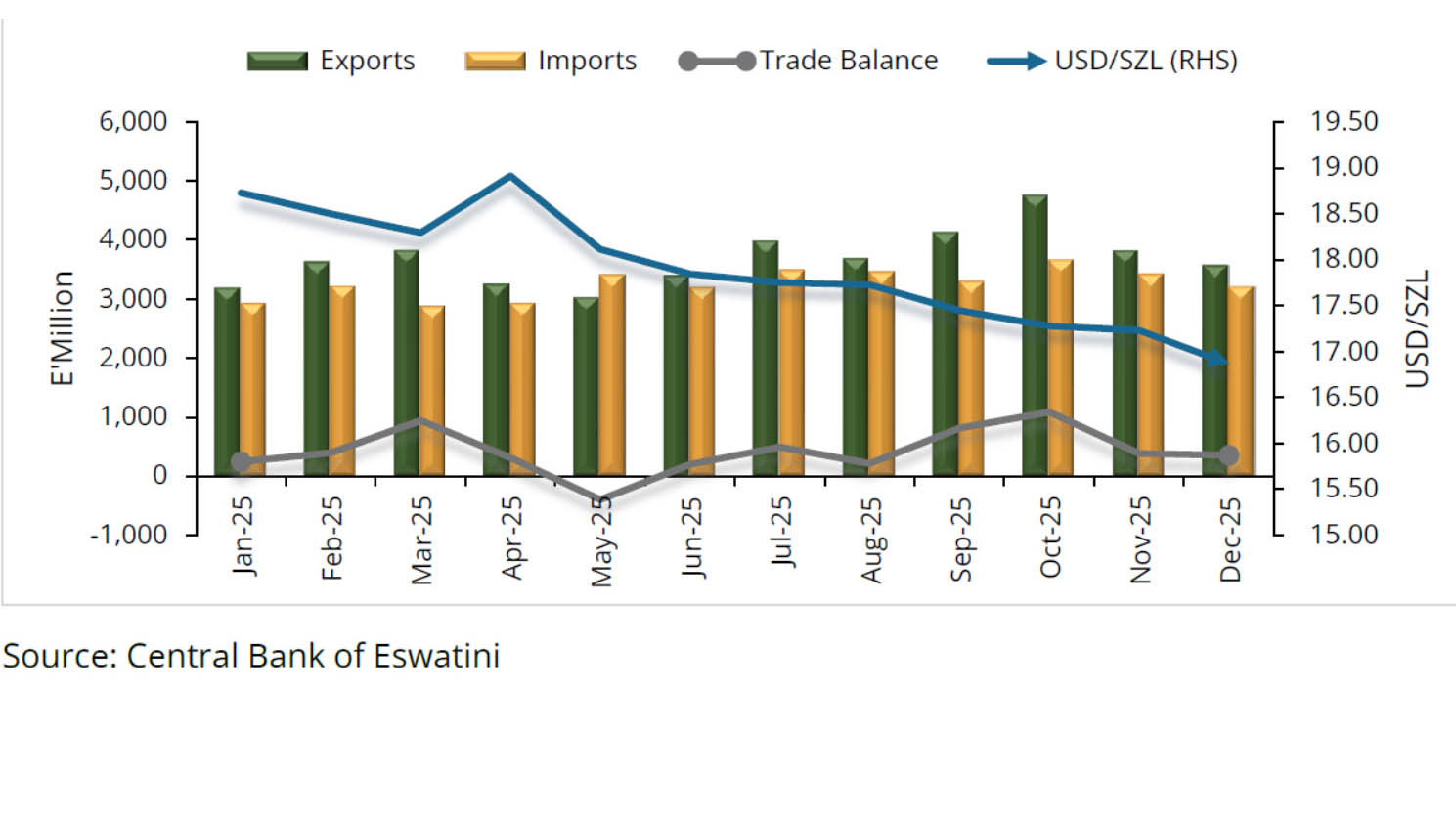
Despite the robust performance of key export products, Eswatini’s overall trade surplus narrowed to E353.1 million in December 2025, slightly below the E386.9 million recorded in November.
The contraction was primarily due to a sharper decline in exports relative to imports on a month-on-month basis.
Total exports declined by 6.7 per cent to E3.6 billion, largely influenced by reduced shipments of wood and wood articles, while imports fell by 6.4 per cent to E3.2 billion. However, on a year-on-year basis, exports were 21.2 per cent higher, reflecting improved global demand and competitiveness, while imports rose by a more modest 5.0 per cent, suggesting contained growth in domestic demand.
Seasonally adjusted figures painted a more favourable picture, placing exports at E3.8 billion and imports at E3.3 billion, resulting in an adjusted trade surplus of E510.2 million for December.
On an annual basis, Eswatini maintained a strong external position.
The cumulative trade surplus for 2025 stood at E5.0 billion, representing a 9.9 per cent improvement from E4.6 billion in 2024.
Total exports reached E44.1 billion, while imports increased to E39.1 billion, reflecting sustained trade activity throughout the year.
Beyond soft drink concentrates and sugar, other export categories recorded mixed performances.
Textiles and textile apparel exports declined sharply by 38.5 per cent month-on-month to E234.6 million, reflecting lower shipments during December.
*…
Inflation moderates as food, fuel prices ease
MBABANE – Domestically, inflationary pressures continued to ease towards the end of the year.
Headline consumer price inflation declined to 2.4 per cent in November 2025, down from 2.9 per cent in October, driven mainly by lower food and transport prices. Inflation continues to fall further to settle at 2.3 per cent in December 2025.
Food inflation recorded zero per cent growth, reflecting sustained price stability in key items such as rice, cereals, meat, dairy products and sugar. Transport inflation also softened, benefitting from a 45-cent-per-litre reduction in fuel prices implemented in early November, combined with slightly lower global oil prices and a strengthening Lilangeni.
These developments offset moderate increases in housing and utilities, as well as clothing and footwear, where prices rose due to higher costs for liquid fuels and garments.
On a month-on-month basis, inflation recorded zero growth, signalling subdued price momentum as the year drew to a close.
Following the increase observed in the previous month with the implementation of the higher sin tax by the Eswatini Revenue Service (ERS), the index for ‘alcoholic beverages and tobacco’ moderated by 9.5 percentage points to record 4.3 per cent during the month under review.
Decreases were noted across all alcohol beverages and tobacco, with steeper declines for ‘beer’ and ‘wine’.
*Full article available on Pressreader*




















Leave a comment