

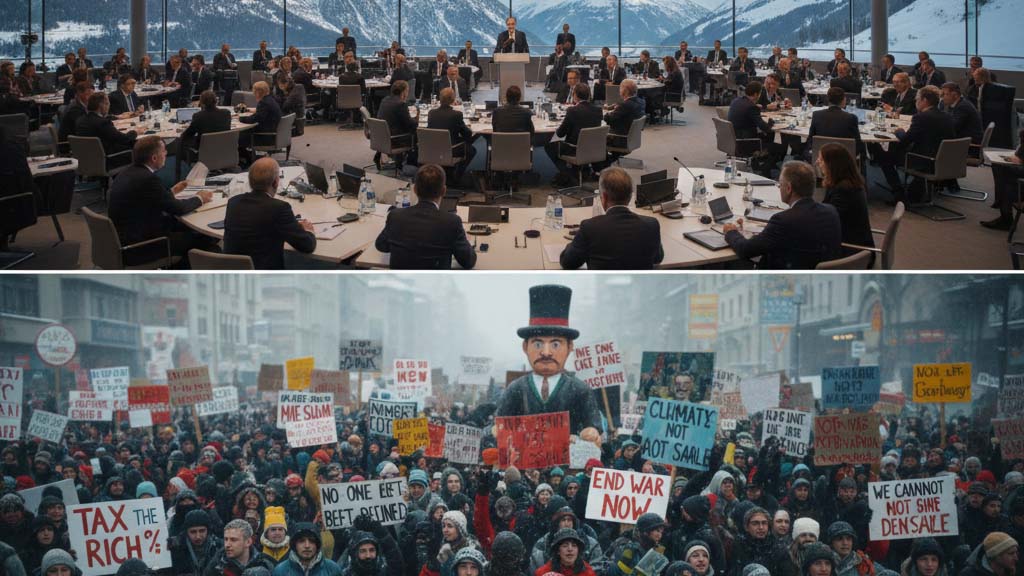
Hundreds of top political leaders from around the world, including close to 65 heads of State and government, about 850 top CEOs and chairs of corporations, civil society gathered in Davos, Switzerland, for the World Economic Forum’s Annual Meeting, held from January 19 to 23 2026.
The motto for the meeting, according to the organising think tank, was: ‘Improving the State of the World,’while the year’s theme was ‘A Spirit of Dialogue.’ The World Economic Forum CEO, Børge Brende, said with regard to the dialogue theme: ‘Dialogue is not a luxury in times of uncertainty; it is an urgent necessity’.
This serves to underscore that Davos should provide space for dialogue in spite of the differences, as this is the only way to reach lasting and beneficial outcomes for the benefit of global populations. The Davos high-level meeting is held when the global community is at the crossroads: The global rule-based system is seriously threatened, as trade wars through the tariff measures adopted by the United States government in President Trump’s second term has undermined international trade.
These trade wars have unfortunately inflicted significant shocks on the world economy, most seriously to multilateralism and free trade.
The resurgence of wars in Ukraine, Gaza has undermined the United Nations ability to maintain global peace.
Other problems include, worsening poverty, which is also deepening and unfortunately undermines the 2030 Sustainable Development Agenda, where no one is not be left behind. There is also a reversal in democratic gains as authoritarianism rises.
Further compounding the situation is heightened inequality between countries and among people. The climate change crisis, in the midst of denialism, continues to devastate countries and people, undermining development, but causing havoc to human lives, infrastructure and livelihoods.
There is a concern among activists that as world leaders meet, 99 per cent of the global population will be left out. ‘The 99 per cent’ is a common phrase used by activists, charities and protesters to highlight the exclusion of the general global population from the wealth and decision-making power concentrated at the World Economic Forum (WEF) in Davos.
Oxfam has published a report stating that the wealth of the top one per cent of billionaires rose by 16 per cent by 2025, reaching US$18.3 trillion. This growth was three times faster than average increase in the last five years.
In fact, billionaire wealth, since 2020, has increased by 81 per cent.
Wealth for the rich is not just raised as an issue it is about how they use their wealth to buy politics to shape the world for themselves and leave the 99 per cent to cope with less and less.
In fact, fewer people would disagree that when a billionaire uses their wealth to buy a politician, to influence a government, to own a newspaper or a social media platform, or to out-lawyer any opposition to ensure them impunity from justice, that these actions are inimical to progress and fairness.
Such power gives billionaires a grasp over all our futures, undermining political freedom and eroding the rights of the many. ‘‘The outsized influence that the superrich have over our politicians, economies and media has deepened inequality and led us far off track on tackling poverty,’’ said Oxfam International Executive Director Amitabh Behar.
Oxfam also estimated that billionaires are 4 000 times more likely to hold political office than common citizens and cited a World Values Survey of 66 countries, which found that almost half of all people polled say the rich often buy elections in their country.
It is indeed unfortunate that voting for political leaders is no longer an exercise of seeking legitimacy, but open vote-buying openly promoted by the rich is now the norm.
The executive director of Oxfam added that, ‘governments should be listening to the needs of the people on issues such as quality healthcare, climate change and tax fairness’. This is the concern that activists are concerned about, as leaders in Davos meet. It is inevitable that the call for no one to be left behind is threatened if the 99 per cent is left out in high level dialogue, such as WEF.
US Supreme Justice Louis Brandeis said something profound, ‘we must make our choice. Either we can have extreme wealth in the hands of a few or we can have democracy. We cannot have both’. The judge was indeed right that there is need for deliberate effort to promote democracy, so that wealth is distributed to the 99 per cent as well. It is encouraging that civil society activist are already waging campaign against concentrating wealth and power to the rich.
What should Davos focus on
- Distribution of resources through taxing the rich in accordance with their resource base.
- A rule-based order should be reaffirmed.














Leave a comment