

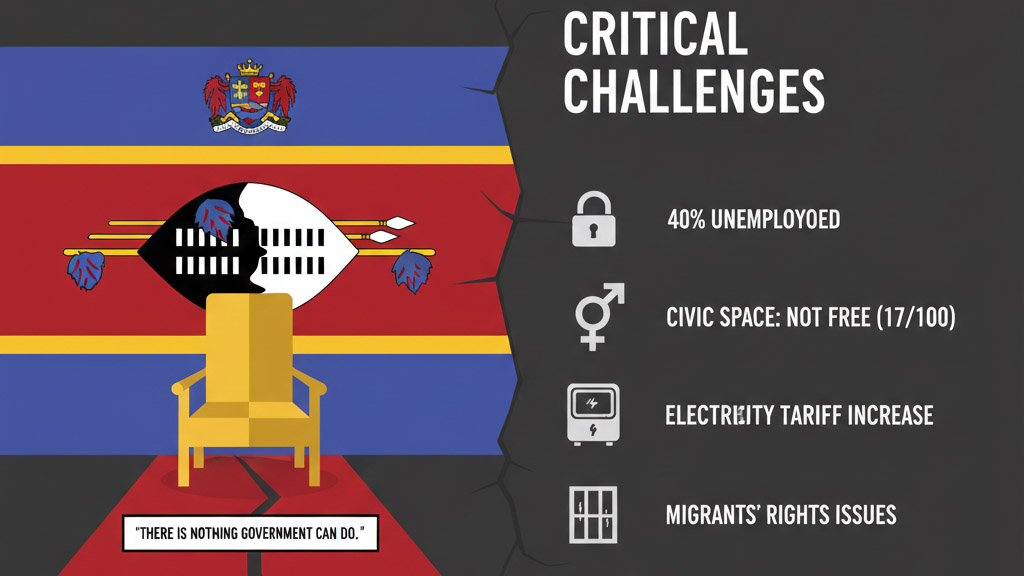
His Majesty King Mswati III on Friday opened Parliament with the much anticipated Speech from the Throne. Parliament is opening at a critical time when emaSwati are facing a diversity of challenges. The most recent is the electricity tariff increase that has been announced by ESERA. Sadly, the last hope has been dashed by the remarks made by the minister for Finance, where he acknowledged the hardship this increase will have on the general populace, in particular in a country where 58 per cent live below poverty line, as well as close to 40 per cent unemployed.
Even with this reality the minister reportedly said: ‘‘There is nothing government can do.’’
Human rights concerns Parliament should prioritise
According to the World Human Right Report 2026, some of the problems that should occupy Members of Parliament include: His Majesty King Mswati III on Friday opened Parliament with the much anticipated Speech from the Throne. Parliament is opening at a critical time when emaSwati are facing a diversity of challenges. The most recent is the electricity tariff increase that has been announced by ESERA. Sadly, the last hope has been dashed by the remarks made by the minister for Finance, where he acknowledged the hardship this increase will have on the general populace, in particular in a country where 58 per cent live below poverty line, as well as close to 40 per cent unemployed.
Even with this reality the minister reportedly said: ‘‘There is nothing government can do.’’
Shrinking civic space
In 2025, civic space and the rule of law remained under threat in Eswatini. Impunity for human rights violations is still entrenched, and the authorities have yet to hold anyone accountable for the June 2021 crackdown against pro-democracy demonstrators.
State of civil and political rights
The country scored 17 out of 100 in Freedom House’s Freedom in the World 2025 Report and scored 1 out of 40 on political freedoms and 16 out of 60 for civil liberties. As in past years, the report concluded that Eswatini is ‘not free.’ The CIVICUS civic space monitor classified Eswatini as a closed space, yet Eswatini has a Constitution with a Bill of Rights. These rights should be enjoyed by emaSwati and these include civil, political and cultural rights. The low scores paint a gloomy picture which should concern Parliament as a representative of emaSwati.
It is stated in the report that the African Commission on Human and Peoples’ Rights (ACHPR) visited Eswatini in July 2025 at the invitation of government. They found that the Public Order Act, the Suppression of Terrorism Act of 2008 and the Sedition and Subversive Act of 1938 are weaponised by the State to suppress dissenting voices and curtail freedoms of expression, assembly and association. In a country that desires to maintain peace as per the request of the King, it is critical that emaSwati should not be muzzled through closing spaces, such as denial of legal entities like the unions to hold public protest.
Gender-based violence
Violence against women and girls remained a concern in 2025 and is rising. The Royal Eswatini Police Service noted an increase from 244 to 262 reported rape cases between April and May 2025, compared to the same period last year. These included statutory rape. An Afro barometer survey found that emaSwati consider violence against women and girls as the most pressing women’s rights issue.
In addition, 43 per cent of people surveyed say violence against women and girls is ‘somewhat common’ (24 per cent) or ‘very common’ (19 percent) in their community.
Gender disparities
In 2025, the Global Gender Gap Index for Eswatini recorded an index of 0.748, ranking the country 46th out of 148 countries.
This index quantifies the gap between women and men in four key areas: Health, education, economy and politics and gives them a score from zero to one. A score of one indicates full equality between women and men, and a score of zero indicates full inequality. This is really bad for our country and Parliament should play a key role in influencing change.
Migrants’ rights
The report notes that as of October 15, Eswatini had received 15 people from Cuba, Jamaica, Laos, Vietnam, Yemen, the Philippines, Ethiopia, Chad, Cambodia and Congo, reportedly holding some at the Mastapha Correctional Complex, a maximum-security prison, under harsh conditions and without access to legal counsel.
Protest by emaSwati on this agreement has fallen on deaf ears. The reality, however, is the country’s image is dented.
Right to health
It is also noted that Eswatini’s public healthcare system faced shortages of essential medicines in public hospitals, leading to preventable deaths and some patients being turned away. In July 2025, the minister for Health outlined challenges, including inadequate public funding, poor quality infrastructure and equipment, understaffing, and poor treatment of patients by public health professionals. Parliament should hold the Executive accountable for this situation.
Parliament’s role
According to the Eswatini Government Website, ‘Parliament is accountable to the people when performing the powers and responsibilities entrusted by the Constitution and any Act of Parliament.
‘It is mandated to strengthen democracy and good governance by enacting legislation, maintain oversight of the Executive and represent interest of Constituencies.’
It is critical that Parliament vigorously promote people-centric issues, including measures to address poverty, unemployment, inequality, gender disparities including gender-based violence and human rights violations.
















Leave a comment