

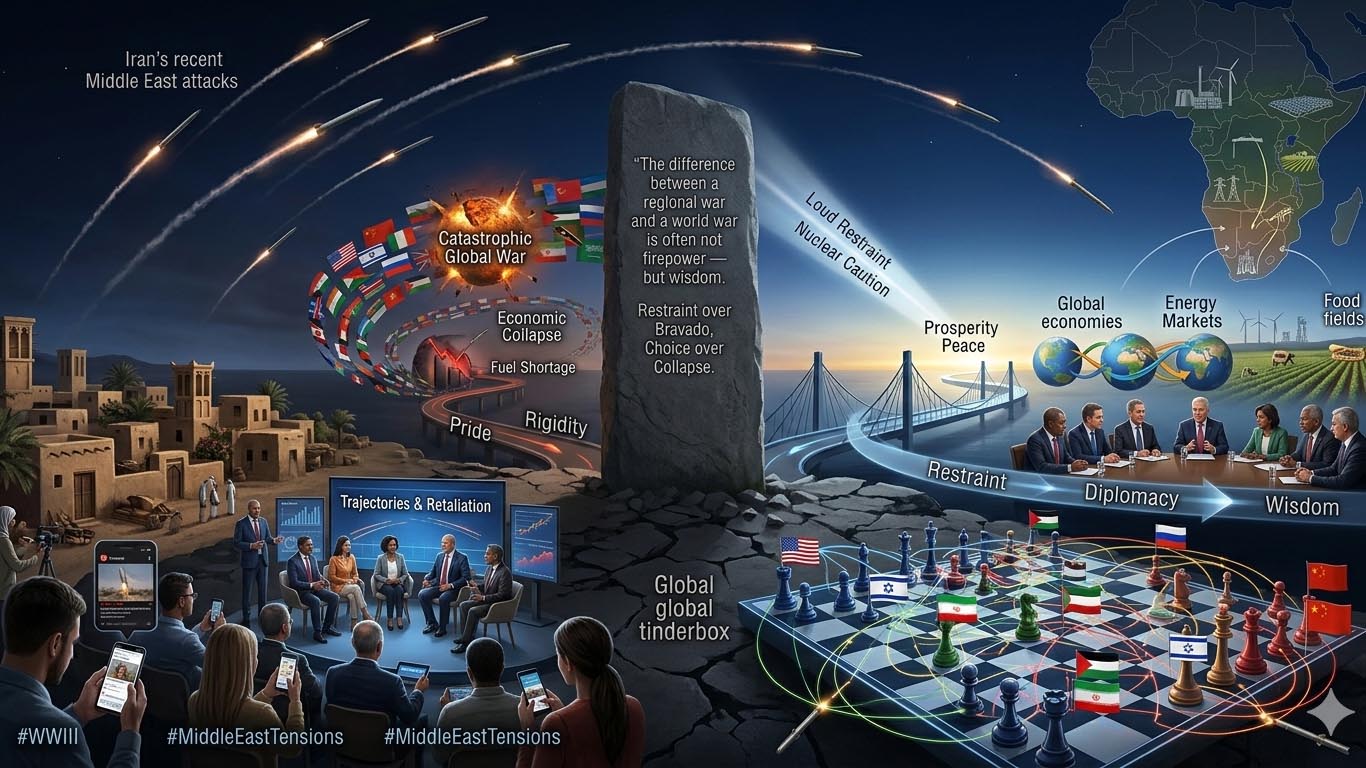
There is something unsettling about how casually the world now consumes footage of missiles crossing the night sky.
Within minutes, videos trend, hashtags form and experts assemble on panels to explain trajectories and retaliation strategies. The recent attacks by Iran in the Middle East have once again jolted a region that has long been described as a tinderbox — as though it were permanently one spark away from combustion.
Yet, here we are again, debating whether this is ‘contained,’ ‘calibrated,’ or the beginning of something far more consequential.
Iran’s strikes did not occur in isolation. They form part of a chain reaction that includes the ongoing war between Israel and Hamas in Gaza, Israel’s shadow conflict with Iran across multiple fronts and a broader contest of influence involving the United States and other global powers. Add to that the unresolved tensions in Ukraine following Russia’s invasion and the geopolitical chessboard begins to look less like a game and more like a test of nerves.
The phrase ‘World War III’ has re-entered casual conversation — often half-jokingly, sometimes anxiously. It is easy to dismiss such talk as alarmist. After all, we have grown accustomed to regional wars that somehow do not spiral into global catastrophe. History however, reminds us that world wars rarely begin with grand declarations. They begin with entanglements, alliances and retaliations that leaders believe they can manage. In 1914, Europe did not wake up intending to start a world war. It stumbled into one through a web of defence pacts and strategic miscalculations.
Today, the web is arguably even more complex. Iran’s regional alliances, Israel’s security partnerships, America’s strategic commitments, Russia’s global ambitions and China’s watchful pragmatism form an intricate network of red lines.
The irony is that modern warfare has become both more precise and more dangerous. Precision-guided missiles and drone technology allow countries to signal strength without immediate full-scale invasion. Leaders speak of ‘measured responses’ and ‘proportional retaliation.’ The language sounds reassuring — almost clinical, but precision does not eliminate risk. It merely narrows the margin for error.What makes the present moment particularly delicate is perception. If Iran believes its deterrence is weakening, it acts to restore it. If Israel perceives an existential threat, it responds decisively. If the United States senses instability that could undermine its regional interests, it positions forces strategically. Each move is rational within its own framework. Collectively, however, they resemble a high-stakes poker game where no one wishes to fold.
Yet, it would be intellectually dishonest and socially irresponsible to declare that global war is inevitable. The same interconnectedness that makes escalation dangerous also acts as a brake. Global economies are intertwined. Energy markets, trade routes and financial systems would suffer catastrophic shocks in a true world war. Major powers understand this. Nuclear deterrence, for all its terrifying implications, has also historically imposed caution. In a strange way, we live in an era of loud restraint.
Leaders escalate rhetorically, flex militarily and then step back just before the precipice. It is geopolitical brinkmanship — dramatic, risky, but often calculated. For smaller nations watching from afar, including those of us in Southern Africa, the lesson is sobering. Global conflict may seem distant, but its consequences are not.
Fuel prices, food security and investment flows react instantly to instability in the Middle East. In a globalised world, no region is an island.So, how close are we to World War III? Close enough to take diplomacy seriously.
Close enough to demand responsible leadership’ but perhaps not as close as our social media feeds suggest.The world today stands not at the edge of inevitable collapse, but at a crossroads shaped by choice.
Wars expand when pride outweighs prudence, when retaliation becomes reflex and when leaders mistake resolve for rigidity.
If there is one hopeful thread running through this tense chapter, it is that history also records moments when escalation was avoided — when backchannel diplomacy prevailed over bravado.
The missiles may light up the night sky, but so too does the possibility of restraint. The real question is whether global leaders will remember that the difference between a regional war and a world war is often not firepower — but wisdom.


















Leave a comment