

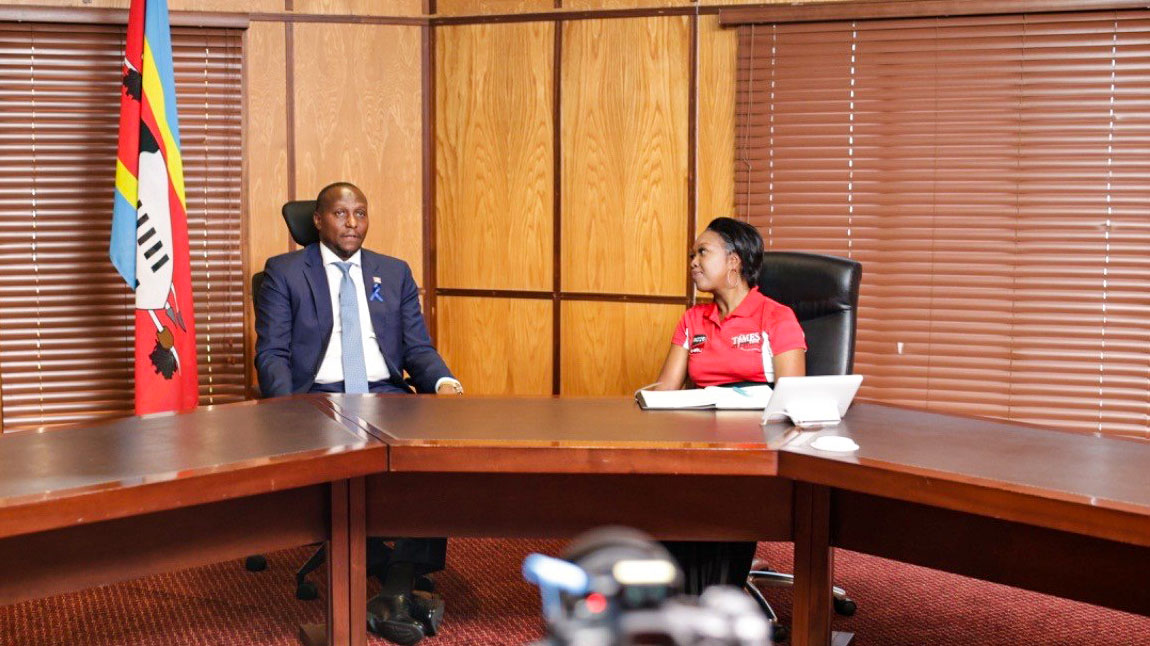
MBABANE – The Prime Minister (PM), Russell Mmiso Dlamini, has acknowledged that corruption remains deeply entrenched across all sectors of the country, admitting that despite government efforts, there is still ‘no light at the end of the tunnel’in the fight against the problem.
The PM said this during an exclusive interview with the Times of Eswatini on Friday, which will be broadcast on our Times YouTube podcast, where the PM offered clarity on a variety of national issues. Speaking in an interview about government’s anti-corruption efforts, the PM reflected on the commitment he made when he assumed office to help the country confront corruption.
Part of that commitment involved establishing an Anti-Corruption Task Team aimed at strengthening action against corrupt activities. However, Dlamini explained that tackling corruption has proven far more complex than initially anticipated because the problem is not confined to a single institution. He said corruption exists across all areas of public life.
During a recent Cabinet Retreat, leaders engaged in discussions about the definition and scope of corruption and came to the realisation that the issue is widespread, even within the highest levels of governance.
According to the prime minister, corruption is present within the Cabinet itself, as well as in Parliament and the Judiciary.
He emphasised that corruption is not necessarily institutionalised, but rather stems from individuals who carry out corrupt practices in the institutions they serve. Dlamini noted that the three arms of government – the Executive, Legislature and the Judiciary – are all affected because they are ultimately made up of people, and it is individuals who engage in corrupt behaviour.
As a result, he said corruption is effectively everywhere. Despite the recognition of the problem, the prime minister admitted that one of the biggest challenges has been the inability to ensure that those found guilty of corruption are punished.
“Unfortunately, it has not been possible even today to punish the people found to be corrupt,” he said, highlighting what he described as a key obstacle in the country’s anti-corruption campaign.
Dlamini referred to the example of Lee Kuan Yew and the reforms implemented in Singapore during that country’s economic transformation. He said Singapore’s leadership adopted a zero-tolerance approach to corruption and ensured that even prominent individuals implicated in corrupt activities were held accountable.
“If there was a prominent person involved in corruption, they made sure that such a person was taken to task,” he said.
The prime minister explained that the establishment of the Anti-Corruption Task Team was intended to ensure that similar decisive action could be taken in Eswatini. He said the task team remains in place and continues its work, but acknowledged that progress has been slower than expected. According to him, the current situation suggests that something within the system is not functioning as it should.
“You can see that by now, there are people who should have been held accountable by being arrested,” Dlamini said. Nevertheless, he insisted that the government has not abandoned its commitment to the fight against corruption. He maintained that authorities remain determined to confront the problem using every available measure. “We have not changed our mind. We are still fighting corruption with all that we have,” he said. The prime minister added that the government has experimented with different strategies to address corruption and is now considering additional approaches in an effort to strengthen accountability. He stressed that these efforts are necessary because corruption continues to undermine national development and is drawing the country backwards. Dlamini said the government hopes that by refining its strategies and maintaining pressure on corrupt practices, those responsible will eventually be brought to book.
*Full article available on Pressreader*

















Leave a comment