

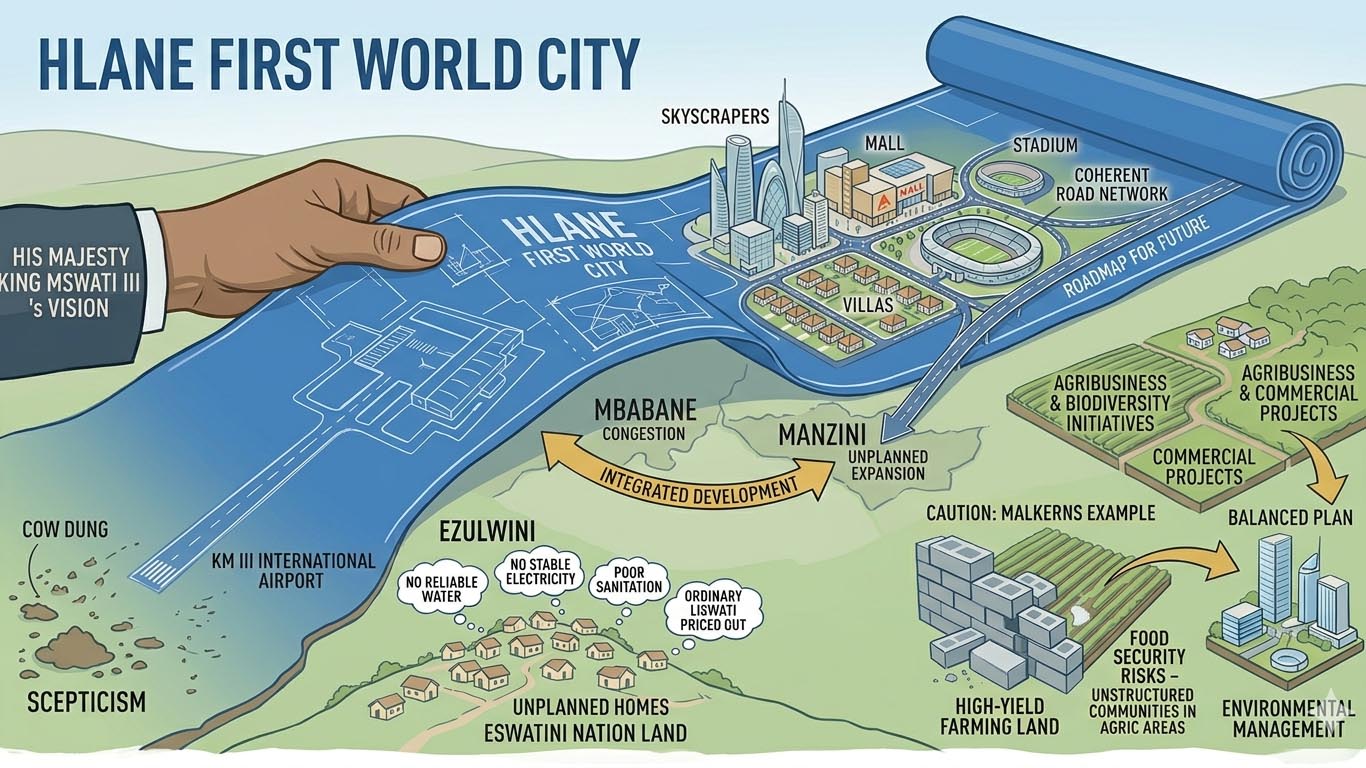
On Monday, during the launch of the Nsulutane Properties Hotel at Hlane, His Majesty King Mswati III did more than simply open a new establishment; he unveiled a blueprint for the future.
With skyscrapers, a mall, villas, a stadium and a coherent road network on the horizon, the vision to transform Hlane into a full-fledged First World city represents the bold ambition required to propel Eswatini towards the developed status we so earnestly seek. Yet, as His Majesty noted, such grand announcements are often met with scepticism. He reminded those present of the early days of the King Mswati III International Airport, recalling how a detractor once collected cow dung from the runway and prophesied failure. “I wish that same person would come back now and look at the airport and still maintain his words,” he said.
That story serves as a powerful metaphor for where we stand as a nation. We are at a critical juncture. While our main urban centres, Mbabane and Manzini, have served us well, they are now struggling with congestion and unplanned expansion.
The time has come for us to look beyond these traditional hubs and embrace a future where towns in the various regions outgrow them. The King’s vision for Hlane is not merely about building another city, it is about creating a model for decentralised growth that avoids the costly mistakes of the past.To understand the urgency of this situation, one needs to look onlyat Ezulwini, our tourist capital. For years, this valley has been the jewel in Eswatini’s crown. Today, however, it is fast transforming into the country’s de facto corporate capital. Land and property prices have skyrocketed, placing home and business ownership beyond the reach of the ordinary liSwati. Ironically, it is the ordinary man and woman whose labour is most needed to keep these new offices running and spotlessly clean, yet they are increasingly being priced out of the very communities they serve.
The demand for EswatiniNation Land on the perimeters of Ezulwini has grown exponentially. Homes now cling to the hillsides overlooking the valley, creating a new problem. The challenge with these structures is that they are largely unplanned. In the absence of a coordinated strategy, we are witnessing the creation of new challenges for the national development programme. The provision of essential utility services, such as reliable water supplies, stable electricity, proper road networks and adequate sanitation, struggles to keep pace with this unregulated growth.
As we develop Hlane and other growth points like Buhleni in the north, we must avoid repeating these mistakes. It is worth remembering that Eswatini once possessed an elaborate and well-documented resettlement plan. For reasons that now serve as a cautionary example, that plan was largely ignored. The result is a landscape filled with unstructured communities and urban dwellings, many of which have taken root in areas initially designated for agricultural use.Malkerns is a prime example of this phenomenon. While growth is welcome, we must guard against sacrificing high-yield farming land for concrete and mortar when food security and agricultural self-sufficiency remain paramount.
The King’s directive for Hlane, which includes agribusiness and biodiversity initiatives alongside commercial and residential projects, presents an opportunity to get the balance right. It offers a chance to integrate economic activity with environmental management and proper planning.
This is where the broader objective of decentralisation comes into sharp focus. The development of smaller towns is not simply about building structures; it is about bringing services closer to the people and creating sustainable job opportunities.
If executed correctly, a coordinated effort to develop towns like Hlane, Buhleni and others could curb the tide of urban migration, which continues to swell the populations of Mbabane and Manzini. By creating viable economic centres in the regions, we can stem the birth of informal settlements that arise from housing demand in the cities. We can reduce hazardous living conditions and mitigate the spread of diseases often associated with overcrowded and poorly serviced urban peripheries.To get this right, however, we require more than just ambition; we require a coordinated development effort. This issue is particularly pertinent given the proposed legislation to introduce local governments at the tinkhundla level. The proposal presents a significant shift in the dynamics of leadership power between urban administrative structures and traditional governance systems. If not managed with care, this transition could place the King’s mandate to create First World cities at risk of becoming a non-starter. We must ensure that the implementation structures are aligned with the vision, working in synergy rather than in conflict, to effectively support the transition and avoid undermining the King’s mandate.
This brings us to a sobering reality: Such a grand vision requires vision carriers. These are leaders, administrators and stakeholders who are totally aligned with the objectives of the national vision.
Unfortunately, there are not many individuals of such calibre among who can prioritise national development over self-interests and execute complex projects with integrity and foresight. Therefore, we must nurture and encourage those who exhibit the ability to continue this mission.
We must acknowledge those who are already answering the call. The Inyatsi Group Holdings is to be commended for living up to His Majesty’s development call with the Nsulutane Properties Hotel project. By providing job opportunities for the people of Hlane, they are demonstrating the kind of public-private partnership that will be essential to our success. They are laying the foundation upon which the future city will be built.
As His Majesty emphasised, emaSwati must benefit directly from the projects being implemented at Hlane. He encouraged the community to come and set up businesses, taking advantage of the already existing infrastructure, adding with humour that: “EmaSwati atsi nelicatsa lenyama kuyalunyiswana, noma nje kulesinye sikhatsi lomunye uluma kakhulu.” (The nation is like a piece of meat that must be shared, even if sometimes one person bites off more than their share).













Leave a comment