

MBABANE – The Eswatini Revenue Service (ERS) has closed the 2025/26 financial year on a strong note, collecting a total of E15.7 billion in revenue, reflecting a 7.6 per cent increase compared to the previous year.
ERS Commissioner General, Brightwell Nkambule, said the performance underscores disciplined execution across both domestic tax and customs operations, coupled with sustained taxpayer engagement and the commitment of ERS staff to mobilise revenue that supports government priorities.
“The outcome reflects disciplined execution across domestic tax and customs operations, sustained taxpayer engagement, and the consistent efforts of ERS staff to secure revenue that funds Government’s mandate,” Nkambule said.
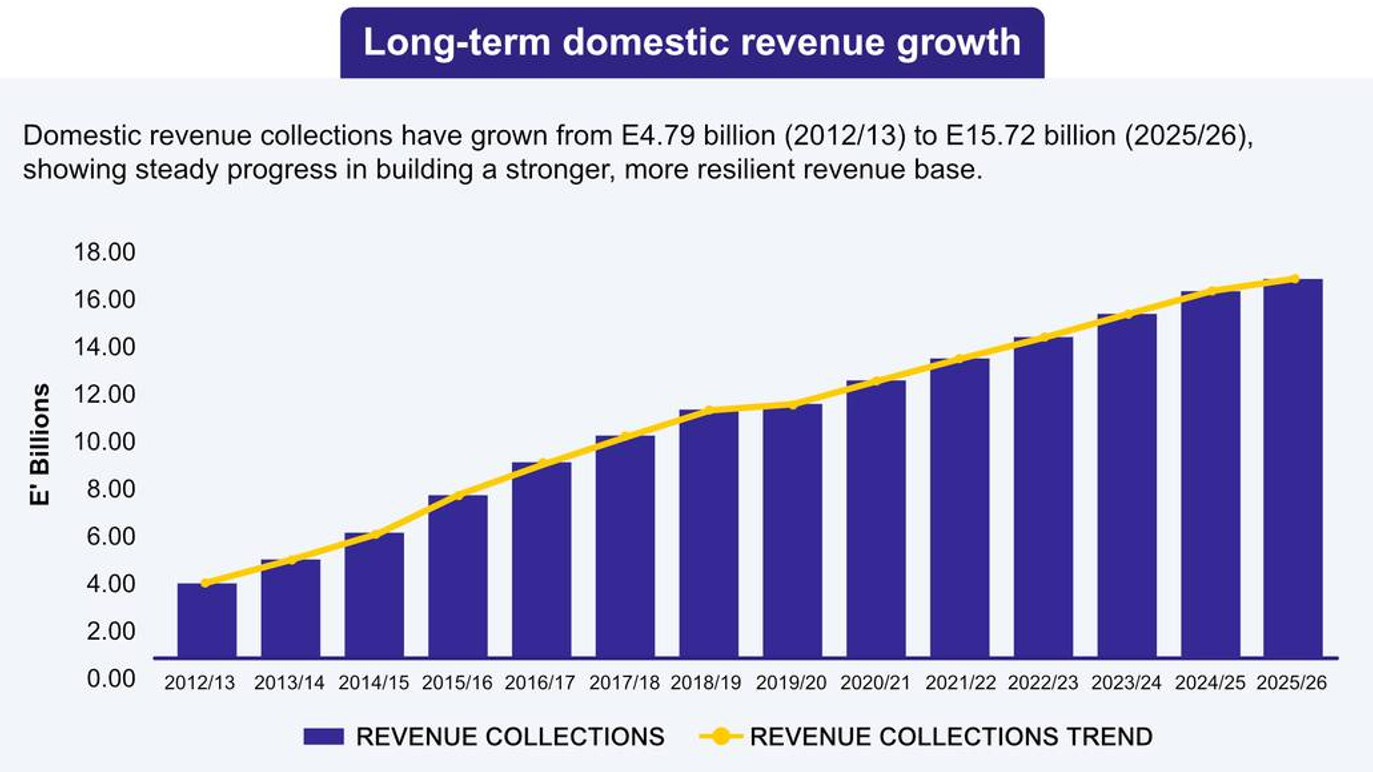
While the annual growth is notable, ERS’s broader performance tells a deeper story of consistency and resilience over time. Domestic revenue collections have more than tripled over the past decade, rising from E4.79 billion in the 2012/13 financial year to E15.72 billion in 2025/26.
This sustained upward trajectory highlights the country’s growing capacity to fund its national priorities through internally generated resources, reducing reliance on external revenue streams.
The steady expansion of domestic revenue has been achieved through a combination of improved tax administration systems, enhanced compliance measures, and ongoing engagement with taxpayers. It also reflects gradual economic growth and formalisation within key sectors of the economy.
For policymakers, this trend provides a more predictable and stable fiscal foundation, enabling better planning and execution of development programmes.
Domestic revenue cushions SACU volatility
MBABANE – A key highlight in the ERS performance is the increasing role of domestic revenue as a stabilising force amid fluctuating receipts from the Southern African Customs Union (SACU).
Over the years, SACU receipts have remained highly volatile, posing significant challenges for fiscal planning. In the latest financial year, SACU revenue declined sharply by 20.4 per cent, falling from E13.07 billion in 2024/25 to E10.40 billion in 2025/26.
This sharp drop underscores the inherent unpredictability of SACU inflows, which are influenced by regional trade dynamics and revenue-sharing formulas beyond Eswatini’s direct control.
In contrast, domestic revenue has demonstrated consistent growth, providing a more reliable source of funding for government operations.
“This shift matters because it shows Eswatini is increasingly funding its priorities through locally generated revenue rather than relying on a revenue line that can change materially from one year to the next,” ERS noted.
The growing contribution of domestic taxes is therefore seen as a critical step towards fiscal sustainability, reducing vulnerability to external shocks and strengthening economic resilience.
ERS also highlighted the importance of timely refunds in maintaining a credible and efficient tax system.
During the 2025/26 financial year, the institution paid out E3.49 billion in refunds, comprising E3.48 billion in Value Added Tax (VAT) refunds and E6.37 million in income tax refunds.
Refunds play a vital role in protecting taxpayer rights and ensuring fairness within the tax system. For businesses in particular, prompt VAT refunds are essential for maintaining cash flow, especially for exporters and companies with significant input costs.
By honouring refund obligations, ERS not only reinforces confidence in the system but also supports economic activity by enabling businesses to reinvest and expand operations.
“Refunds are a core part of a credible tax system. They protect taxpayer rights, support business cash flow, and reinforce confidence that the system works fairly and lawfully,” the organisation stated.
Beyond revenue collection, ERS has made notable strides in improving customer experience, which remains central to its long-term strategy.
The institution recorded a Net Promoter Score (NPS) of 83.96 per cent for the 2025/26 financial year, up from 77.3 per cent in the previous year.
The NPS is a widely used metric that measures customer satisfaction and loyalty by assessing the likelihood of clients recommending a service.
The improvement signals growing confidence in ERS services and reflects ongoing efforts to enhance service delivery, streamline processes, and make compliance easier for taxpayers.
A positive customer experience is increasingly recognised as a key driver of voluntary compliance, which in turn supports sustainable revenue growth.
ERS indicated that it will continue to expand platforms for taxpayer feedback, allowing clients to share their experiences more conveniently and in real time.
This feedback-driven approach is expected to further refine service delivery and strengthen relationships with taxpayers.
Looking ahead to the 2026/27 financial year, ERS plans to build on the current momentum by deepening compliance programmes and further simplifying tax processes.
The institution aims to leverage technology and improved service channels to make it easier for taxpayers to meet their obligations, while also strengthening enforcement measures to protect the tax base.
Nkambule emphasised the importance of collaboration between ERS, taxpayers, and other stakeholders in achieving these objectives.
“We sincerely thank our compliant taxpayers and traders whose contributions keep the country working. We also recognise the commitment of ERS employees whose daily work underpins these results,” he said.
“Our focus is clear: protect the tax base, improve fairness, raise service standards, and strengthen compliance so that the country can fund its priorities with certainty.”



















Leave a comment