

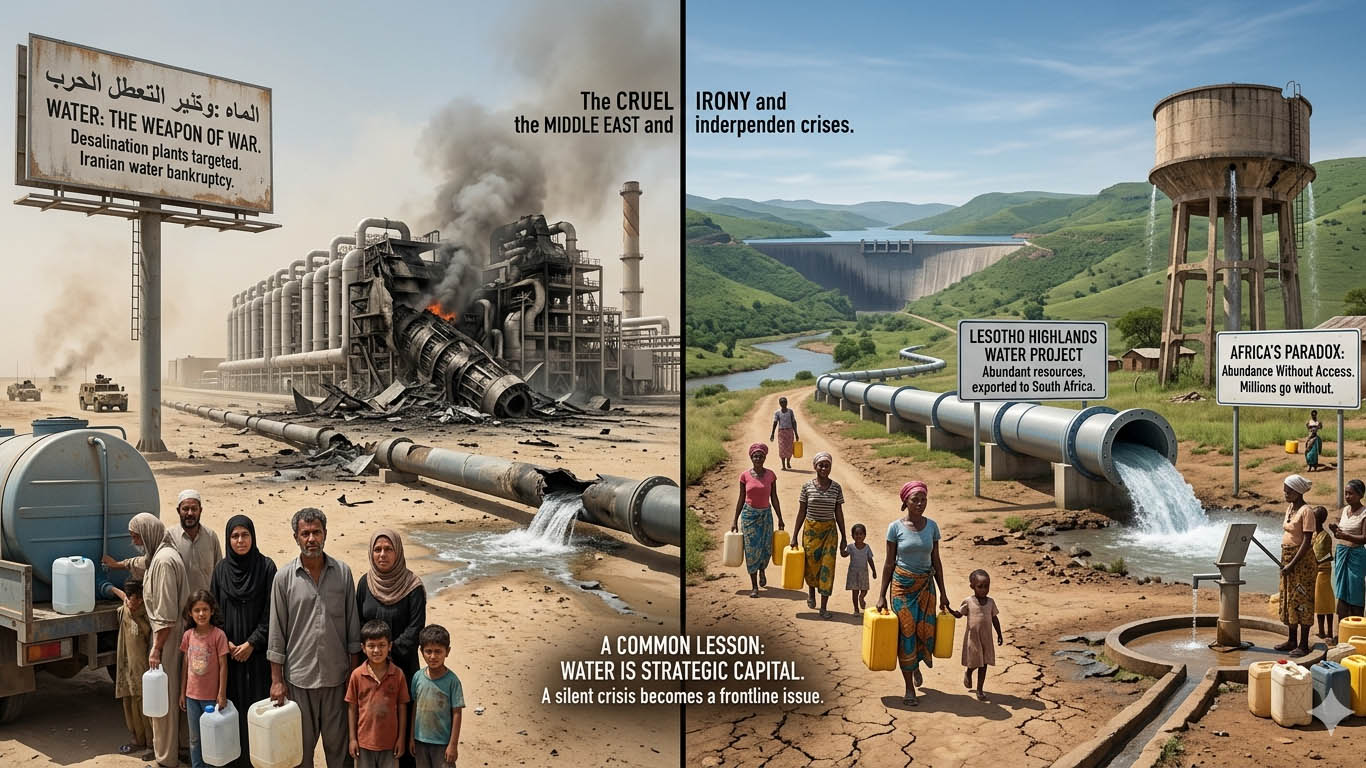
There is a cruel irony unfolding across two regions that seldom share the same headline. In parts of the Middle East, water is so scarce that it is now a weapon of war. In parts of Africa, water is abundant enough to export; nevertheless, millions still go without it. Between these extremes, lies a lesson the continent cannot afford to ignore.
The latest escalation in the Iran conflict has brought water security into sharp, unsettling focus. What began as a conventional geopolitical confrontation has morphed into something far more dangerous: The deliberate targeting of civilian infrastructure, including water systems. Iran has warned it could strike desalination plants across the Gulf, facilities that supply up to 80 per cent of drinking water in some countries.
In a region where rainfall is negligible and freshwater is scarce, such attacks threaten to leave entire populations without water within days.
This is not hypothetical. Early in the war, a desalination plant in Iran was reportedly hit, disrupting supply to dozens of villages. Analysts now warn that water – more than oil – may be the most strategic vulnerability in the conflict.Still, this crisis did not begin with missiles. Iran was already on the brink of what experts describe as ‘water bankruptcy’, after years of drought and mismanagement. The war has simply brought to the fore how brittle water systems become when governance fails and conflict intervenes.
Africa should be paying close attention, because, while the continent is not yet bombing water plants, it is inching towards its own version of a water crisis -one driven less by war and more by neglect, inequality and climate stress. Across sub-Saharan Africa, water scarcity is intensifying, not only due to drought, but also because of weak infrastructure, poor planning and growing demands. Conflicts between farmers and pastoralists over water are increasing, and experts warn of future ‘water wars’ if tensions are not managed.
Still, Africa’s story is not one of absolute scarcity. It is one of contradiction.
Take Lesotho, the small mountain kingdom that Bloomberg recently highlighted as a potential solution to Johannesburg’s water crisis. The country is rich in water resources, exporting billions of litres annually to South Africa through the Lesotho Highlands Water Project. While Johannesburg faces periodic shortages, Lesotho quite literally sits on a reservoir of untapped potential. Gauteng Premier Panyaza Lesufi recently complained about having to use a hotel, because of the water shortage issue in Johannesburg, complaint millions wish they had, but they cannot afford hotel stays.
This is Africa’s paradox: Abundance without access. The continent holds vast freshwater resources rivers, lakes and aquifers, but fails to distribute them equitably or sustainably. In rural communities, women and children still walk kilometres for water. In cities, ageing infrastructure leaks precious supply. In agriculture, inefficient irrigation wastes what little is available.What the Iran war reveals is how quickly water insecurity can escalate from inconvenience to catastrophe. When water systems are friable, they become easy targets -not just in military terms, but economically and politically. Even without direct conflict, Africa is already feeling the ripple effects of the war. Fuel prices have surged due to disruptions in key global supply routes, increasing the cost of pumping, treating and transporting water.
Water, in other words, is not isolated from global crises. It is deeply interconnected with energy, politics and economics.
This interdependence is precisely why Africa must rethink how it manages water. The Lesotho example offers a glimpse of what is possible when water is treated not merely as a resource, but as strategic capital.
There is also a darker lesson, too. In the Middle East, water scarcity has long been intertwined with conflict, from disputes over the Nile to tensions in the Tigris-Euphrates basin. As climate change intensifies, these pressures are expected to worsen, turning water into both a cause and casualty of war.
Africa is not immune to this trajectory. Consider the Nile Basin, where upstream and downstream countries are locked in ongoing disputes over usage rights. Or the Sahel, where shrinking water sources are fuelling communal violence. These are early warning signs of a future, where water scarcity could destabilise entire regions.
The difference is that Africa still has time to act. Unlike Iran, which is confronting the consequences of decades of overuse and underinvestment. This means investing in infrastructure, strengthening governance and embracing regional cooperation rather than competition. If the Iran war has shown anything, it is that water is no longer a silent crisis. It is a frontline issue. When bombs fall on desalination plants, when governments threaten to cut off supply,when millions risk losing access overnight, water becomes a weapon.
The continent must ensure it never reaches that point. In a world where water can trigger conflict or sustain peace, the choice is unambiguous. Africa can either learn from the crises unfolding elsewhere – or repeat them under far harsher conditions.
The taps have not run dry yet though warning signs are evident.














Leave a comment