

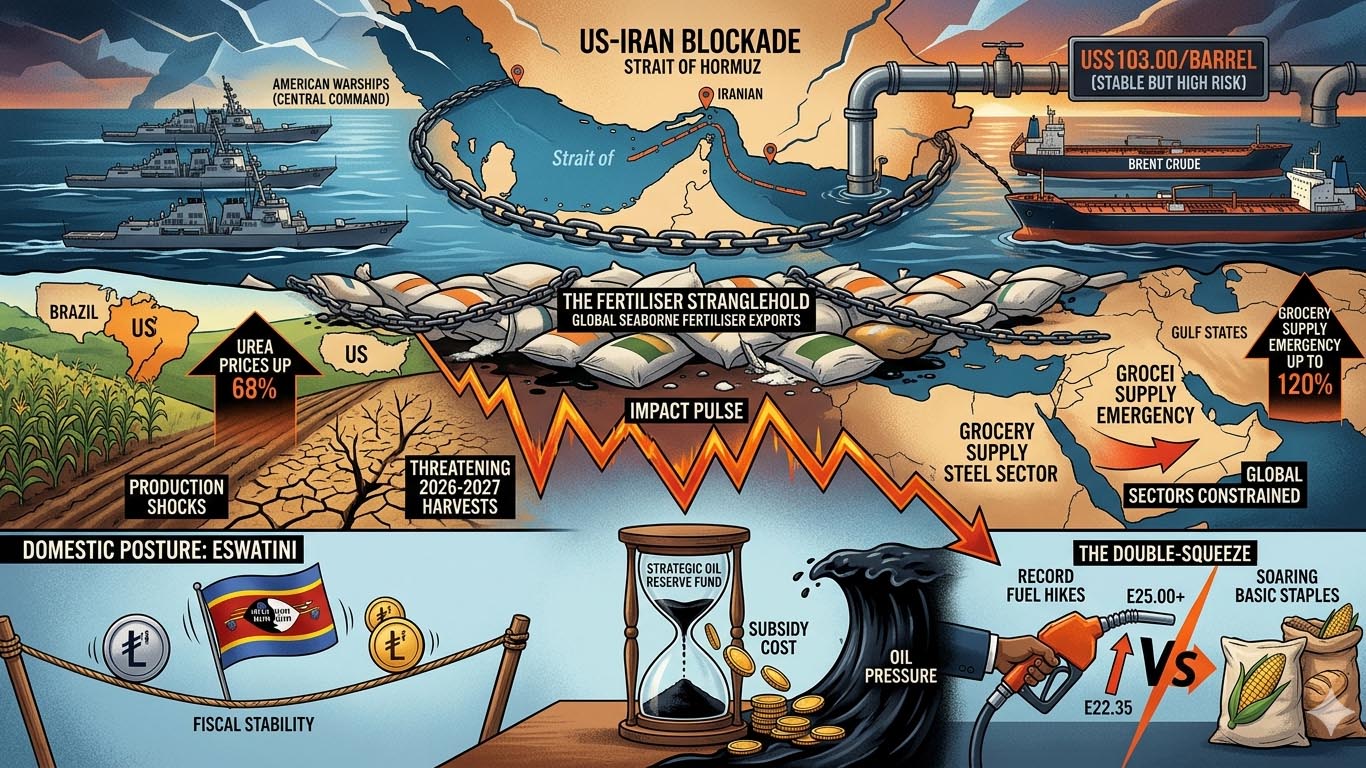
Last week, the world over was optimistic of a long-lasting ceasefire as the outcome of the talks between the US and Iran, held in Islamabad over the past weekend. The talks broke down over the weekend, sending the price of Brent Crude above the US$100 per barrel mark. Essentially, the world is in the same position as before the talks began and the impacts on global oil transit and the flow of commodities through the Strait of Hormuz remain limited and curtailed. Though the world is largely focused on the impacts of the war on the price of oil and the overall cost of energy. A very salient and under-analysed impacts of the war is the stranglehold that this war puts on the prices of fertiliser and likely impacts on the prices of food in the near term. Hence, today we are going to attempt to make sense of this new blockade within a blockade and map a new impact pulse for the global economy and our own economy.
The US blockade
Any commentary on the issue must start with unpacking the US blockade, try make sense of what it is. It is vital to note that any analysis of the matter relies on hour-on-hour news coming out of Washington, Tehran and Tel-Aviv. This remains a moving element, hence making for difficulty in understanding what it is and what it is not. Washington, through Central Command, has enforced a blockade on Iranian ports. This blockade, according to central command, will not affect any vessels departing from non-Iran ports. Also, vessels deemed to have paid for the right of passage to the Iranians, essentially, the endgame seems to be to cut Iran’s remaining economic functions. To this end, 15-20 American warships have been deployed to enforce this blockade as an apparatus to get Iran back to the negotiation table.
News out of Tehran, on the other hand, states that Iran continues to have control over traffic traversing the Strait. Also, Tehran has vowed that no port is safe unless Iran’s ports are safe. This essentially means that attacks on non-Iranian harbours and infrastructure remain under threat. Consequently, traffic in the Strait remains limited even with the US Navy presence in the Strait.
Europe and other nations refuse to be drawn into the Strait and offer protection. Global shipping remains very volatile within the Strait and as such, the price of Brent crude remains elevated above US$100 per barrel.
Impacts
The US blockade of the Strait of Hormuz has catalysed what the International Energy Agency (IEA) describes as the largest supply disruption in the history of the global oil market, forcing Brent Crude to surge past US$120 per barrel and triggering a wave of demand destruction across Asian and European industries. Though at present, the price of Brent crude averages US$103 since the blockade, however, risks remain and will push the price of Brent crude. Beyond energy, the most critical second-order shock is the paralysis of the global fertiliser market, as the Persian Gulf accounts for roughly 30 per cent of global seaborne fertiliser exports.
With one-third of global urea and significant phosphate supplies now stranded, prices for urea have spiked by over 68 per cent, leaving farmers in major breadbaskets like Brazil and the United States facing a production shock that threatens the 2026 and 2027 harvests. This grocery supply emergency is particularly acute in the Gulf States, which have seen food import costs rise by up to 120 per cent, while global manufacturers in the chemical and steel sectors have been forced to impose surcharges of up to 30 per cent to offset soaring feedstock costs. The cumulative effect is a period of global stagflation, where the 40-day threshold of disruption, passed in early April, has already locked in long-term food inflation and heightened the risk of a technical recession for energy-dependent economies.
Domestic posture
Eswatini’s economy is currently facing a precarious balancing act as the global surge in oil prices exerts extreme pressure on its domestic fiscal stability. As of mid-April 2026, the local price of fuel is heavily shielded by the Strategic Oil Reserve Fund, which is effectively subsidising the under-recovery costs, the massive gap between the actual landed cost of fuel and the regulated pump price. Currently, government is absorbing a deficit of roughly E332 million to keep Unleaded Petrol near E22.35 per litre, a move designed to prevent immediate excessive inflation in the transport and food sectors.
However, this Stabilisation Fund is being depleted at an unsustainable rate; if the global Brent Crude price remains above US$100 per barrel due to the ongoing Middle East blockade, government will likely be forced to pass these costs directly to consumers.
This would result in a sharp correction that could push fuel prices well beyond E25 per litre, threatening to destabilise the nation’s 2026 inflation targets and significantly increasing the cost of living for the average Swati household.As shipping costs and fertiliser shortages collide, the kingdom faces a double-squeeze of record fuel hikes and soaring prices for basic food staples like maize and bread.



















Leave a comment