

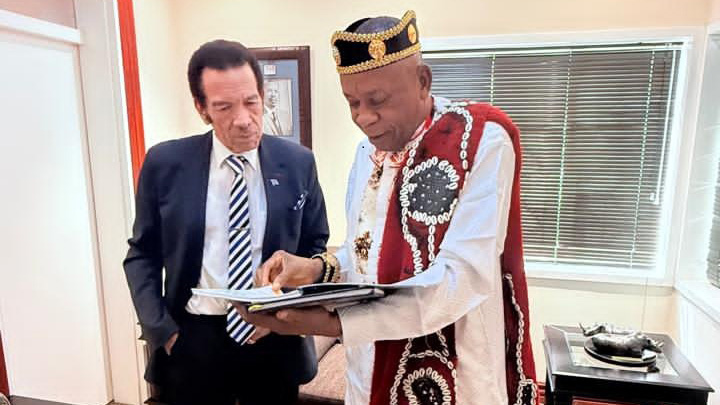
MBABANE – King Robinson Tanyi (Dr) has paid royal tribute to His Majesty King Mswati III.
He said Ingwenyama is an exemplary Monarch.
The King, who leads the African Indigenous Governance Council (AIGC) as president and head of the Tinto-Mbu Kingdom in Cameroon, says his council offers its highest honour to His Majesty King Mswati III of the Kingdom of Eswatini.
The Tinto-Mbu King said His Majesty King Mswati III’s Throne is a centre of national life.
His Majesty Tanyi made this royal statement in a tribute shared with the Times of Eswatini. It comes at a time when His Majesty King Mswati III celebrates his 40th anniversary on the Throne tomorrow, alongside his 58th birthday.
The AIGC, led by His Majesty Tanyi, is a continental body representing traditional leaders and institutions across Africa.
It advocates for integrating traditional leadership and indigenous knowledge into Africa’s formal development and governance structures, promoting peace, unity and cultural diplomacy
In this tribute, King Tanyi said the anniversary gathers the weight of four decades into a moment of continental recognition.
He said it specifically invites Africa to acknowledge a reign that has carried a nation with steadiness, cultural confidence and a deep understanding of the covenant between a people and their ancestral institutions.
King Tanyi said Eswatini stands as one of Africa’s most complete expressions of indigenous governance.
“The Throne remains the centre of national life. The councils of chiefs continue to anchor communities,” the Tinto-Mbu King said.
Regarding Sibaya in Eswatini (the People’s Parliament), he said it retains its role as the voice of the nation.
His Majesty stated that umphakatsi (royal kraal, meaning traditional leadership structure) sustains the link between land, lineage and leadership.
He added that these institutions form a living architecture that rises from the soil of Eswatini itself, holding the memory of a proud people and guiding the rhythm of a collective.
King Tanyi said the reign of Ingwenyama forms a significant chapter in the long story of African monarchy.
He recalled that the transition of 1986 carried forward the legacy of King Sobhuza II, whose leadership shaped the modern identity of Eswatini and strengthened the foundations, upon which the kingdom stands today.
Through shifting regional landscapes and global transitions, the King of the Tinto-Mbu Kingdom said His Majesty King Mswati III’s Throne has remained a steady centre.
He said Eswatini has preserved a governance tradition that speaks with the voice of its ancestors while engaging the world with a clear sense of identity.
“This continuity offers Africa a rare example of leadership grounded in its own foundations,” King Tanyi said.
He said the ceremonies of the Kingdom of Eswatini continue to express the spirit of the nation with remarkable depth.
He also mentioned that Incwala renews the spiritual heart of Eswatini and affirms the relationship between the Monarch, the land and the ancestors.
King Tanyi stated that Umhlanga (Reed Dance Ceremony) strengthens the bond between generations and carries forward the values that hold the nation together.
The Tinto-Mbu Kingdom’s leader emphasised: “These ceremonies are the pulse of a people.”
He further explained what these ceremonies do: “They embody unity, discipline and cultural pride in a form that speaks to both the past and the future.”
King Tanyi further noted that across these four decades, Eswatini has advanced in ways that reflect both cultural continuity and national progress.
He said education had expanded with primary school enrolment remaining above 85 per cent, while secondary enrolment had risen from around 30 per cent in the early 1990s to over 60 per cent today.
He added that literacy had stayed consistently above 85 per cent, strengthening the intellectual foundation of the kingdom.
He said the economy has grown from just over US$1 billion (E17 billion) in the mid-1980s to more than US$4 billion (E68 billion) today, placing Eswatini among the highest per-capita income countries in Sub-Saharan Africa outside oil-producing states.
King Tanyi noted with appreciation that electrification has increased from under 10 per cent to more than 80 per cent of households and access to clean water now reaches over 70 per cent of the population.
“These achievements reflect a nation that honours its heritage, while building its future with purpose,” he said.
For the African Indigenous Governance Council, His Majesty said this anniversary speaks directly to the work of restoring Africaʼs governance traditions to their rightful place.
He said the council draws strength from the patronage of His Majesty King Mswati III whose stewardship of Eswatini stands as a living example of the indigenous governance values AIGC advances across Africa.
King Tanyi said His Majesty King Mswati III’s leadership affirms the principle that African governance flourishes when it rises from its own cultural soil.
He said Eswatini, therefore, offers the continent a model that honours heritage, strengthens community and preserves the sacred relationship between people and land.
He mentioned that 40 years on the Throne reflects a life shaped by service to a nationʼs soul. He said it reflects a monarch who has carried the identity of his people with dignity.
King Tanyi said 40 years on the Throne reflects a leader whose stewardship continues to inspire traditional authorities across Africa and strengthens the continental movement to affirm indigenous governance as a modern and respected system.
As Eswatini marks this historic milestone, the King Tanyi stated that the AIGC stands in recognition of a reign that has fortified African heritage, strengthened cultural sovereignty and contributed to the renaissance of indigenous governance across the continent.
















Leave a comment