

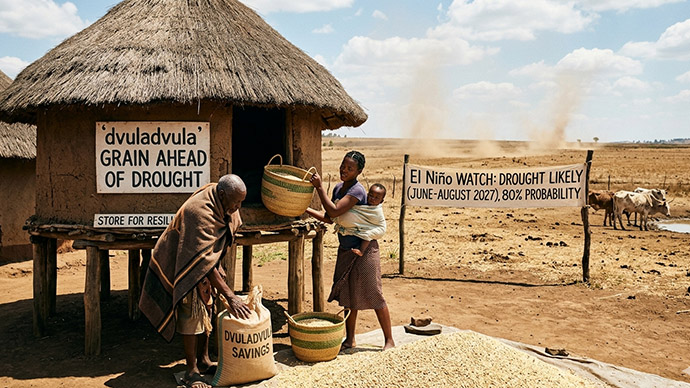
The long-awaited financial relief is finally within sight for thousands of civil servants. In about six weeks, government will dish out the remaining 85 per cent salary review backpay to our civil servants.
This massive E1.643 billion payout, dubbed ‘Dvuladvula’, will see individual gross cash ranging from E14 968 for lower grades up to a substantial E174 733 for the upper levels.
Naturally, this news has brought immense relief. For years, stagnant wages and a rising cost of living have put immense stress on our civil servants. Economists are already predicting a spectacular, short-term fiscal stimulus that will see a stampede of consumer spending on retail goods, home improvements and vehicle purchases, giving local businesses a much-needed boost.
However, as this wave of cash prepares to leave the public treasury, government should ensure there is enough left in the coffers to cater to a looming threat that will require an extensive amount of resources. The same goes for our civil servants.
Global climate monitoring agencies, including the World Meteorological Organisation (WMO) and the US National Oceanic and Atmospheric Administration (NOAA), have placed Southern Africa under an urgent ‘El Niño Watch’.
The data shows a staggering 80 per cent probability that an El Niño-induced drought will grip our region starting between June and August this year, with that probability climbing past 90 per cent as we move into early 2027.
This prediction should serve as a reminder of the consequences of ignoring warning signs. The horrific 2015/16 El Niño drought may have been a decade ago, but its impact is still being felt by many of those who suffered drastic losses in livestock and crops, especially in the Lowveld and Shiselweni regions.
That drought cost Eswatini a staggering E3.843 billion in national economic losses. It was a total structural collapse.
When our local water tables dried up and grazing lands turned to dust, the country rapidly ran out of hay bales. Because we failed to prepare, we were forced to rely on external markets where regional scarcity had driven import prices to exorbitant levels.
The average Swati smallholder was priced out of survival. The result? Over 80 000 heads of cattle, which serve as life savings and generational wealth for rural families, starved to death in our fields.
We cannot allow history to repeat itself by prioritising immediate pleasure over long-term survival. The Communications Manager for the National Disaster Risk Management Authority (NDRMA), Magman Mahlalela, has rightly cautioned: “Experience from previous El Niño events has shown that early preparedness significantly reduces the human and economic costs associated with drought and other climate-related impacts. This advisory is intended to encourage early action rather than cause alarm.”
What seems alarming, though, is that while disaster management experts and meteorologists are frantically sounding the horn, a sense of bureaucratic complacency is lingering within the Ministry of Agriculture. Speaking from his journey to a high-level summit in Egypt, Minister Mandla Tshawuka acknowledged the WMO alerts, but advocated for a passive, reactive approach rather than deploying a proactive State-level mobilisation plan. “We will monitor the situation until the farming season so that farmers remain updated,” Minister Tshawuka stated. “For now, we are approaching the matter cautiously so that we can respond appropriately. Weather predictions are not always certain. We remember recent predictions where farmers abandoned their fields in fear, only for the country to receive normal rains, leaving them in deep regret.”
With respect to the minister, a ‘wait-and-see’ strategy is a luxury this country cannot afford. While the Eswatini Meteorological Service reports that our current winter conditions look deceptively favourable, their long-range models show a rapid warming of the equatorial Pacific Ocean that will inevitably fracture our next crucial summer cropping season.
An official from the Meteorological Service, speaking on the condition of anonymity, was clear: “The current favourable winter conditions must not lull the public into a false sense of security. Our models indicate that while we are enjoying stable rain now, this brewing El Niño is highly likely to disrupt our crucial summer rainfall season, dropping precipitation far below the volumes required to sustain our agricultural baseline.”
This scenario is very worrying for our farming community, which is already restricted by the foot-and-mouth disease (FMD) outbreak curbing measures. Cedusizi Ndlovu, a passionate farmer from the Shiselweni Region, pointed out to our journalist the frustration brought about by the freezing of livestock movement across the country. “Farmers cannot sell their cattle to other regions to liquidate their assets before the drought hits. If government waits until the rainy season to act, our livestock will simply be legally cordoned off to die,” he said.
Rather than waiting, the Ministry of Agriculture should be acting today. They should be aggressively educating farmers on drought-resistant crops and actively engaging major commercial sugar cane estates to harvest and store sugar cane tops as well as harvest residues for emergency fodder before commercial feed prices rise beyond affordability for the ordinary farmer.
Yet, because we cannot rely on the state to move quickly, the burden of survival falls directly onto individual households. So, when ‘dvuladvula’ hits the bank account next month, the recipients must choose resilience, not indulgence, in order to save our families from a repeat of the 2015/16 disaster.


















Leave a comment