

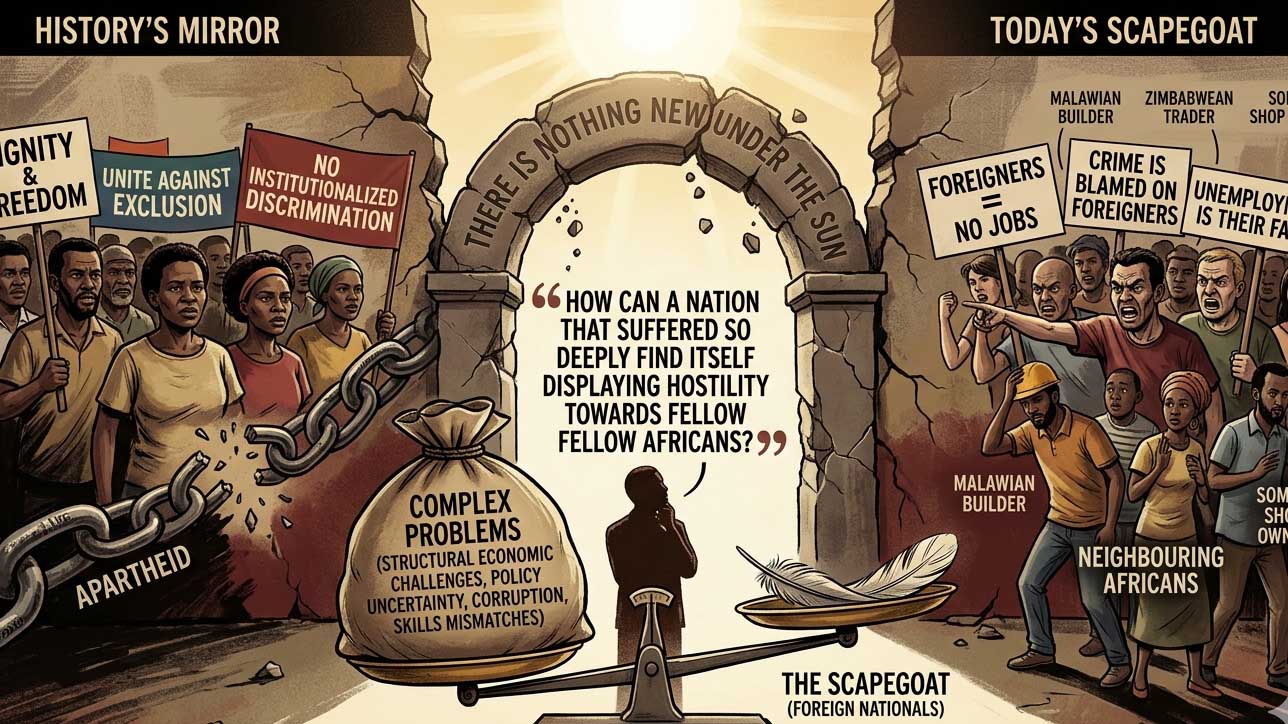
“There is nothing new under the sun.” Those timeless words, found in Ecclesiastes 1:9, may have been written thousands of years ago, though they remain remarkably relevant today as South Africa wrestles with questions of identity, belonging and blame.
Watching recent scenes of hostility directed at foreign nationals in parts of South Africa, one cannot help but marvel at the irony. Here is a country whose people endured one of history’s most notorious systems of institutionalised discrimination. Apartheid denied millions of black South Africans their dignity, freedom and opportunities based solely on characteristics they could not change. It was a cruel system founded on exclusion, division and the belief that some people belonged while others did not.
How then does a nation that suffered so deeply under such a system find itself with pockets of society displaying hostility towards fellow Africans? It is difficult to comprehend. Even more perplexing is the fact that many of those targeted come from neighbouring African countries, whose citizens supported South Africa’s liberation struggle in various ways. No sensible person disputes that undocumented immigrants should be dealt with according to the law. Every sovereign State has a responsibility to protect its borders and regulate migration. That principle is neither controversial nor unreasonable. A distinction must, however, be made between enforcing immigration laws and cultivating hostility towards people simply because they were born elsewhere.
What should concern all Africans is the growing tendency to portray foreign nationals as the source of virtually every challenge facing South Africa.
ANC Member of Parliament Buti Manamela once mocked the tendency to blame former President Jacob Zuma for everything that went wrong in the country. Speaking during a parliamentary debate, he remarked: “If the Rand is weak, blame Zuma. If there’s a cloud on Table Mountain, blame Zuma.”
His point was simple. Complex problems were being reduced to a convenient target. More than a decade later, the scapegoat appears to have changed.
Today, foreign nationals have become South Africa’s new Zuma. Crime is blamed on foreigners. Unemployment is blamed on foreigners. Pressure on public services is blamed on foreigners. Housing shortages are blamed on foreigners. Business closures are blamed on foreigners. Social decay is blamed on foreigners. Listening to some of the rhetoric, one could be forgiven for believing that every challenge confronting Africa’s most industrialised economy can somehow be traced back to a Zimbabwean trader, a Malawian builder, a Mozambican farm worker or a Somali shop owner. The reality is far more complicated.
South Africa’s unemployment crisis is rooted in decades of structural economic challenges. Slow economic growth, policy uncertainty, corruption, weak service delivery, skills mismatches, energy constraints and global economic headwinds have all contributed to the problem. To suggest that foreign nationals are responsible for unemployment levels affecting millions of South Africans is not serious analysis. It is merely an attempt to find an easy answer to a difficult question.
Scapegoating has always been politically convenient. It redirects frustration away from institutions, leaders and policies and places it squarely on a group that often lacks the numbers or influence to defend itself effectively. History is filled with examples of societies blaming outsiders during periods of hardship. Unfortunately, such blame seldom solves the underlying problem. It simply provides temporary emotional satisfaction while the real causes remain unaddressed. Economies do not recover because migrants are harassed. Jobs are not magically created because a foreign-owned shop is closed. Investment does not flow because communities have turned against outsiders.
For emaSwati, this debate is particularly important. Many of us have relatives living in South Africa. Others work there, study there, invest there or have married South Africans. Families, businesses and friendships stretch across borders. The relationship between Eswatini and South Africa is not merely diplomatic; it is deeply personal.
When some South Africans speak broadly about foreigners, do they also mean the liSwati nurse working in a hospital? The liSwati student attending university? The liSwati entrepreneur running a small business? The liSwati professionally contributing skills to the economy?
The question deserves careful consideration.
Former South African President Nelson Mandela once said: “No one is born hating another person because of the colour of his skin, or his background, or his religion.” Those words carry particular resonance in contemporary South Africa.
There is also a practical reality that cannot be ignored. No country is an island. No modern economy can fully sustain itself solely through the talents and labour of its own citizens. Human capital is among the world’s most valuable resources. Nations compete fiercely to attract skilled workers, entrepreneurs, researchers, healthcare professionals and investors.
The United States attracts talent from every corner of the globe. The United Kingdom relies heavily on foreign professionals in critical sectors. Gulf economies depend substantially on expatriate labour. Across Africa, people move between countries in pursuit of opportunities and livelihoods.
Migration is not an anomaly. It is a feature of human civilisation. The world develops when knowledge, skills, investment and people move across borders. Nationality itself should never become a crime. When society begins viewing entire groups of people as responsible for its problems, alarm bells should sound. And sound loudly, cacophonously if need be.

















Leave a comment