

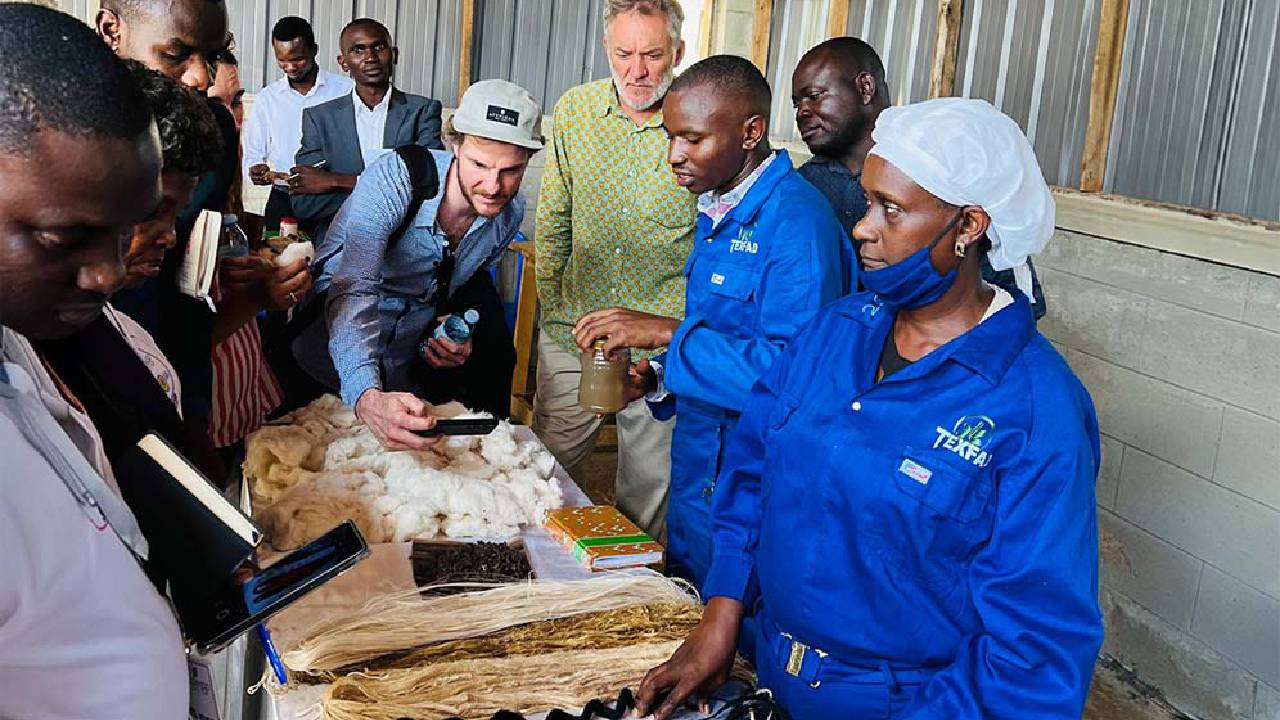
UGANDAN researchers are transforming discarded banana stems into textiles, hair exten¬sions and sanitary pads, posi¬tioning the East African nation to capitalise on growing global demand for sustainable fibres.
The Banatex-EA (Banana Textiles in East Africa) project at Busitema University, eastern Uganda, has created spinnable banana fibre that can be used in textile production, presenting an alternative to cotton and synthetic materials, the researchers say.
Project leader Edwin Kamalha, a lecturer in Textile Engineering at the university, says the initiative will make banana production less waste¬ful and provide an extra source of revenue for farmers.
“Banana fibre shares several desirable properties with cotton—our most widely used natural textile fibre,” Says Ka¬malha. His team focused on developing techniques to soften the fibre, making it more like cotton.
This enabled them to produce spinnable banana fibre for cloth and hair extensions.
WHY BANANA FIBRE?
KAMALHA, Head of the Department of Polymer,Textile and Industrial Engineering, Busitema University says:
“It’s a plant that generates a lot of waste, and if people can tap into that waste to earn an extra income, what was once discarded can become a valuable resource,” he says.
Banana fibres share several desirable properties with cotton, Uganda’s most widely used natural textile fibre, Kamalha explains. He believes the global impact of using it in textiles could be significant.
The team began their research in March 2024. They received funding of £600 600 (around 3 billion Ugandan Shillings) from the Uganda National Council for Science and Technology under the Science Granting Councils Initiative (SGCI). Additional support came from partners including the UK’s Foreign, Commonwealth and Development Office.
Bananas are one of the most widely grown staple food crops in Uganda, cultivated by about three quarters of farmers. However, a significant amount of the harvested plant becomes post-harvest waste.


















Leave a comment