

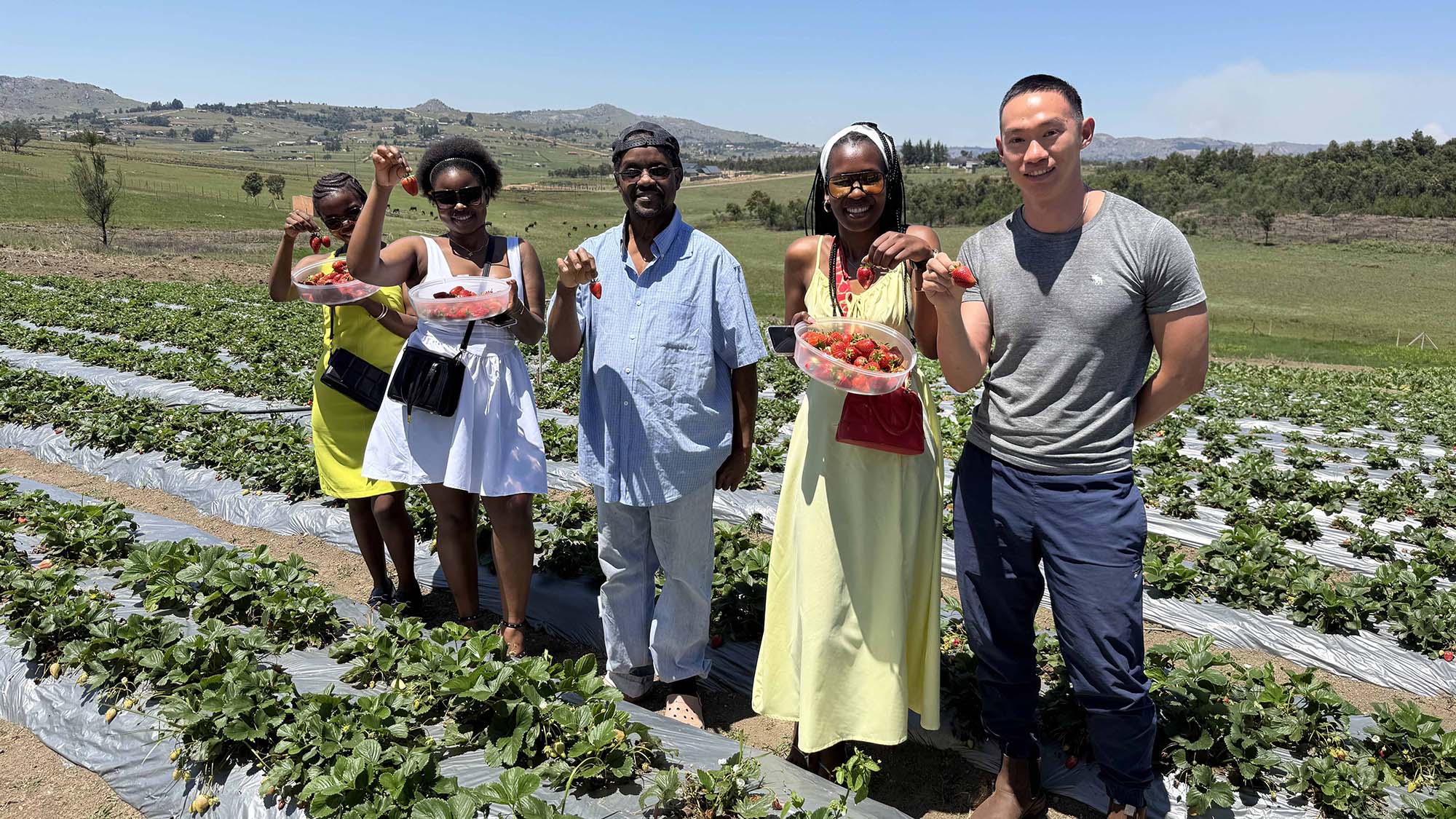
With long-term support from the Taiwan Technical Mission (TTM), Eswatini’s strawberry industry is steadily evolving towards diversification and professionalisation. In May this year, Happiness Simelane, a member of the Hawane Multi-purpose Co-operative, successfully transformed her traditional strawberry farm co-owned with her husband Cyprian Simelane into Eswatini’s first strawberry hand-picking experience under the guidance of Alex Lin, specialist of the Emerging Fruit Tree Production, Marketing and Capacity Building Project. The farm, now open for public picking activities, marks a new chapter of agricultural innovation in Eswatini.
Located in the Hhohho Region, the farm enjoys a cool climate and moderate humidity, ideal conditions for strawberry growth. The significant temperature difference between day and night enhances sugar accumulation and aroma, producing strawberries that are bright red, firm and flavourful.
In the past, Happiness cultivated strawberries in open fields and sold her harvest at local markets. However, due to unpredictable weather and market fluctuations, her income was often unstable.
Under TTM’s technical guidance, she adopted Integrated Pest Management (IPM) practices, drip irrigation and mulching techniques to overcome challenges such as drought and pest damage. Based on local environmental conditions, Specialist Alex Lin also helped her instal shade and bird nets to ensure fruit cleanliness and improve yield stability. As her cultivation skills advanced, Lin encouraged her to embrace the concept of agricultural experience-based business, transforming her production site into a farm that integrates education, hands-on activities and direct sales.
After months of preparation, the farm officially opened to the public in September 2025. Currently, it offers pick-your-own strawberry experiences, with future plans to add a rest area where visitors can safely and comfortably enjoy the harvest season.
Guests can not only taste freshly picked strawberries, but also purchase homemade strawberry jam, vegetable produce and strawberry seedlings, promoting a full farm-to-table experience.
Since opening, the farm has gained popularity through social media platforms such as Facebook and Instagram, attracting families and young people eager to experience the joy of handpicking strawberries. On weekends, the farm buzzes with laughter and excitement as parents and children walk between rows of strawberry plants, enjoying the hands-on fun. To Happiness’ surprise, some visitors have even travelled from Mpumalanga and KwaZulu-Natal provinces in South Africa, bringing new energy and tourism income to the small community.
In an interview, Shabangu shared: “I never imagined my strawberry farm could become a place where people come to experience harvesting and connect with nature. Before, I was just growing and selling strawberries, but now I can share their story and see people’s happy smiles. I’m deeply grateful to TTM for helping me make this dream come true.” She added that she plans to expand her cultivation area and build a small café corner, allowing visitors to enjoy strawberry desserts and drinks while relaxing at the farm.
Lin highlighted that Shabangu’s transformation demonstrates that agricultural innovation is not only about technology, but also about a shift in entrepreneurial mindset. “In Eswatini, many farmers still rely on traditional selling methods and respond slowly to market changes. Happiness showed great courage and a willingness to learn. By integrating modern cultivation practices and creating a brand identity, she successfully increased the value of her products,” Lin said. He added that experience-based farming can help smallholders secure more stable income sources, while fostering rural employment and community development.
Other members of the Hawane Co-operative have since visited the farm to learn from her success, hoping to apply similar approaches in their own operations. The co-operative’s chairperson noted that the establishment of this strawberry experience farm has not only increased community visibility, but also inspired young people to see farming as a viable and attractive career path.















Leave a comment