

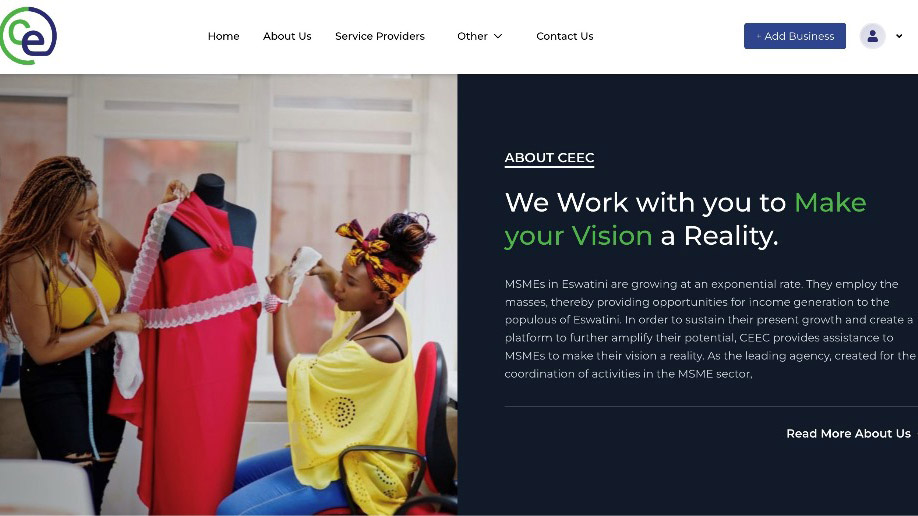
The Citizens Economic Empowerment Council (CEEC) is leading a major national drive to increase visibility, market access and formal recognition for Micro, Small and Medium Enterprises (MSMEs) in Eswatini – a sector which accounts for more than 90 per cent of the country’s business activity and yet remains largely invisible in official datasets and procurement pipelines.
The initiative is centred around a national MSME Registry Platform, developed with support from the Ministry of Commerce, Industry and Trade and technical partners.
The platform makes it possible for businesses, even informal ones to create digital profiles that can be seen by customers, financiers, corporates and public sector buyers.
According to CEEC, the lack of structured profiling has historically meant that small businesses are unable to access markets beyond their neighbourhoods and are often excluded from procurement opportunities simply because there was no central way to verify them or discover their offerings.
In short: Eswatini’s biggest business sector has been hidden in plain sight.
This new digital register is designed to correct that.
CEEC officials emphasise that the platform is not intended for taxation or penalties, but for economic empowerment, market access and business visibility.
The objective is to level the playing field for ordinary liSwati business owners, not to regulate or restrict them.
The council says the platform is not a ‘technology product’ in isolation, it is a national economic empowerment tool.
It supports government’s push for import substitution, local supplier development and fairer access to opportunity. It gives the public and private sector a legitimate pool of suppliers to source from when buying goods and services.
In turn, small businesses gain visibility, credibility and a digital footprint without needing to physically register with multiple stakeholders or wait for referrals.



















Leave a comment