

Maize is one of the most important staple and commercial crops in Eswatini. However, Soil Science and Plant Nutrition Research Officer Bongani Mvubu says a successful maize enterprise does not end in the field, it depends greatly on proper harvesting and post-harvest handling. “Poor timing, inadequate drying and weak storage facilities can lead to serious losses through pests, mould and spoilage,” he shared.
- Preparation for harvesting maize
Preparation should begin 2–3 weeks before expected harvest. The following steps are critical:
- a) Field assessment
- Monitor crop maturity and moisture levels.
- Check for lodging (fallen plants).
- Inspect for pest damage (stalk borers, rodents, birds).
- b) Organise labour and equipment
- Arrange sufficient labour.
- Prepare harvesting tools (hand slashers, sickles, combine harvesters, maize shellers if needed).
- Clean and disinfect storage facilities.
- c) Prepare storage in advance
- Storage must be ready before harvesting begins. This includes:
- Constructing or repairing maize cribs.
- Ensuring fencing is intact.
- Clearing vegetation around storage areas.
Failure to prepare storage early often results in maize being heaped on the ground, increasing contamination and moisture absorption.
- Maize crib construction
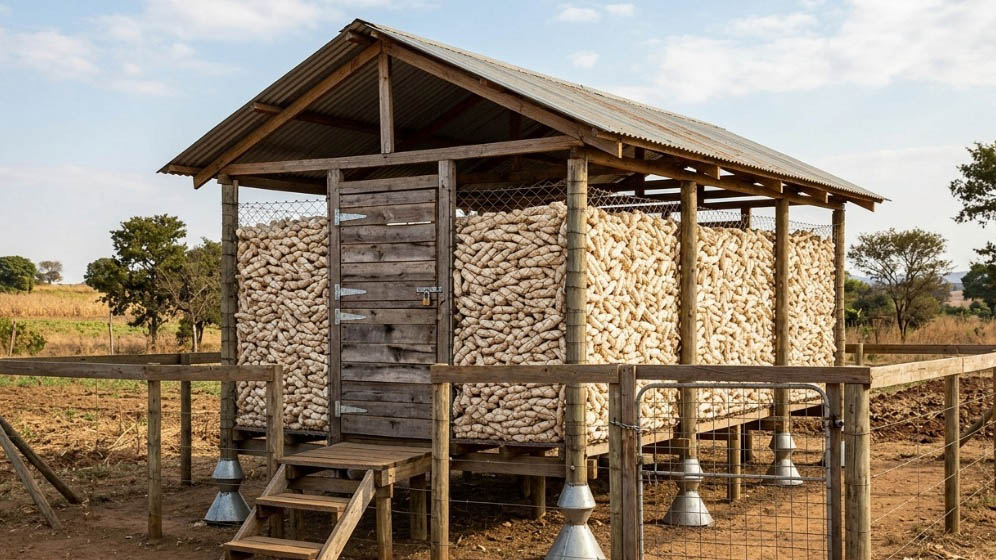
A maize crib is a well-ventilated storage structure used to dry and store maize cobs before shelling.
Standard elevated maize crib (recommended design)
For small to medium-scale farmers:
- Width: 2 metres
- Length: 4 metres, can be more depending on produce
- Height above ground: 1 metre
- Wall height: 2–3 metres
- Roof overhang: At least 0.5 metres to prevent rain splash
- Steps: To enable loading maize on the crib, but removed once crib is full
These dimensions allow good air circulation while providing sufficient storage capacity.
Key construction features
- Elevation (1 metre above ground)
- Supported by strong treated wooden poles.
- Prevents moisture absorption from soil.
- Reduces rodent access.
- Rat Baffles (Rat Guards)
- Installed on each supporting pole.
- Made from smooth metal sheets shaped like inverted cones.
- Prevent rats from climbing into the crib.
- Corrugated iron roof
- Galvanized iron sheets.
- Sloped for rainwater runoff.
- Wide overhang protects walls from direct rain.
- Fencing
- Wire mesh fence around the crib.
- Prevents livestock and unauthorized access.
- Recommended fence height: 1.5 metres.
- All wood should be treated against termites and decay.
- Why use a maize crib?
Using a maize crib offers several advantages:
- Proper drying
The open slatted design allows continuous airflow, reducing moisture content naturally.
- Reduced post-harvest losses
- Minimises mould growth.
- Reduces aflatoxin contamination risk.
- Prevents rodent and livestock damage.
- Improved grain quality
Well-dried maize has:
- Better market value
- Longer storage life
- Higher seed viability
- Food safety
Poor drying leads to fungal growth, which may produce toxins harmful to humans and livestock.
- When to harvest maize
Harvest timing is critical.
Signs of Physiological Maturity
- Husks turn brown and dry.
- Cobs droop downward.
- Kernels are hard and shiny.
- Black layer forms at the base of kernels.
Moisture content
- Ideal harvesting moisture: 20–25% (on cob)
- For storage: Must be dried to 12–13% (shelled grain)
Harvesting too early results in:
- Shrivelled grain
- Poor weight
- Higher drying costs
Harvesting too late increases:
- Field pest damage
- Lodging
- Theft risk
- How to harvest maize
Step 1: Select mature cobs
Only harvest fully mature and dry cobs.
Step 2: Hand harvesting
- Twist or snap cobs from stalks.
- Avoid pulling entire plants unnecessarily.
Step 3: Remove damaged cobs
- Separate mouldy or insect-damaged cobs.
- Do not mix with good maize.
Step 4: Transport carefully
- Use clean bags or trailers.
- Avoid placing cobs directly on wet soil.
Step 5: Load into crib
- Arrange evenly for airflow.
- Do not compress tightly.
Allow maize to dry in crib for 4–8 weeks before shelling (depending on weather conditions).
- What to avoid when harvesting maize
Harvesting wet maize: Leads to mould and aflatoxin contamination.
Heaping maize on bare ground: Causes contamination and moisture absorption.
Mixing good and bad cobs: Accelerates spoilage.
Poor ventilation: Closed storage encourages fungal growth.
Delayed harvest: Increases pest and rodent damage.
Using untreated wood: May lead to termite damage and structural collapse.
- Additional post-harvest recommendations
- Shell maize only after proper drying.
- Use moisture meters where available.
- Treat shelled maize with recommended grain protectants.
- Store in clean, dry, airtight bags or silos.
- Regularly inspect for pests.



















Leave a comment