


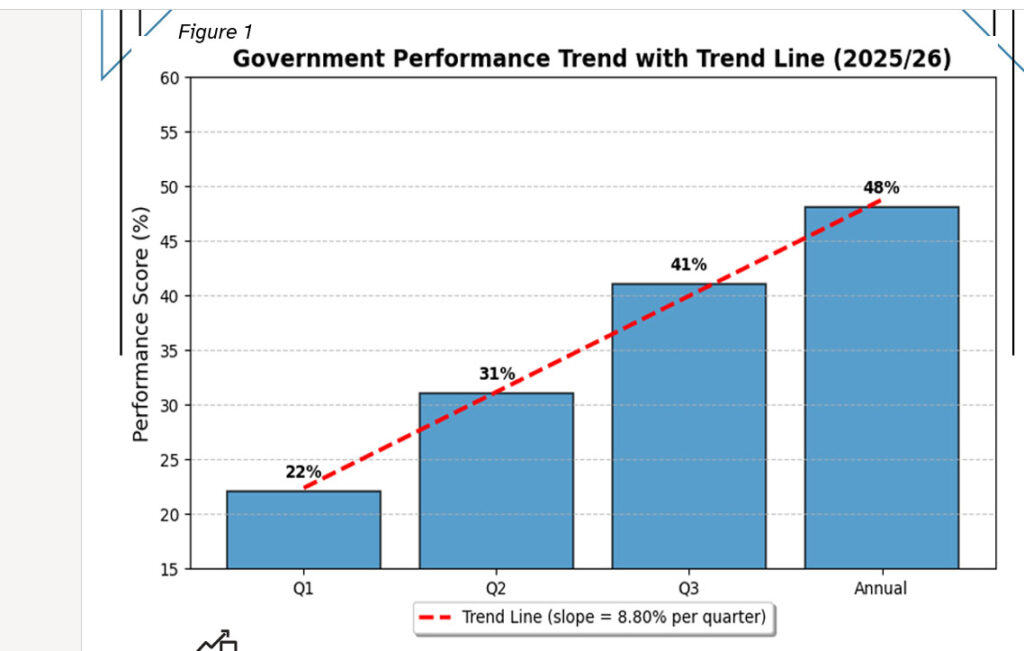
LOBAMBA – The performance of government, through the various ministries, improved from 22 per cent in the first quarter of the 2025/2026 financial year to 48 per cent.
However, the score remains below what would be expected from the performance of the various ministries to meet the ambitious Nkwe Programme of Action targets.
This was revealed by the Prime Minister (PM), Russell Mmiso Dlamini, when he presented the first-ever Government Performance Report of 2025 during a press conference held at Cabinet yesterday.
The report, which assesses government’s implementation of the Nkwe Programme of Action during the 2025/26 financial year, shows that while performance improved steadily throughout the year, government, through the various ministries, still fell short of delivering more than half of its targeted programmes.
The annual performance score of 48 per cent represents a significant improvement from the 22 per cent recorded in the first quarter. However, the figure also highlights the scale of work required if government is to achieve the development targets set for 2029.
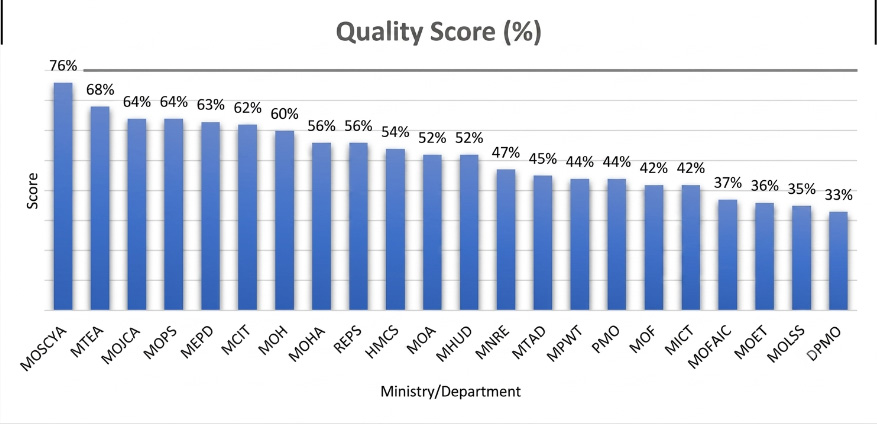
According to the report, prepared by the Policy and Programme Coordination Unit (PPCU), government performance was assessed using three key areas: Execution of plans, which accounted for 80 per cent of the score; quality of execution, at 15 per cent; and timeliness of reporting, at five per cent.
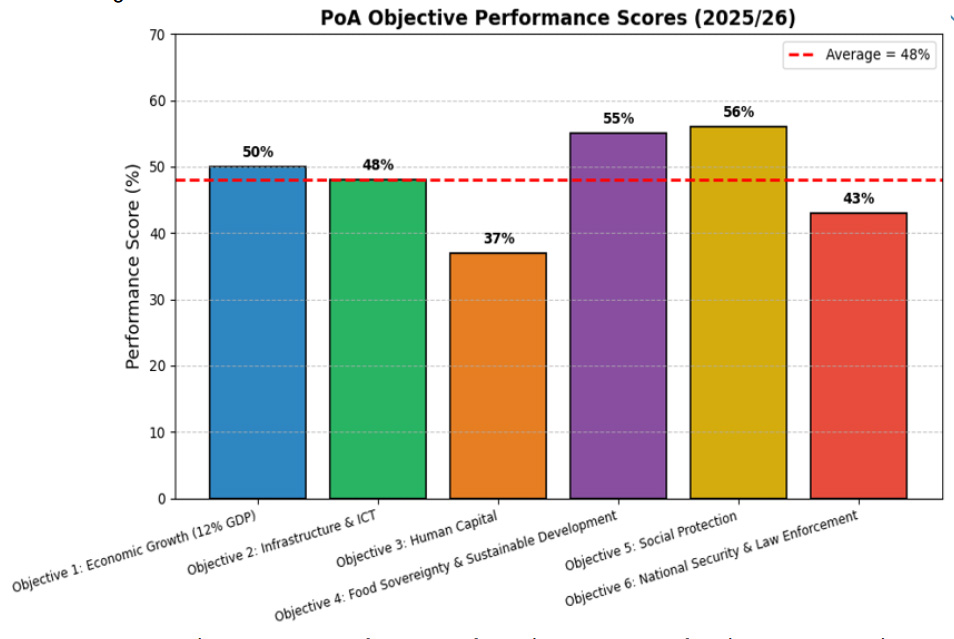
The assessment was intended to provide a comprehensive picture of implementation across government, including progress on national priorities, service delivery and the six objectives contained in the Nkwe Programme of Action.
Presenting the report, Dlamini said the improvement demonstrated that ministries were accelerating implementation as the financial year progressed.
He, however, acknowledged that the 48 per cent score was a warning that implementation needed to be significantly accelerated.
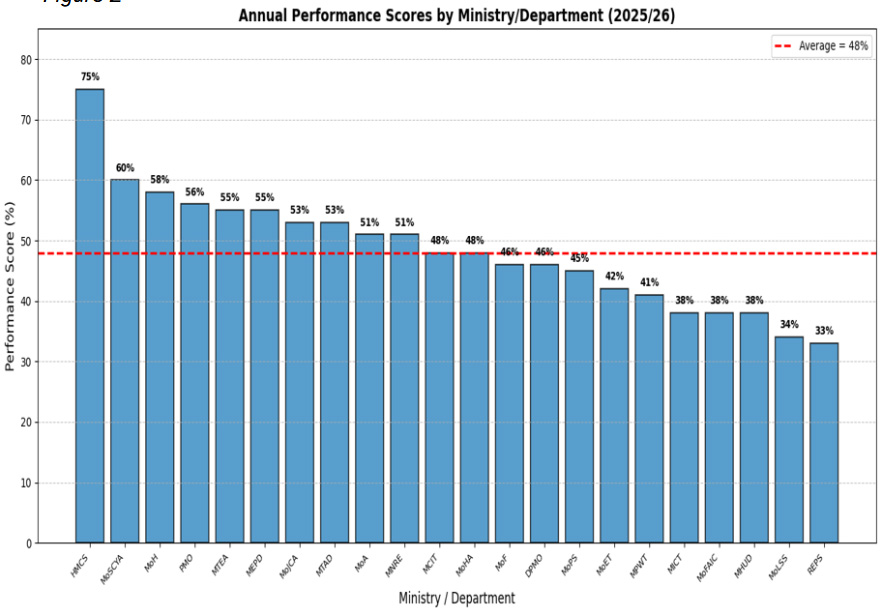
Among ministries and departments, His Majesty’s Correctional Services emerged as the best-performing institution, recording an overall score of 75 per cent.
It was followed by the Ministry of Sports, Culture and Youth Affairs at 60 per cent, the Ministry of Health at 58 per cent and the Prime Minister’s Office at 56 per cent.
These institutions were the only ones listed as performing above the national average, with the report attributing their performance to effective planning, strong leadership and disciplined execution.
The results varied considerably across the six Programme of Action objectives. Despite the overall score, the report highlighted several achievements recorded during the financial year.
However, it also identified persistent challenges that slowed implementation across ministries and departments. Among the major constraints were delays in the release of budgets, procurement bottlenecks, difficulties in inter-ministerial coordination, legislative delays and dependence on external funding partners.
Weaknesses in planning and reporting were also identified as factors contributing to delays in implementing planned outputs.
Dlamini said the challenges needed to be addressed if government was to improve its performance and ensure that planned programmes translated into tangible benefits for the public.
“The overall performance score is a clear call for accelerated action.”
Another major concern raised in the report was government’s compliance with performance reporting requirements.
The PM said the performance assessment should not only be viewed as a measure of what government had failed to achieve, but also as a tool for improving future implementation.
The findings will be used to inform planning, resource allocation and performance management in the coming period.
Dlamini maintained that government remained committed to ensuring that public programmes resulted in tangible improvements in the lives of emaSwati.
“The findings of this report provide a clear roadmap for strengthening government performance and ensuring that national development commitments translate into tangible benefits for the people of Eswatini.”
With an annual performance score of 48 per cent, government now faces the challenge of turning the lessons from the assessment into faster implementation.
The report effectively places greater pressure on ministries to improve execution, strengthen accountability and ensure that resources are directed towards programmes capable of delivering measurable results.
The PPCU used the approved Criteria for Assessment of Ministry Performance Reports to measure government performance during the 2025/26 financial year.
The assessment framework measures performance across three main components: Execution of plans, quality of execution and timeliness of submission.
Execution of Plans accounts for 80 per cent of the assessment and measures the degree to which ministries achieved their planned outputs.
Under this component, performance is assessed by comparing final realised outputs against planned outputs, as well as planned activities against activities that were actually undertaken.
Quality of Execution accounts for five per cent and evaluates whether outputs meet the expected standards.
The assessment also considers efficiency, including whether projects were completed within the allocated budget and prescribed timeframe, as well as the impact and innovation associated with implementation.
The report states that quality of execution is assessed annually and at the end of the term.
Timeliness of submission accounts for a further five per cent and assesses whether ministries submitted their performance reports by the prescribed deadline of March 27, 2026.
Ministries that submitted their reports after the deadline received a score of zero per cent for this component.
The assessment process involved several stages, beginning with the definition of expected outputs and activities.
Ministries then submitted annual reports detailing their actual outputs and activities during the financial year.
These reports were supplemented by supporting evidence, including completion certificates, attendance records and financial statements.
The assessment process also involved site visits and independent verification where possible.















Leave a comment