

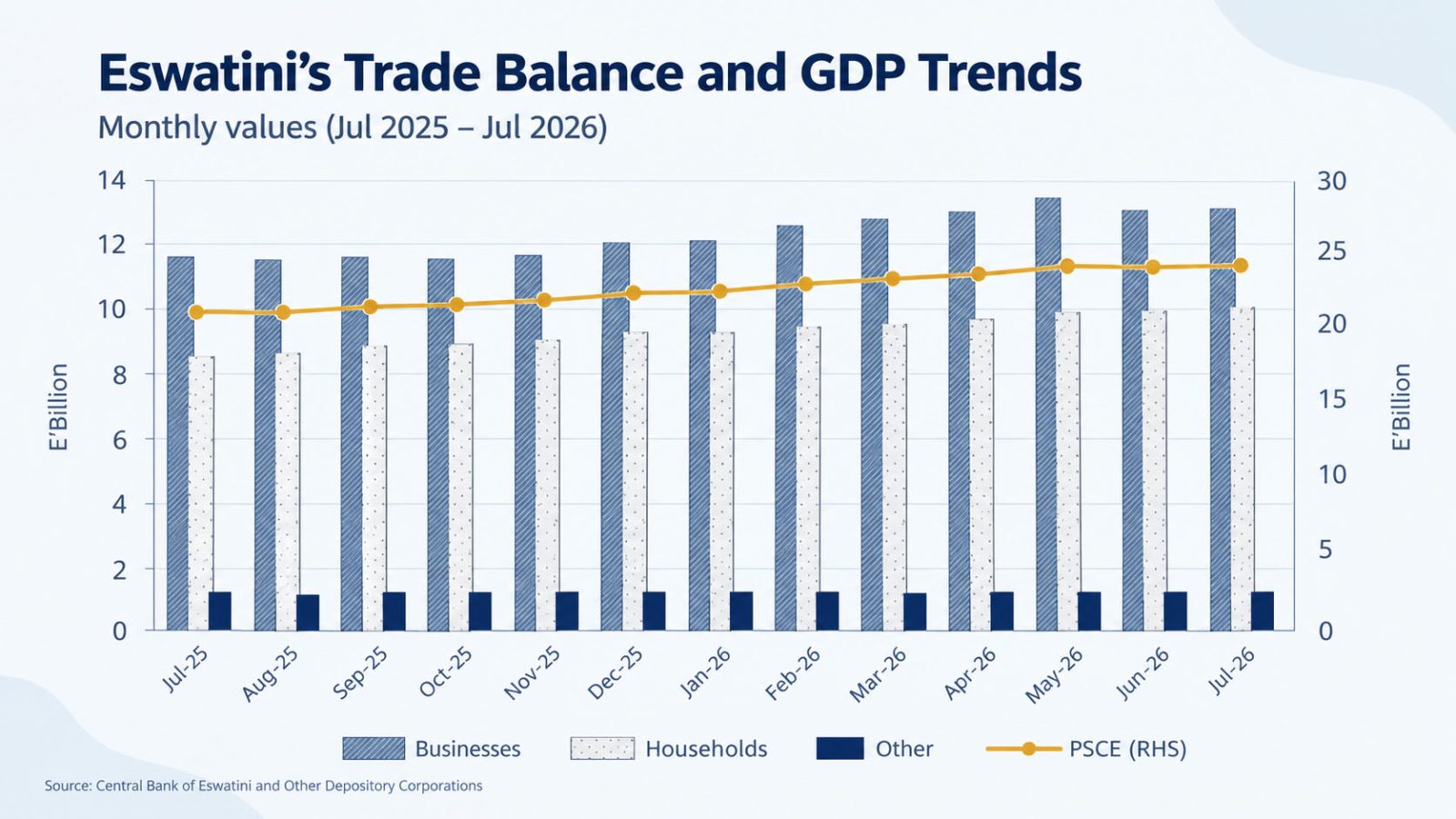
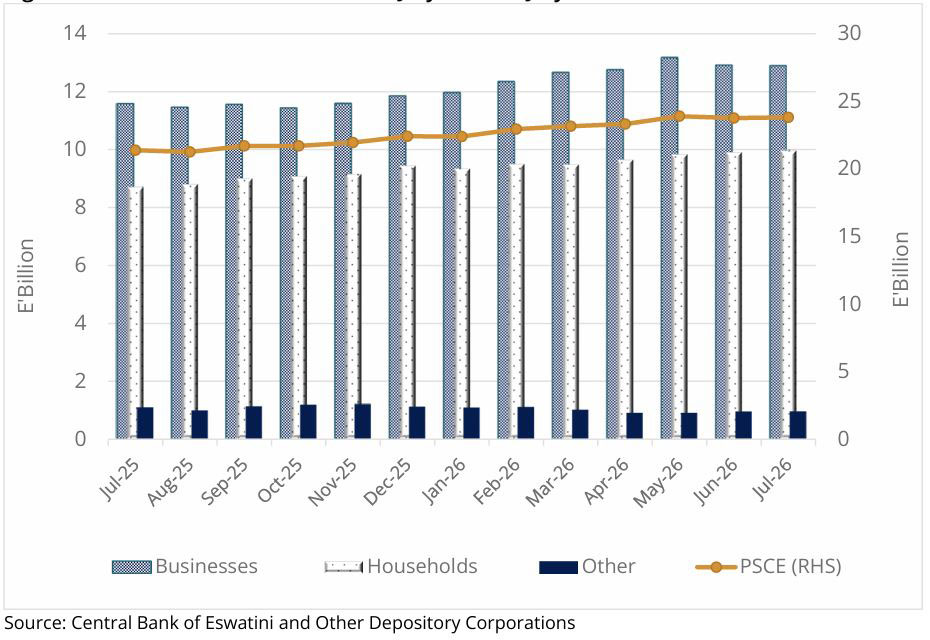
MBABANE – Private sector credit edged higher to E23.8 billion in July 2026, although lending to businesses and small enterprises recorded declines during the month.
The Central Bank of Eswatini (CBE)’s July/August 2026 Monthly Statistical Release shows that credit extended to the private sector increased by 0.2 per cent month-on-month and 11.4 per cent year-on-year, with the monthly expansion largely driven by increased borrowing by households and other sectors of the economy.
However, the figures reveal a divergence between household and business lending, with credit to the business sector contracting marginally while household borrowing continued to grow.
Credit extended to businesses fell by 0.1 per cent month-on-month to E12.9 billion in July, although it remained 11.3 per cent higher than a year earlier.
The decline was mainly attributed to reduced lending across several industries, including manufacturing, agriculture and forestry, construction, transport and communication, and real estate.
Manufacturing recorded the largest contraction among the affected sectors, with credit falling by 3.7 per cent, followed by agriculture and forestry at 1.2 per cent. Construction declined by 0.8 per cent, while transport and communication and real estate each contracted by 0.3 per cent.
The declines were partly offset by stronger lending to community, social and personal services, which grew by 18 per cent, mining and quarrying by 4.1 per cent, and distribution and tourism by 0.7 per cent.
The monthly decline in business lending was particularly pronounced among small and medium-sized enterprises (SMEs).
According to the CBE, credit extended to SMEs contracted by 4.9 per cent month-on-month and 1.8 per cent year-on-year to E3.6 billion in July.
In contrast, lending to large enterprises increased by 1.9 per cent month-on-month and 17.5 per cent year-on-year, reaching E9.2 billion.
Household borrowing rises
While businesses experienced a marginal contraction, households and non-profit institutions serving households recorded stronger credit growth.
Household credit reached E10 billion, representing a 0.6 per cent month-on-month increase and 14.4 per cent growth year-on-year.
The monthly increase was supported by unsecured personal loans and motor vehicle financing. Other personal loans increased by 1.3 per cent to E4.2 billion, while motor vehicle loans grew by 0.6 per cent to E1.5 billion.
Housing loans, however, declined marginally by 0.1 per cent to E4.3 billion.
Money supply expands
The country’s broad money supply also increased during July.
Broad money supply, measured as M2, rose by 3.2 per cent month-on-month and 12.5 per cent year-on-year to E28.5 billion.
The CBE attributed the expansion to increases in private sector credit and net foreign assets.
Narrow money supply, or M1, increased by 5.2 per cent month-on-month and 14.2 per cent year-on-year to E10.7 billion.
The increase was largely driven by a 19.4 per cent rise in Emalangeni in circulation to E1 billion, while transferable demand deposits increased by 3.8 per cent to E9.6 billion.
Quasi-money also expanded by 2 per cent month-on-month and 11.5 per cent year-on-year to E17.9 billion, supported by increases in savings and time deposits.
Banking liquidity eases
Despite growth in money supply, the banking sector recorded a slight weakening in its liquidity position.
Domestic liquid assets fell by 1.1 per cent month-on-month but remained 4.8 per cent higher year-on-year, standing at E8.6 billion in July.
The CBE said the monthly decline was mainly due to lower cash holdings and balances held by banks with the Central Bank, as well as reduced currency held by commercial banks.
Consequently, the banking sector’s liquidity ratio declined from 32 per cent in June to 31.2 per cent in July.
Reserves recover in August
On the external front, provisional gross official reserves increased during August.
Reserves rose by 3.9 per cent month-on-month to E10.4 billion, although they were still 12 per cent lower year-on-year.
The CBE attributed the monthly improvement mainly to Rand inflows arising from trades with commercial banks.
As a result, the country’s import cover improved from 2.3 months in July to 2.4 months in August.




















Leave a comment