

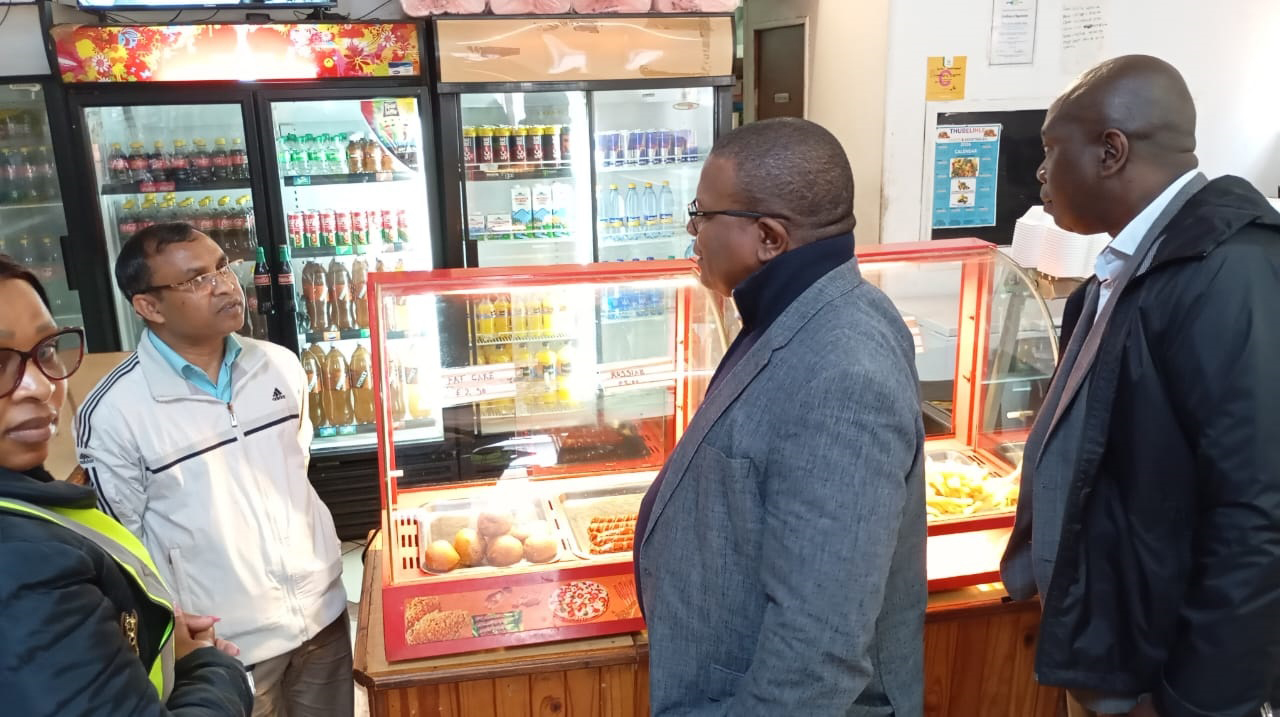
MBABANE – Minister for Commerce, Industry and Trade Manqoba Khumalo is championing a nationwide inspection exercise aimed at ensuring businesses comply with Eswatini’s laws and regulatory requirements.
Khumalo said the exercise is intended to ensure that businesses operating across the country have the necessary licences and permits and meet their statutory obligations, including the payment of taxes and contributions to institutions such as the Eswatini National Provident Fund (ENPF).
The inspections will also scrutinise the compliance of foreign-owned businesses, particularly whether they have the required documentation to operate legally in Eswatini.
The inspection exercise commenced on August 26 and will last for two months. Today, the minister joined the inspectorate team at Holneck and Nhlangano town for the national inspection exercise.
Khumalo’s push for greater compliance comes as government accelerates efforts to promote citizen participation and ownership in the economy through the Citizens Economic Empowerment Act.
The regulations to the Act were recently tabled in Parliament and provide for the reservation of a broad range of economic activities for targeted citizen-owned companies.
One of the key provisions is that all retail operations with an annual turnover below E8 million are to be reserved for emaSwati.
The threshold covers a wide range of everyday businesses, including general dealer shops, supermarkets, grocery shops, pharmacies, automotive spares, hardware shops, liquor outlets, laundries and dry-cleaning businesses, agricultural inputs and feed shops, minimarkets and convenience stores.
The regulations form part of government’s wider push to increase local ownership and control of economic activities, with the Citizen Economic Empowerment Council playing a central role in implementing the framework.
The retail reservation provision follows government’s stated objective of ensuring that more economic opportunities are accessed by citizen-owned businesses.
Khumalo has described the empowerment framework as a major step in transforming economic participation, while the regulations establish specific areas and thresholds where activities will be reserved for targeted citizen-owned companies.
The nationwide inspections therefore come at a time when government is seeking both stronger regulatory compliance among existing businesses and greater participation of emaSwati in the ownership of businesses operating in the country.

















Mine as a Swazi Citizen lesizamako ngitsi ngiyatibongela kakhulu ku Mntungwa kucabangela Sive Semaswati since car washes, chemist, groceries, tire businesses, mobile money and almost everything is taken by foreigners and tsine we do not have that much capital to kick start our business. Sicelo sami sinye kutsi EmaSwati must have easy access to business capital ngiyacela.