It is encouraging that the African continent has embraced an African institution to measure governance among countries in Africa. The Mo Ibrahim Foundation defines governance as ‘the provision of political, social, economic and environmental public goods and services that every citizen has the right to expect from their government, and that a government has the responsibility to deliver to its citizens’.
The former United Nations Secretary General once said: “Good governance is perhaps the single most important factor in eradicating poverty and promoting development.” Hence, we need to think aloud about how our beloved kingdom should address its governance weaknesses.
Governance trend
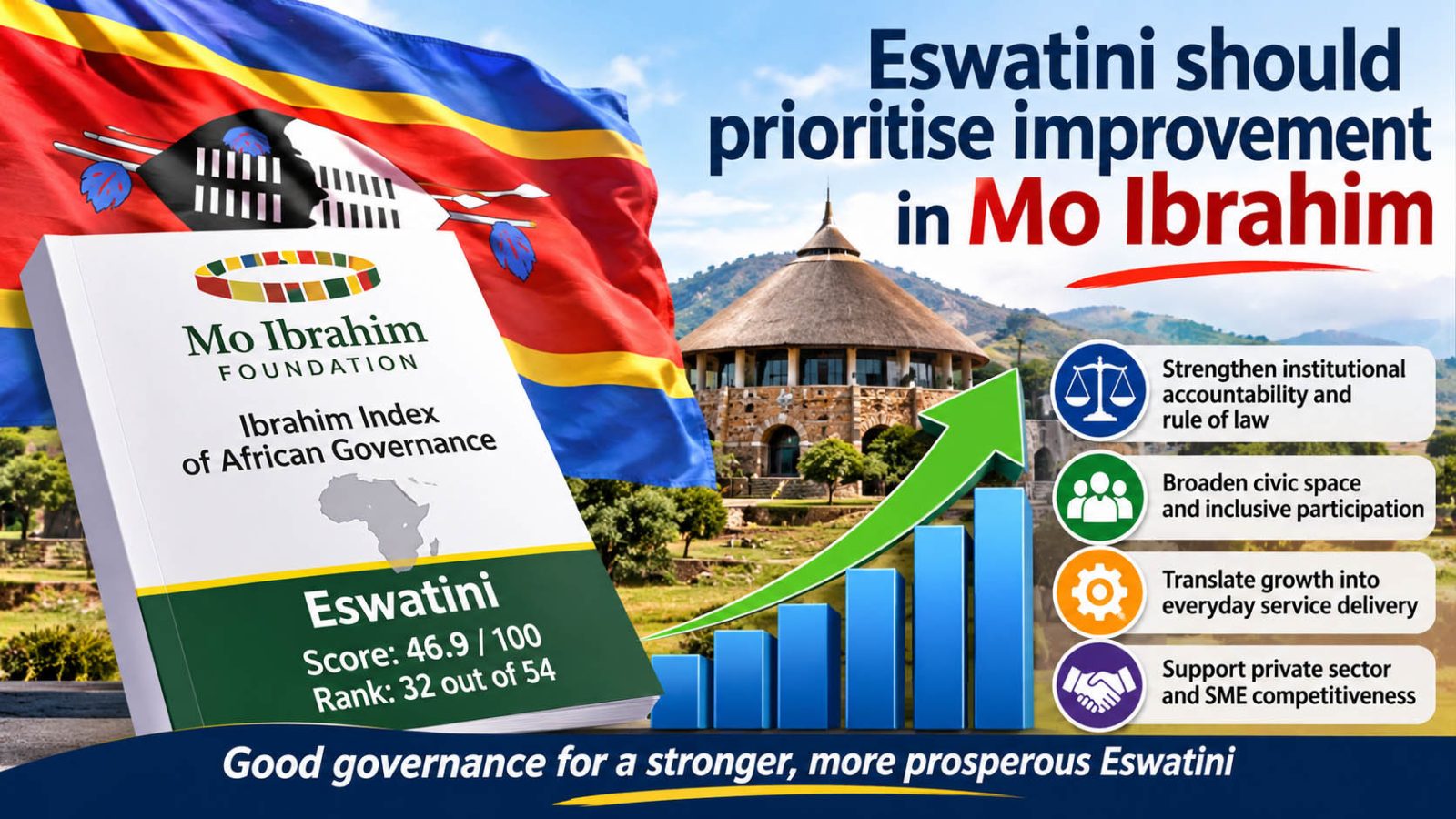
For the 2016–2025 overall governance trend across 54 countries in Africa, the Ibrahim Index of African Governance (IIAG) reported that the Kingdom of Eswatini’s placement is 32nd out of 54 African nations. The index assessed 96 indicators drawn from 51 independent African and international sources.
Eswatini scored 46.9 out of 100.0, trailing both the African continental average of 50.1 and the Southern African regional average of 56.1. Top-scoring countries included Seychelles at number 1, Mauritius at number 2, Botswana at 4, South Africa at 5 and Namibia at 6.
The index covers the following areas:
Security and rule of law: Personal safety, national security, judicial independence, accountability, transparency and anti-corruption.
Participation, rights and inclusion: Democratic participation, human rights, civil liberties, inclusion and gender equality.
Foundations for economic opportunity: Public administration efficiency, business and labour environments, infrastructure and rural economic support; and human development: Access to quality healthcare, education, social protection and a sustainable environment.
Regional contrast, impact on Eswatini’s competitiveness
Although Eswatini posted an encouraging 4.2 per cent GDP growth rate in 2025, its governance score highlights a widening gap between economic output and institutional performance relative to its neighbours.
By sitting more than nine points below the Southern African regional average, Eswatini risks losing ground in attracting long-term foreign direct investment, strengthening public service delivery and building institutional resilience.
Mo Ibrahim Foundation concern
It is noted in the report that while some areas improved in most countries, security and rule of law, as well as participation, Rights and Inclusion, have suffered widespread declines.
In fact, Mo Ibrahim Foundation founder Mo Ibrahim warned upon the report’s release: “Economic and social gains will not last and will always be weaker, without progress in security, rule of law and participation.”
What Eswatini should do
The need for Eswatini to address its governance deficit cannot be overemphasised. For Eswatini to climb out of the bottom half of the continental rankings, policymakers must focus on four immediate priorities:
Strengthening institutional accountability and rule of law: Across Africa, indicators measuring judicial independence, transparency and the absence of undue influence recorded the steepest ten-year drops. Bolstering anti-corruption mechanisms, ensuring public procurement transparency and reinforcing trust in justice institutions are essential for improving investor confidence. Eswatini has struggled to address corruption head-on. The problem is acknowledged, yet very few tangible and effective steps are taken. Money lost through corruption is fuelling poor service delivery, unemployment and poverty, especially amongst the youth. The need for strengthening institutions such as the justice system cannot be overemphasised. Potential investors would like a guarantee that the justice system will enforce contracts. While many applaud the appointment of a female acting chief justice as historic, she will only be measured by how the justice system serves all without fear, favour or prejudice.
Broadening civic space and inclusive participation: With 36.5 per cent of Eswatini’s 1.3 million citizens aged between 15 and 34, expanding constructive channels for youth engagement, civic dialogue and participatory decision-making is critical to long-term social stability. Also critical is that, since 2021, even legal entities such as trade unions cannot exercise their right to protest. In fact, veteran journalist Bheki Makhubu has lamented that emaSwati are silenced. Where will development ideas come from if a nation is not engaging with national development issues openly?
Political participation will remain a problem as long as emaSwati are deprived of the enjoyment of their rights to associate, freedom of speech and movement. This must be addressed as a matter of urgency.
Translating macro growth into everyday service delivery: The 2026 IIAG highlights a recurring continental disconnect between statistical infrastructure gains and citizens’ lived realities. Ensuring that Eswatini’s economic growth translates into tangible improvements in rural infrastructure, education and public health will directly lift human development scores.
Supporting private sector and SME competitiveness: Streamlining business registration, reducing regulatory bottlenecks and expanding access to finance for local entrepreneurs will strengthen the foundations for the economic opportunity pillar and create sustainable jobs for young emaSwati.
Turning data into action
Aligning national development strategies with transparency, public service efficiency, and citizen inclusion offers a clear path to closing the governance gap.