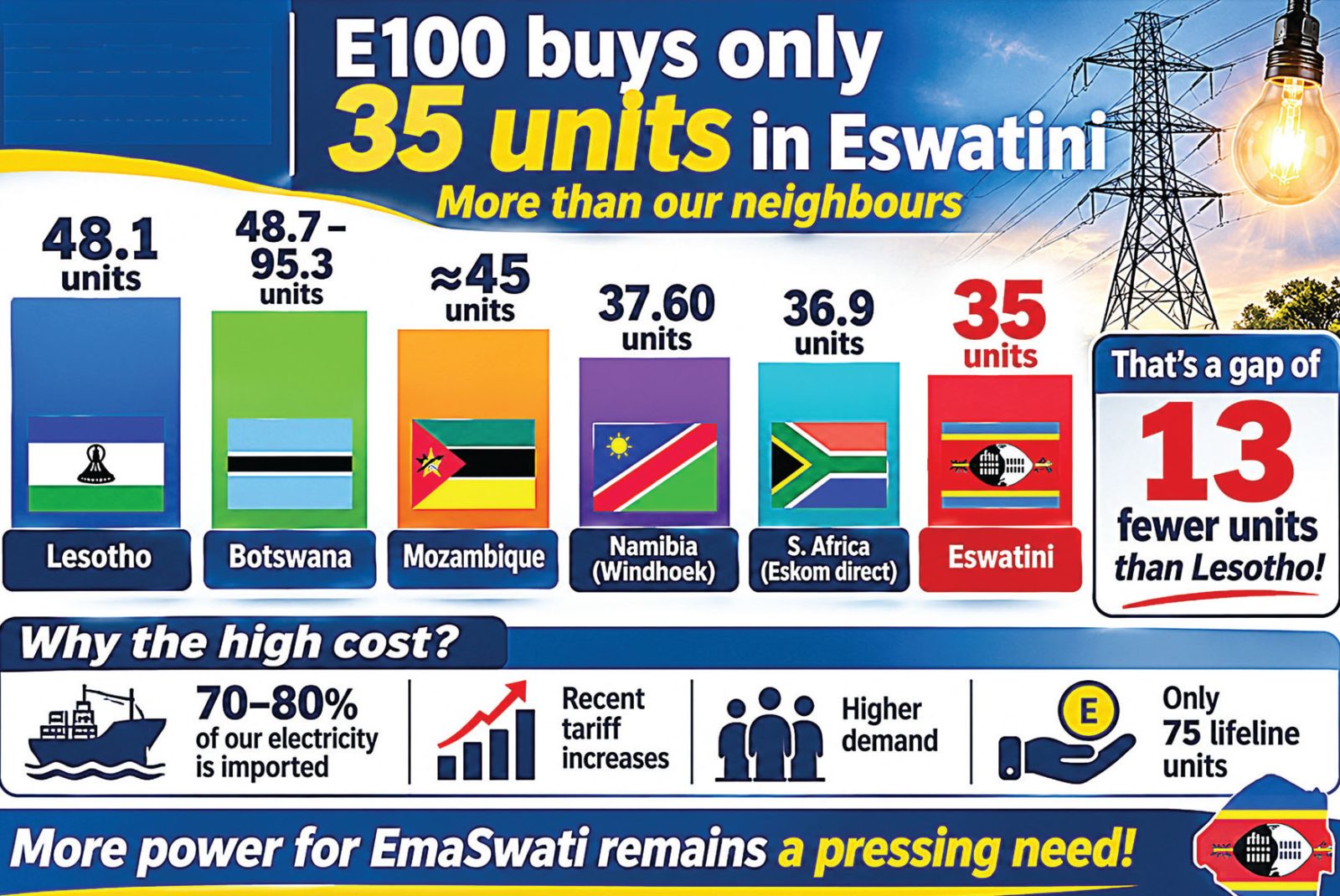
MBABANE – Electricity consumers in Eswatini are spending more of their money on power than households in the other members of the Southern African Customs Union (SACU).
A check of the 2026 prepaid tariffs of the five SACU members, South Africa, Botswana, Lesotho, Namibia and Eswatini, shows that E100 buys fewer units at home than in almost any of the neighbouring countries.
Mozambique, which is not a SACU member, was added to make the regional picture complete. Mozambique also shares borders with Eswatini in the East.
It has been learnt that a unit of electricity, the kilowatt-hour (kWh), is the power a 100-watt bulb burns in 10 hours.
For this comparison, the same shopping basket was used in every country, which is E100 worth of prepaid electricity.
Because the Lesotho loti and the Namibian Dollar are pegged one-to-one to the South African Rand.
It means, therefore, R100 is exactly M100 or N$100 or E100. In Botswana, E100 changes hands for about P81.03. In Mozambique, it converts to roughly 366 meticais.
To simplify it, it is worth mentioning that prepaid buyers feed money into a meter and receive a slip of tokens, so the number of units printed on that slip is the truest test of what a country really charges.
Information sourced from Our Power South Africa reveals that E100 (R100) bought between roughly 24 and 48 units of residential prepaid electricity across South Africa, Lesotho, Namibia and Mozambique in 2026, with Lesotho selling the most units and South Africa’s metros the fewest.
It has been established that South Africa has the region’s widest price spread, according to the 2026 comparison, because what a buyer receives depends on whether they purchase directly from Eskom or through a municipality and on how much power they have already bought in that month.
Information sourced from Our Power South Africa further reveals that buying directly from Eskom on the ‘Homelight’ prepaid tariff, at about R2.71 per unit, gives roughly 36.9 units for R100. Rand Tools, which tracks tariffs and exchange rates, confirms the sums that R100 buys 36.9 units at that rate and R200 buys 73.8 units.
City customers receive less, it must be said. The metros of Cape Town, Johannesburg and eThekwini give between 24.2 and 30 units on a buyer’s first purchase of the month, which works out at close to R4.13 per unit.
It is mentioned on energybee.co.za that South African households fall under inclining block tariffs, a system in which the price per unit climbs as more units are bought within the same month.
Fixed monthly service charges are also deducted from the first top-up, cutting the number of units a buyer receives even further.
The gap between an Eskom direct customer and a metro customer can, therefore, be more than a dozen units on the same R100.
Research by the Times SUNDAY reveals that Lesotho gives buyers the most power for their money.
At the standard domestic tariff of M2.08 (E2.08) per unit in the 2025/2026 schedule, M100 (E100) buys about 48.1 units, according to the Lesotho Electricity and Water Authority (LEWA). LEWA states that poor households that qualify for the subsidised lifeline rate of M0.93 per unit receive more than 100 units for the same M100.
The lifeline and social subsidies are meant to keep basic electricity affordable for low-income homes and to cut reliance on indoor solid fuels such as wood and coal.
What are the reasons behind the soft prices? It has been found that Lesotho generates about 60 per cent of its own electricity at home, mainly through the roughly 75MW ‘Muela hydropower station, and its businesses pay very low energy charges of about M0.34 (E0.34) to M0.37 (E0.37) per unit in the published 2025/2026 schedules, paired with monthly maximum-demand fees. Information sourced from a 2026 African Development Bank (AfDB) tariff study reveals that the Lesotho Electricity Company recovers only M74 (E74) for every M100 it needs to cover its costs, meaning tariffs there have long sat below the true cost of supply.
However, this publication can mention that such comfort is now under strain. This is because drought and low water levels in the Katse and Mohale dams have cut hydropower output and forced the mountain kingdom to rely on more expensive imports.
Lesotho’s regulators are proposing multi-year increases to close the gap.
Namibia
Namibia sits in the middle of the table. Following the August 2026 tariff adjustments by the Electricity Control Board (ECB), N$100 (E100) buys 37.60 units in the City of Windhoek, 36.35 units in the northern regions served by NORED, 35.52 units in CENORED’s central-north areas, 33.89 units in Keetmanshoop and 31.11 units on the coast under Erongo RED. It is mentioned on The Brief (thebrief.com.na) that the number of units a buyer receives now depends on the regional electricity distributor or the municipality that sells the power, with official schedules published by the ECB and NamPower.
Botswana
Based on the figures, it can be said that Botswana beats Eswatini comfortably, even though its own tariffs rose this year. The Botswana Energy Regulatory Authority (BERA) approved a nine per cent increase that took effect on August 1, 2026, and the Botswana Power Corporation implemented the new domestic tariffs inclusive of 14 per cent VAT. Even so, P81.03, the exact equivalent of E100, buys between 48.7 and 95.3 units of domestic prepaid power, depending on how much electricity a household has already bought in that month.
The rise bit households there too, but from a much lower base than Eswatini’s. Research goes further to show that electricity is significantly cheaper in Botswana than in Eswatini once the exchange rate and the per-unit tariffs are weighed together. Botswana’s standard rate above 200 units works out to about E2.05 per unit, well below Eswatini’s E2.86.
However, it must be said that every Batswana household buys its first 200 units each month at the lowest rate, while Eswatini’s subsidised lifeline covers only the first 75 units. It is worth noting that the one-time Eswatini looks cheaper is a small first purchase by a low-usage lifeline household, because Botswana deducts a fixed monthly fee worth about E43.24 from the top, while the EEC charges no monthly facility fee on domestic meters. On any later top-up, Botswana delivers nearly three times the units for the same money.
Mozambique
Mozambique, though outside SACU, strengthens the picture because it is Eswatini’s closest neighbour. Eswatini also buys electricity from Mozambique.
Prepaid electricity, sold as CREDELEC tokens by the State utility Electricidade de Moçambique (EDM), costs an average of 8.12 meticais per unit for homes, taxes and fees included, according to GlobalPetrolPrices.com.
CREDELEC tokens are numerical codes used to load prepaid electricity credit onto meters operated by EDM.
At that rate, 366 meticais, the value of R100, buys about 45 units. The Times SUNDAY can reveal that low-income homes that use up to 125 units a month pay a heavily subsidised social tariff of 1.07 meticais per unit, which yields more than 340 units for the same money. The Banco de Moçambique tracks the daily rand-metical exchange rate.
Eswatini
Eswatini Electricity Company’s (EEC) tariff schedule shows that the standard domestic rate now stands at E2.86 per unit.
That means E100 buys about 35 units. When contrasting the units purchased for the same amount, Eswatini households receive fewer units than buyers in Lesotho (48.1), Botswana (48.7 to 95.3), Mozambique (about 45), Windhoek (37.60) and Eskom’s direct customers across the border (36.9). Only first purchases in South Africa’s metros and Namibia’s coastal Erongo RED (31.11) give fewer.
In Eswatini, it is worth acknowledging that the lifeline tariff shields only the first 75 units a household buys each month.
Why emaSwati pay more?
This is because Eswatini imports roughly 70 to 80 per cent of its electricity from South Africa’s Eskom and Mozambique’s EDM.
It has also been gathered that the country’s total demand is roughly double Lesotho’s, which forces it to buy far more power on external markets. When Eskom renegotiated its supply contracts, Eswatini’s costs rose sharply.
As a result, the Eswatini Energy Regulatory Authority (ESERA) implemented consecutive tariff increases of eight per cent in 2025/26 and 11.74 per cent in 2026/27, passing the import bill on to consumers.
Lesotho, by contrast, held its prices below cost for years to protect affordability, though its regulator is now proposing steady multi-year rises to close the shortfall.
It has also been established that Lesotho and Eswatini price business electricity differently.
This is what happens. Lesotho charges a low rate per unit used plus a high monthly fee for peak power capacity, while Eswatini charges higher rates during busy times of the day. To simplify it further, the news team found that the same E100 that lights and cooks for a family in Maseru buys noticeably less in Mbabane. Also, the cushion given to the poorest is thinner, which is 75 subsidised units at home against 200 in Botswana and 125 in Mozambique.
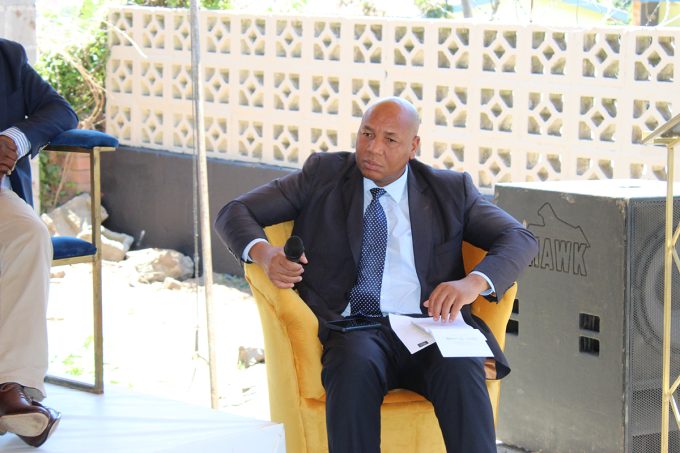
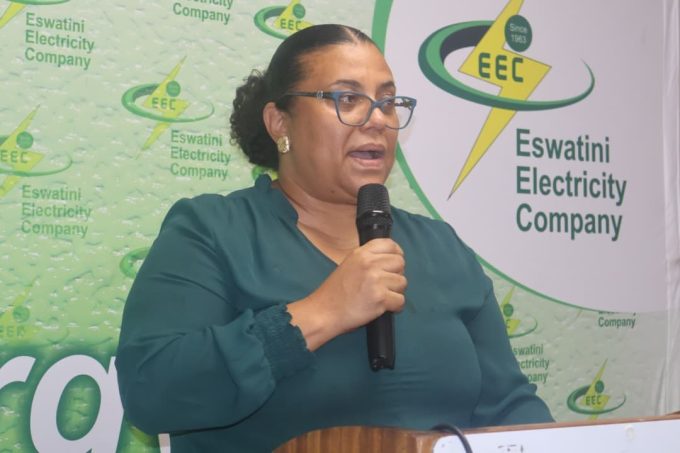
On Friday at Mountain View in Mbabane at a media session for EEC, Mphumuzi Maziya, the General Manager for Research and Development, said a ministerial committee was accelerating a push for a thermal power plant project.
“We hope to get one valuable coal by June 2027, either for boiler or to be sold to the market, and whatever we decide to do with it, it will benefit the consumer,” he said.
He said the licence the utility got in December 2025 has conditions that mining must start within 18 months.
He said previous studies showed potential for mining, but they (studies) could not be used to determine the viability of a current mine, hence EEC decided to engage a consultant.