
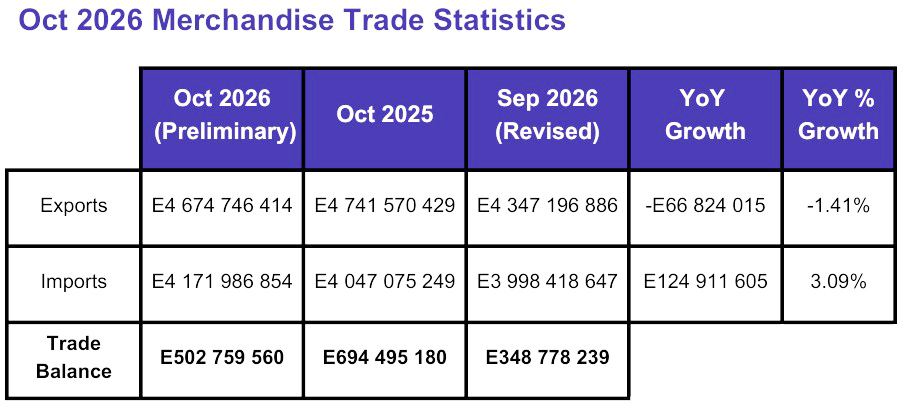
MBABANE – Eswatini posted a E502.76-million merchandise trade surplus in October, despite weaker exports and rising fuel imports, while cumulative trade slipped into deficit during the fiscal year.
According to the latest Merchandise Trade Statistics for October 2026 released by the Eswatini Revenue Service (ERS), the country exported goods worth E4.67 billion against imports amounting to E4.17 billion, resulting in a positive trade balance of E502.76 million.
However, the monthly surplus was lower than the E694.50 million recorded in September 2026, representing a decline of approximately 27.6 per cent. It was also below the E694.50 million surplus recorded in October 2025, indicating that the country’s merchandise trade performance has weakened compared to the corresponding period last year.
The October performance was characterised by a contraction in exports alongside an increase in imports, a development that highlights the pressure facing the country’s external trade position despite the positive monthly balance.
On a year-on-year basis, merchandise exports declined by E66.82 million, equivalent to 1.41 per cent, from E4.74 billion in October 2025 to E4.67 billion in the period under review.
The ERS attributed the decline primarily to lower exports of concentrates and sugar, two commodities that contribute to the country’s export earnings.
In contrast, merchandise imports increased by E124.91 million, representing 3.09 per cent growth, from E4.05 billion in October 2025 to E4.17 billion in October 2026.
The increase was largely driven by higher imports of diesel and petrol, reflecting the country’s continued reliance on imported petroleum products to meet domestic energy and transport requirements.
While October delivered a substantial surplus, the cumulative merchandise trade position for the 2026/27 financial year has moved into negative territory.
The ERS statistics show that between April and October 2026, Eswatini recorded a preliminary merchandise trade deficit of E29.90 million, compared to a marginal surplus of E1.02 million during the corresponding period in the previous financial year.
This means that the country’s merchandise imports marginally exceeded its exports over the seven-month period, despite growth in both trade categories.
Cumulative merchandise exports increased by 5.80 per cent year-on-year, rising from E25.77 billion during April to October 2025 to E27.27 billion in the corresponding period this year.
However, imports grew at a slightly faster rate of 5.92 per cent, increasing from E25.77 billion to E27.30 billion.
In monetary terms, exports generated an additional E1.49 billion compared to the previous financial year, while imports increased by E1.53 billion.
Chemical products, foodstuffs lead exports
MBABANE – An analysis of the merchandise exports by Harmonised System (HS) sections shows that chemical products, prepared foodstuffs and textiles continued to account for significant portions of Eswatini’s export earnings.
Products of chemical or allied industries remained the largest export category in October, generating E2 billion, although this represented a decline of 3.96 per cent from E2.08 billion recorded in October 2025.
The category accounted for approximately 42.8 per cent of total merchandise exports during the month.
Prepared foodstuffs, beverages, spirits, vinegar and tobacco products generated E1.42 billion, representing a 7.61 per cent decline from E1.54 billion in the corresponding month last year.
Wood and articles of wood contributed E300.08 million, increasing by 3.69 per cent from E289.42 million.
Textile and textile articles, another important export category, generated E495.01 million, down marginally by 1.23 per cent from E501.18 million. Despite the decline in some of the country’s traditional export categories, certain sectors registered significant improvements.
Mineral products exports increased by 187.16 per cent, from E42.60 million in October 2025 to E122.33 million in October 2026.
Machinery and mechanical appliances, including electrical equipment, also recorded an increase of 49.20 per cent, rising from E61.82 million to E92.23 million.
Vegetable products exports increased by 52.53 per cent, from E47.91 million to E73.08 million.
However, the growth in these categories was insufficient to offset the decline in some of the larger export segments, particularly prepared foodstuffs and chemical products.
On a cumulative basis, the export picture was more encouraging, with total exports increasing by 5.80 per cent to E27.27 billion.
Prepared foodstuffs generated E8.80 billion between April and October 2026, up 8.88 per cent from E8.08 billion in the corresponding period last year.
Chemical products contributed E10.57 billion, marginally higher than the E10.56 billion recorded previously. Textile exports increased by 10.96 per cent to E3.01 billion from E2.71 billion, while mineral products grew by 25.48 per cent to E681.98 million.
These figures indicate that the overall improvement in cumulative exports has been supported by growth across several important sectors, notwithstanding the weaker performance recorded in October.